
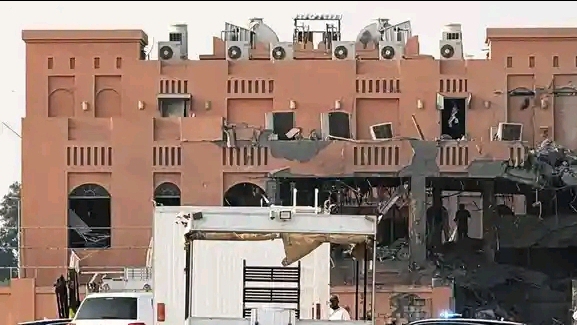

Doha, Qatar| On Tuesday, September 9, 2025, a series of powerful explosions shattered the calm in Qatar’s capital, Doha, sending plumes of thick black smoke billowing over the affluent Katara District.
Eyewitnesses reported hearing multiple blasts, with Reuters correspondents confirming the unsettling sounds that reverberated through the city.
The Israeli military swiftly claimed responsibility, declaring the strikes as a precision operation targeting senior leaders of Hamas, the Palestinian militant group whose political bureau operates out of Doha.
This bold move, described by Israeli officials as a “wholly independent” operation, has sparked intense speculation about its implications for regional stability and the ongoing Israeli-Palestinian conflict.
A Targeted Assassination Attempt
According to Axios reporter Barak Ravid, who cited high-ranking Israeli officials, the explosions were part of a calculated assassination attempt aimed at top Hamas officials.
The strikes zeroed in on buildings known to house members of the Palestinian group’s political leadership, a presence that has long been a point of contention in Qatar’s delicate balancing act as a mediator in Middle Eastern conflicts.
The Israeli military’s acknowledgment of the operation underscores its intent to disrupt Hamas’s leadership structure, even on foreign soil.
The office of Israeli Prime Minister Benjamin Netanyahu issued a resolute statement, emphasizing the autonomy of the operation: “Today’s action against the top terrorist chieftains of Hamas was a wholly independent Israeli operation. Israel initiated it, Israel conducted it, and Israel takes full responsibility.”
The declaration reflects Israel’s unwavering stance on pursuing Hamas leaders, regardless of their location, in response to ongoing security concerns.
Chaos in the Katara District
The Katara District, a cultural and residential hub in Doha, became the epicenter of the chaos.
Eyewitnesses described a surreal scene as smoke rose high above the district’s skyline, casting a grim shadow over the usually vibrant area known for its art galleries, theaters, and waterfront promenade.
AFP journalists on the ground reported hearing the deafening blasts, followed by the sight of emergency responders rushing to the scene.
While details about casualties or the extent of the damage remain scarce, the targeted nature of the strikes suggests a high-stakes operation with significant political ramifications.
Qatar, a key diplomatic player in the region, has hosted Hamas’s political bureau since 2012, a decision that has allowed the Gulf state to mediate ceasefire talks and humanitarian efforts in the Israeli-Palestinian conflict.
The unprecedented attack on Qatari soil raises questions about the future of Doha’s role as a neutral broker and the potential fallout for its relations with Israel and other regional powers.
A Broader Context of Tensions
The strikes come amid heightened tensions in the Middle East, with Israel intensifying its efforts to neutralize Hamas’s leadership following years of intermittent conflict.
Hamas, designated as a terrorist organization by Israel, the United States, and the European Union, has been a focal point of Israeli military operations, particularly since the escalation of violence in Gaza and the West Bank.
The decision to carry out such a high-profile operation in Doha signals a bold escalation, as Israel extends its reach beyond its borders to target key figures in the group’s political wing.
Netanyahu’s office did not disclose specific details about the targets or the outcome of the operation, leaving room for speculation about which Hamas leaders were in the crosshairs.
The group’s political bureau in Doha has historically included prominent figures such as Khaled Meshaal and Ismail Haniyeh, though it remains unclear who, if anyone, was harmed in the strikes.
Hamas has yet to issue an official statement, but the attack is likely to provoke a strong response from the group and its allies.
Implications for Qatar and the Region
The explosions in Doha mark a rare instance of foreign military action on Qatari soil, challenging the Gulf state’s reputation as a safe haven for diplomatic activities.
Qatar has positioned itself as a mediator in numerous regional conflicts, from hosting Taliban peace talks to facilitating negotiations between Israel and Hamas. This incident could strain Qatar’s relationships with both Israel and Hamas, as well as its standing in the broader Arab world.
Analysts suggest that the strikes may also complicate ongoing ceasefire efforts in Gaza, where Qatar has played a pivotal role in brokering humanitarian pauses and prisoner exchanges.
The targeting of Hamas leaders in Doha could be perceived as a direct affront to Qatar’s sovereignty, potentially prompting a diplomatic backlash.
At the same time, Israel’s willingness to act unilaterally underscores its determination to dismantle Hamas’s operational capabilities, regardless of the geopolitical consequences.
Global Reactions and Unanswered Questions
As news of the strikes spread, international observers are closely monitoring the situation for signs of escalation.
The United States, a key ally of both Israel and Qatar, has yet to comment officially, but the incident is likely to draw scrutiny given Washington’s strategic interests in the region.
Other global powers, including the European Union and the United Nations, may call for restraint to prevent further destabilization in an already volatile region.
Key questions remain unanswered: Were any senior Hamas leaders killed or injured in the strikes? How will Qatar respond to this breach of its sovereignty? And what does this mean for the fragile balance of power in the Middle East?
As the dust settles over Doha, the world awaits clarity on the full scope of the operation and its far-reaching consequences.
What Next?
The explosions in Doha on September 9, 2025, represent a dramatic escalation in Israel’s campaign against Hamas, with the Israeli military claiming full responsibility for a targeted strike on the group’s leadership in Qatar’s capital.
The operation, centered in the Katara District, has sent shockwaves through the region, raising questions about Qatar’s role as a mediator and the future of Israeli-Palestinian relations.
As the international community braces for potential fallout, the strikes underscore the persistent volatility of the Middle East and the high stakes of the ongoing conflict.
For further updates on this developing story, stay tuned to reliable news sources and official statements from the involved parties.
Share This Post