
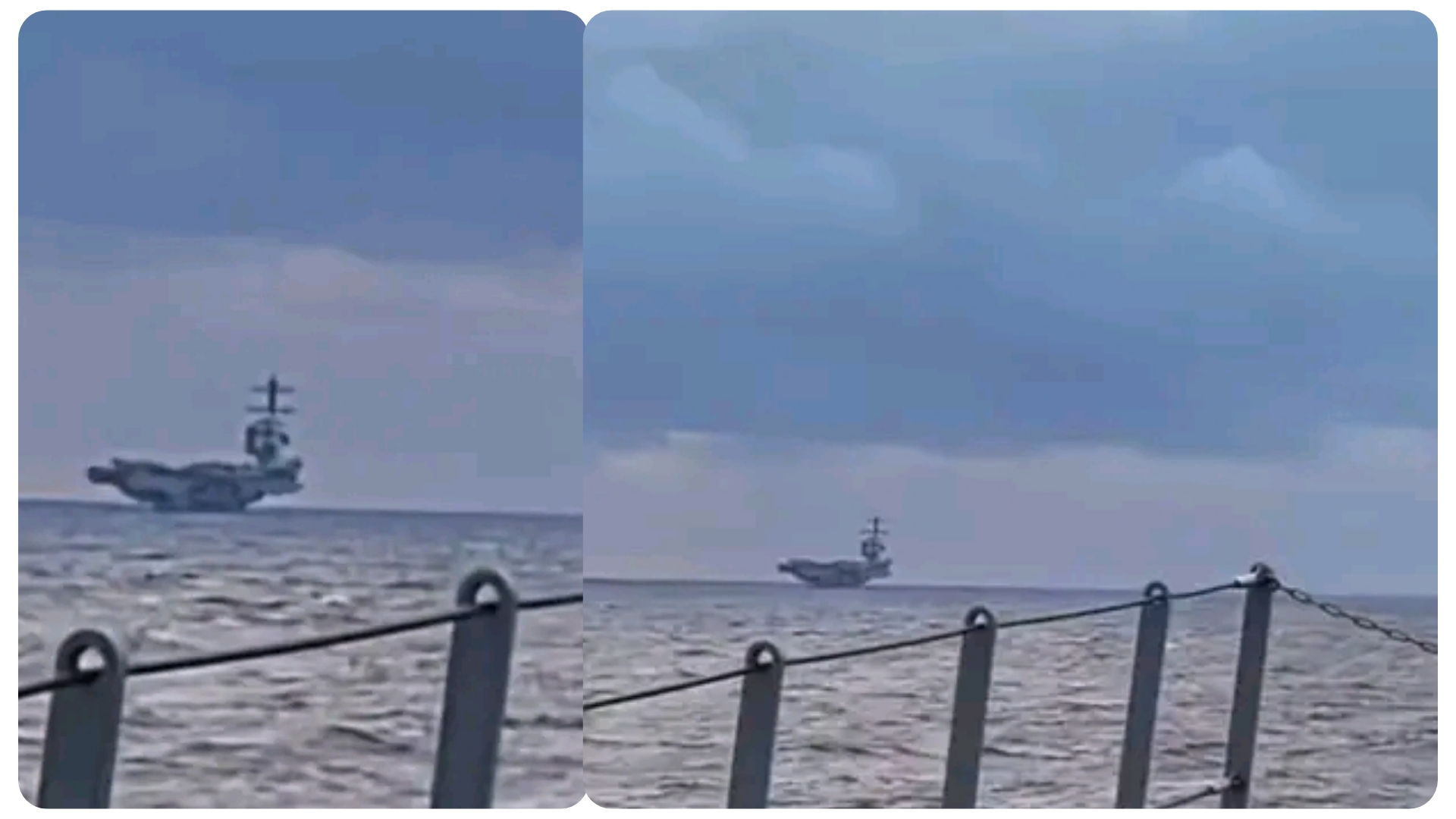

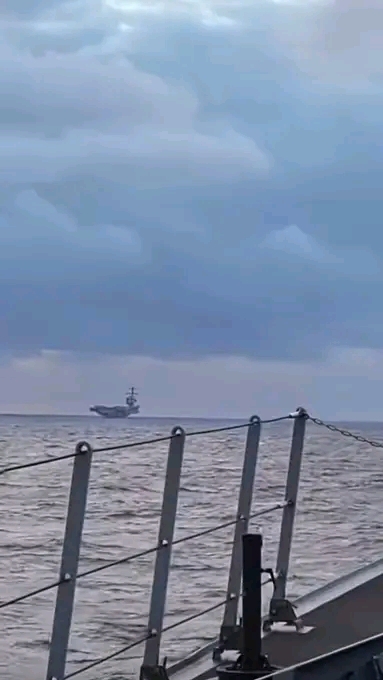
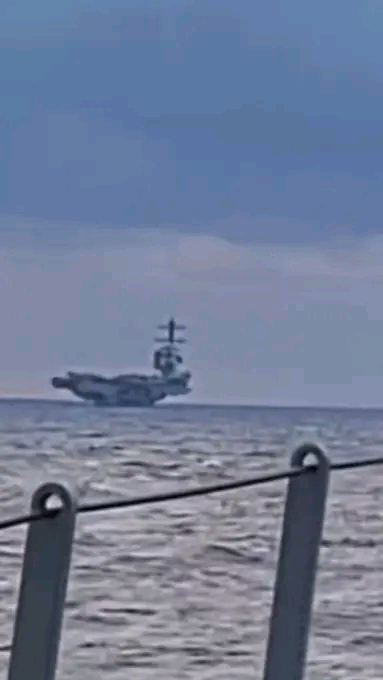
In what is being quietly described by Pentagon insiders as a “posture of maximum readiness,” the United States has assembled an unprecedented naval armada in and around the Middle East—three nuclear-powered aircraft carriers, accompanied by two full Marine Expeditionary Units.
The USS Abraham Lincoln, USS Gerald R. Ford, and USS George H.W. Bush now operate within striking distance of Iranian shores, a concentration of firepower not seen since the early phases of the Iraq War.
On the surface, official statements frame the deployment as routine deterrence—a message to Tehran to “de-escalate” regional tensions.
But a sceptical reading of both the scale and composition of this force suggests something far more ominous: the architecture of a full-spectrum, coordinated assault.
More Than a Show of Force
Three carrier strike groups do not simply float. They project sovereign, sustained offensive capability.
Each carrier carries roughly 75 combat aircraft—F-35C Lightning IIs, F/A-18 Super Hornets, and EA-18G Growlers for electronic warfare.
Combined, that is over 200 advanced fighter jets, capable of suppressing Iran’s air defenses, targeting nuclear facilities, and severing command-and-control nodes within hours.
The addition of two Marine Expeditionary Units (MEUs) changes the calculus entirely. MEUs are not defensive contingents.
They are self-contained amphibious landing forces, equipped with armored vehicles, artillery, logistics, and vertical-lift aviation.
Their presence signals preparation not merely for airstrikes but for coastal seizure, ground incursion, and territorial occupation—scenarios that go far beyond “deterrence.”
Israel’s Shadow Over the Buildup
While the Pentagon insists the deployment is not directed at any single nation, Israeli military and intelligence officials have openly escalated their rhetoric against Iran’s nuclear program.
In recent weeks, Israeli defense minister Yoav Gallant described the “window for action” as closing, while Mossad chief David Barnea has repeatedly warned of “preemptive operations.”
What is unfolding appears less like a spontaneous American initiative and more like a coordinated choreography—with Washington providing the heavy lift for what Tel Aviv has long demanded: a decisive military blow to Iran’s enrichment infrastructure.
The real question is not whether the U.S. is preparing for war, but whether Israel has already secured a green light to trigger one.
Diplomacy as a Façade
Simultaneous to this military buildup, the Biden administration has continued to insist it seeks a diplomatic path. But on the ground, the actions contradict the words.
Sanctions have been tightened, intermediaries in Oman and Qatar sidelined, and the Joint Comprehensive Plan of Action (JCPOA) remains buried without a funeral. The message to Iran is clear: capitulate or be crushed.
Yet Tehran, for its part, has shown no signs of backing down. Recent satellite imagery reveals hardened tunnel entrances near Natanz and Fordow, while Iranian naval vessels have conducted high-speed maneuvers near the Strait of Hormuz. Both sides are calibrating for a flashpoint.
A War the World Cannot Afford
A full-scale U.S.-Israeli war against Iran would not remain contained. The Strait of Hormuz—through which 20% of global oil passes—would become a naval graveyard.
Hezbollah’s rocket arsenal in Lebanon, Houthi missile capabilities in Yemen, and pro-Iranian militias in Syria and Iraq would all be activated. The result would be a regional wildfire, with global economic collapse as a near-certainty.
And yet, the political and military machinery on both sides of the Atlantic appears to be grinding toward that very outcome—with little meaningful debate, no congressional authorization, and almost no media scrutiny of the scale of the force now positioned off Iran’s coastline.
Epilogue: Preparing the Public for Impact
When three carrier strike groups and two Marine landing forces assemble in one theater, it is not a drill. It is not posturing. It is the unmistakable signature of an invasion force.
The question that remains—and that the media has largely failed to ask—is not whether the United States and Israel can militarily defeat Iran.
It is whether the American and Israeli publics have been told the truth about what is coming, or whether they are being led, step by step, into yet another imperial war dressed in the language of defense.
For now, the carriers steam on, the jets sit fueled, and the Marines wait in the well decks. The only missing ingredient is a spark.
And in the current climate, that spark may be only a misinterpreted radar blip—or a political calculation—away.
Share This Post