
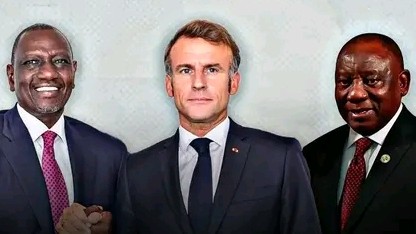

As France prepares to welcome world leaders to the G7 summit in Evian-les-Bains this June, a significant diplomatic recalibration has captured international attention.
Paris has confirmed that Kenyan President William Ruto will join the prestigious gathering as a guest leader—while South African President Cyril Ramaphosa, initially understood to be on the list, has been left off the invitation.
The decision, finalized in the official guest list released this week, signals a strategic pivot in Franco-African relations and has ignited speculation over the role of Western alliances in shaping the continent’s diplomatic landscape.
The summit, scheduled for 15–17 June in the picturesque French lakeside town, will see France host the annual G7 leaders’ meeting.
Alongside the core members, Paris has extended invitations to a select group of guest countries: India, South Korea, Brazil, and now Kenya.
South Africa, a regular fixture at such forums and the continent’s most industrialized economy, is notably absent.
According to initial accounts from South Africa’s presidency, the French embassy in Pretoria communicated the withdrawal of Ramaphosa’s invitation roughly two weeks ago.
Officials in Pretoria suggested the move came after sustained pressure from Washington—including what they described as a threat by the Biden administration to boycott the summit if South Africa were to attend.
The claim hinted at lingering tensions over South Africa’s non-aligned posture in global geopolitics, including its legal case against Israel at the International Court of Justice and its historically close ties with Russia.
However, in the days that followed, South African officials appeared to recalibrate their stance.
President Ramaphosa himself struck a measured tone, noting that invitations for non-G7 countries are never guaranteed and that South Africa’s absence should not be viewed as a diplomatic snub.
“These are choices host nations make,” he remarked, adding that the country’s international standing remains strong regardless of a single invitation.
French authorities, for their part, have forcefully denied that external pressure influenced their decision.
Foreign Minister Jean-Noël Barrot and a spokesperson for the French Foreign Ministry have both emphasized that South Africa remains an “essential partner” to France.
Instead, they framed the move as part of a deliberate effort to “streamline” the guest list and build forward-looking momentum ahead of President Emmanuel Macron’s scheduled visit to Nairobi for the Africa-France Summit in May.
“Kenya was chosen following close consultations among G7 members,” a French official explained. “It reflects a shared interest in deepening engagement with a dynamic regional leader and aligning diplomatic priorities ahead of key engagements on the continent.”
The White House has publicly backed France’s account, with a U.S. National Security Council spokesperson stating that Washington neither requested South Africa’s exclusion nor threatened a boycott.
“We welcome Kenya’s participation and look forward to a productive summit focused on shared global priorities,” the spokesperson said.
For Kenya, the invitation represents a significant diplomatic achievement. President Ruto has positioned himself as a vocal advocate for African debt restructuring, climate-resilient development, and a reformed multilateral system—themes that align closely with the G7’s stated agenda this year.
Nairobi has also emerged as a key security partner for Western nations, particularly in counterterrorism and peacekeeping operations across East Africa.
Analysts suggest the shift reflects a broader strategic recalculation by European powers seeking to engage a new generation of African leaders who combine geopolitical pragmatism with economic ambition.
“France is signaling that its Africa strategy is no longer tethered to former colonial networks or historical inertia,” said Dr. Makena Mutegi, a Nairobi-based international relations scholar.
“Kenya represents a different kind of partnership—one rooted in mutual interest, regional stability, and forward-looking economic cooperation.”
South Africa’s exclusion, while diplomatically uncomfortable, is unlikely to upend its longstanding ties with Paris or Washington.
Both France and the United States continue to engage Pretoria on trade, climate, and security matters.
Yet the episode underscores a growing reality: in a crowded global arena, invitations to elite diplomatic forums are increasingly contingent on alignment with host nations’ strategic priorities.
As the June summit approaches, all eyes will be on Evian-les-Bains—not only for the outcomes of G7 deliberations but also for the diplomatic symbolism of who sits at the table.
For Kenya, the seat comes as a validation of its rising global profile. For South Africa, it is a reminder that even long-standing partners must continually navigate the shifting currents of international diplomacy.
This is a developing story. Further reactions from the African Union and additional details on the summit agenda are expected in the coming weeks.
Share This Post