
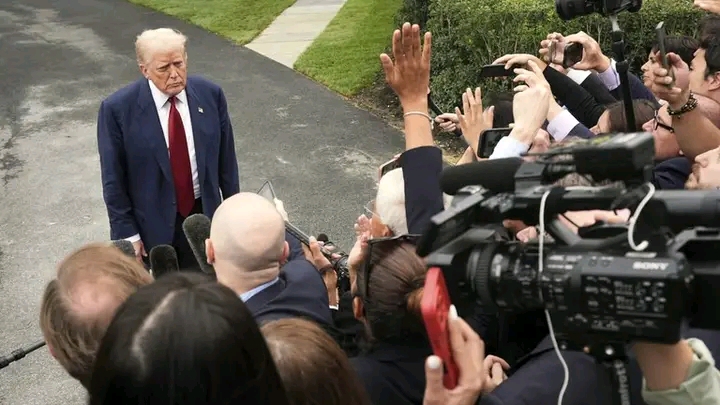

In a dramatic escalation of rhetoric that has reignited concerns about global nuclear tensions, U.S. President Donald Trump has declared that the United States is “totally prepared” for any potential nuclear confrontation with Russia.
The statement, delivered during a tense press briefing at the White House on Friday, August 1, 2025, follows what Trump described as an “inappropriate threat” made online by former Russian President Dmitry Medvedev.
In response, Trump claimed to have ordered the deployment of two U.S. nuclear submarines to “appropriate regions” near Russian waters, a move he justified as essential for national security.
The provocative exchange has sparked widespread debate about the risks of nuclear brinkmanship and the delicate balance of U.S.-Russia relations in an increasingly volatile geopolitical landscape.
A War of Words Ignites Strategic Maneuvers
The latest flare-up began when Trump, in a post on his social media platform Truth Social, announced the alleged redeployment of two U.S. nuclear submarines.
He described the decision as a direct response to what he called “foolish and inflammatory” remarks by Medvedev, who currently serves as deputy chairman of Russia’s Security Council.
Trump condemned Medvedev’s rhetoric, warning that “words are very important, and can often lead to unintended consequences.” The president’s comments came after he publicly referred to Medvedev as a “failed” leader, urging him to “watch his words.”
Medvedev, known for his sharp and often provocative rhetoric, responded with a scathing message on social media.
Referencing Trump’s remarks about the “dead economies” of Russia and India, Medvedev invoked apocalyptic imagery, alluding to “the walking dead” and the infamous “Dead Hand” system—a Soviet-era automatic nuclear retaliation mechanism, also known as Perimetr.
While Russia has never officially confirmed the system’s existence, Western analysts widely regard it as a last-resort deterrent designed to ensure a retaliatory nuclear strike in the event of a catastrophic attack on Russian leadership.
Medvedev’s veiled reference to this doomsday system was interpreted as a warning against provoking Moscow, further escalating the verbal sparring match.
Trump’s Rationale: A Defensive Posture or Dangerous Provocation?
Speaking to reporters, Trump defended his decision to reposition the submarines, emphasizing the gravity of any discussion involving nuclear weapons.
“Well, we had to do that. We just have to be careful. A threat was made, and we didn’t think it was appropriate,” he said. “A threat was made by a former president of Russia, and we’re going to protect our people. When you talk about nuclear, we have to be prepared. And we’re totally prepared.”
The president’s remarks underscore a broader stance that the U.S. cannot afford to take nuclear threats lightly, particularly in an era of heightened global tensions.
However, neither the White House nor the Pentagon has provided additional details to corroborate Trump’s claims about the submarine deployment.
The locations and patrol routes of U.S. nuclear submarines, such as those in the Ohio-class fleet, are among the military’s most closely guarded secrets, rendering independent verification of the move impossible at this stage.
The “Dead Hand” and Nuclear Deterrence
Medvedev’s reference to the “Dead Hand” system has reignited discussions about Russia’s nuclear capabilities and its doctrine of deterrence.
Conceived during the Cold War, Perimetr is believed to be an automated system designed to launch a retaliatory nuclear strike if Russia’s command structure is incapacitated.
While its operational status remains unconfirmed, the system’s mere mention serves as a chilling reminder of the catastrophic stakes involved in U.S.-Russia relations.
Analysts suggest that Medvedev’s comments were likely intended to signal Russia’s resolve to counter any perceived aggression, even as they amplify fears of miscalculation in an already fraught environment.
A Pattern of Escalation
This is not the first time Trump and Medvedev have clashed publicly. The former Russian president has frequently used social media to criticize Western leaders, often employing hyperbolic language to underscore Russia’s military might.
Trump, known for his combative style, has responded in kind, framing his actions as necessary to safeguard American interests. The submarine deployment, if true, would mark a significant escalation in U.S. military posturing, potentially signaling a shift toward a more assertive stance against Russia.
However, the lack of transparency from both the White House and the Pentagon raises questions about the veracity and intent behind Trump’s announcement.
Some analysts speculate that the claim may be a rhetorical flourish aimed at domestic audiences or a strategic signal to Moscow, rather than an actual operational shift.
Others warn that such public declarations, even if symbolic, risk inflaming tensions and increasing the likelihood of missteps in an already precarious geopolitical climate.
Global Implications and the Path Forward
The exchange between Trump and Medvedev comes at a time when U.S.-Russia relations are already strained by ongoing conflicts, including Russia’s war in Ukraine and disputes over NATO expansion.
The specter of nuclear escalation has loomed large in recent years, with both nations modernizing their nuclear arsenals and engaging in high-stakes military posturing.
The mention of nuclear submarines and automated retaliation systems only heightens global anxieties about the potential for a catastrophic miscalculation.
International observers have called for restraint and diplomatic engagement to de-escalate the situation. The absence of official confirmation from the Pentagon underscores the need for clarity and caution in addressing such sensitive matters.
Meanwhile, the international community watches closely, aware that the stakes of this verbal and strategic sparring extend far beyond the two leaders’ rhetoric.
Looking Ahead
As President Trump and Dmitry Medvedev trade barbs over nuclear capabilities, the world is reminded of the fragile balance that underpins global security.
Trump’s claim of deploying nuclear submarines, whether factual or rhetorical, signals a willingness to respond forcefully to perceived threats.
Medvedev’s invocation of Russia’s doomsday system serves as a stark counterpoint, highlighting the ever-present danger of escalation in U.S.-Russia relations.
For now, the international community can only hope that cooler heads prevail, as the specter of nuclear conflict casts a long shadow over an already turbulent world stage.
Share This Post