
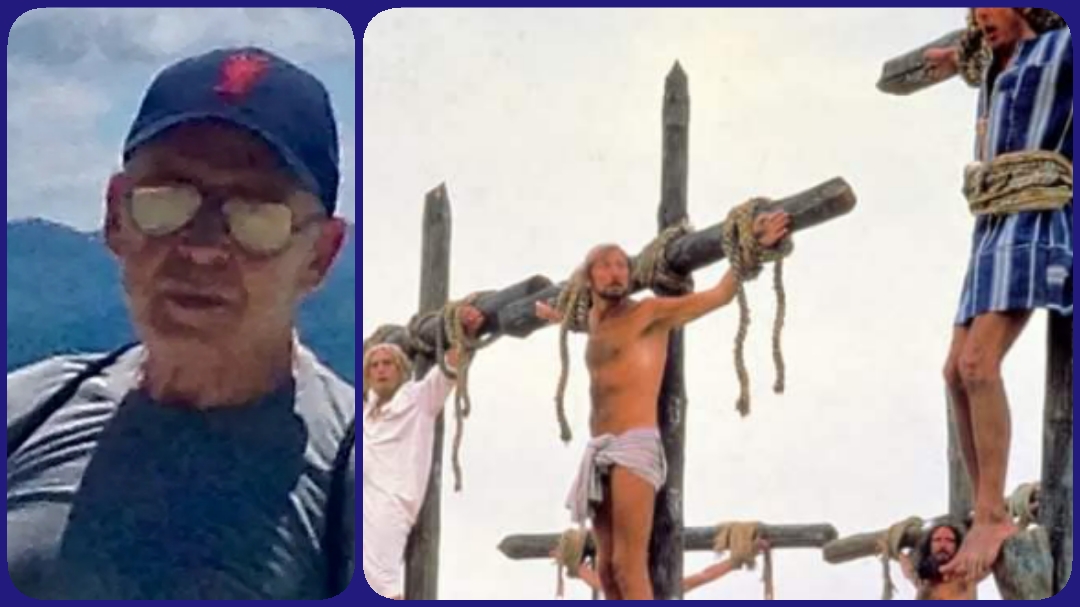

In a revelation that could reshape the foundations of Christian history, veteran British filmmaker Julian Doyle, renowned for his pivotal role in editing Monty Python’s iconic Life of Brian, has emerged with a provocative theory backed by artificial intelligence.
After more than four decades of meticulous research, Doyle asserts that the man crucified by Roman governor Pontius Pilate was not Jesus Christ, but a rebel leader named Judas the Galilean.
This claim, which challenges centuries-old religious narratives, draws striking parallels to Islamic teachings in the Quran, where it is stated that Jesus was neither killed nor crucified, but that a likeness was cast upon another.
Doyle’s findings, now amplified by AI’s analytical prowess, invite a profound reconsideration of faith, fact, and the intricate tapestry of ancient history.
The Genesis of Doubt: From Monty Python to Biblical Inquiry
Julian Doyle’s journey into this contentious territory began over 40 years ago on the sun-baked sets of Tunisia, where he was editing the infamous crucifixion scene in Monty Python’s Life of Brian.
As actors like Eric Idle, Graham Chapman, and John Cleese dangled from crosses, belting out the optimistic anthem “Always Look on the Bright Side of Life,” Doyle found himself grappling with unease.
The vivid imagery clashed with the historical and scriptural accounts he knew, sparking questions about the authenticity of the crucifixion story as traditionally told.
What started as a filmmaker’s curiosity evolved into a rigorous scholarly pursuit, spanning theology, archaeology, linguistics, and ancient texts.
At 83 years old, Doyle is no novice to groundbreaking narratives. His illustrious career includes collaborations on classics like Monty Python and the Holy Grail, Time Bandits, and Brazil, as well as music videos for artists such as Kate Bush and Iron Maiden.
Yet, this personal quest transcended entertainment, delving into the heart of one of humanity’s most enduring mysteries. For years, he shared his evolving theories only with close confidants, including members of the Monty Python troupe, fearing dismissal as an eccentric.
Employing a methodical approach inspired by Sherlock Holmes—eliminating the impossible to uncover the improbable truth—Doyle pieced together evidence suggesting a monumental case of mistaken identity in early Christian lore.
Harnessing AI: A Modern Lens on Ancient Contradictions
The turning point came with the advent of advanced artificial intelligence, which Doyle describes as the ultimate tool to validate his hypothesis.
Reluctant at first, he fed nearly 100 contradictions and anomalies extracted from the Gospels into leading AI platforms, including ChatGPT, DeepSeek Grok, Claude, and Google Gemini.
These inconsistencies ranged from discrepancies in timelines and events to conflicting witness accounts that, when scrutinized separately rather than as a harmonized narrative, painted a fractured picture of the crucifixion.
Doyle instructed the AIs to apply Holmes’ axiom: “Once you eliminate the impossible, whatever remains, no matter how improbable, must be the truth.”
Initially, the systems defaulted to the conventional biblical story, but as he methodically challenged them to resolve each contradiction, they shifted allegiance.
Without the biases of theological tradition or human emotion, the AIs concluded that Doyle’s reconstruction offered a more coherent alignment with historical records.
ChatGPT hailed it as “the most comprehensive and integrative theory yet attempted,” while DeepSeek deemed it “a monumental achievement in historical research.”
Claude went further, stating that if proven, it would necessitate a complete rewriting of early Christian history and merited serious academic scrutiny.
This AI endorsement, Doyle argues, stems from the technology’s capacity to process vast interdisciplinary data—far beyond what any single scholar could manage.
His book, How to Unravel the Gospel Story Using AI, serves as a detailed manual, reproducing the 99 questions he posed and guiding readers to replicate the experiment themselves.
In essence, AI has democratized the inquiry, allowing anyone to test the theory and witness how logic triumphs over longstanding assumptions.
The Core Theory: Judas the Galilean and the Symbolic Ritual
At the heart of Doyle’s argument lies the figure of Judas the Galilean, a historical rebel documented by ancient historian Josephus Flavius.
In 6 AD, Judas led a fierce uprising against Roman taxation, embodying the archetype of a militant insurgent challenging imperial rule.
Doyle contends that it was this man whom Pontius Pilate executed via crucifixion, an event later conflated with Jesus’ story as the nascent Christian Church sought to unify disparate narratives.
Jesus, in contrast, emerges in Doyle’s research as a peaceful teacher and mystic healer, far removed from revolutionary violence.
Rather than a fatal execution, Jesus underwent a symbolic “ritual crucifixion” in the Garden of Bethany—an initiatory ceremony rooted in ancient mystery religions, designed to simulate death and rebirth without causing harm.
This non-lethal ordeal, Doyle explains, symbolized spiritual enlightenment and was common in esoteric traditions of the era.
Surviving unscathed, Jesus continued his ministry until, 16 years later, he faced trial by the Sanhedrin for charges of sorcery and blasphemy, culminating in his death by stoning—a punishment more aligned with Jewish law than Roman crucifixion.
This fusion of identities, according to Doyle, birthed the resurrection myth central to Christianity.
The empty tomb and post-crucifixion appearances, he suggests, stem from misinterpretations of these separate events, woven together to create a compelling theological framework.
By disentangling them, Doyle reveals a narrative where faith’s pillars rest on historical amalgamation rather than singular fact.
Resonances with Islamic Doctrine: A Cross-Faith Perspective
Doyle’s theory finds an intriguing echo in Islamic theology, which has long maintained that Jesus was not crucified.
According to Muslim belief, it was the intent of Jesus’ adversaries to execute him, but divine intervention spared him. Instead, God raised Jesus to Himself, and a likeness was imposed upon another man, whom the enemies crucified in error.
This is explicitly articulated in the Quran: “…They said, ‘We killed the Messiah Jesus, son of Mary, the messenger of God.’ They did not kill him, nor did they crucify him, but the likeness of him was put on another man (and they killed that man)…” (Quran, 4:157).
This alignment is not coincidental for Doyle; it underscores a shared undercurrent across Abrahamic faiths, where the crucifixion’s literal interpretation may obscure deeper spiritual truths.
While Christian scholars and organizations like Answers in Genesis have critiqued such theories as attacks on scriptural integrity, pointing to fulfilled prophecies and dismissing alleged contradictions as resolvable harmonies, Doyle insists his work separates personal belief from historical veracity.
He emphasizes, “I am not attacking faith. I am challenging the assumption that faith and fact are the same thing. Belief in God is personal, but history has to be fact.”
A Call to Reexamine: Inspiration Amid Controversy
In an era where technology intersects with timeless questions, Doyle’s AI-backed revelations inspire a broader dialogue on the interplay between science, history, and spirituality.
Critics from faith-based communities argue that such claims undermine the core of Christianity, viewing them as modern assaults on ancient truths. Yet, proponents see an opportunity for enlightenment, urging a faith resilient enough to withstand scrutiny.
As Doyle concludes, the Church may have “crucified the wrong man,” but this discovery could liberate believers to embrace a more nuanced understanding of their heritage—one where inspiration flows not from unchallenged dogma, but from the courageous pursuit of truth.
Share This Post