
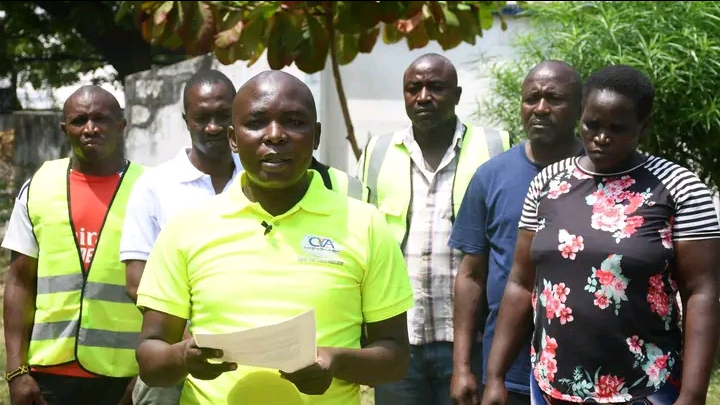

Rabai, Kilifi County, Kenya| In a heartbreaking workplace tragedy that underscores ongoing concerns about industrial safety in Kenya’s mining and construction sectors, the family of 40-year-old mason Dennis Nyakanga is urgently calling for justice and transparency following his untimely death in a crane accident at a quarry in Rabai Sub-County.
Nyakanga, a dedicated worker and sole provider for his young family, was crushed under a collapsing crane on October 16, 2025, while on duty at a site owned by a local cement company.
As investigations stall and allegations of corporate evasion surface, the incident has sparked renewed discussions on worker protections, compensation rights, and accountability in high-risk industries.
The Tragic Incident: What Happened on October 16
Dennis Nyakanga, originally from Kisii County, had been employed as a mason at the quarry, where he was tasked with constructing a perimeter wall.
According to eyewitness accounts and family reports, the crane unexpectedly toppled during operations, trapping Nyakanga beneath its massive metal frame. Despite frantic efforts by his colleagues to extricate him, the rescue attempts proved futile.
Emergency responders pronounced him dead at the scene, marking yet another fatal accident in Kenya’s quarry operations, a sector plagued by equipment failures and inadequate safety protocols.
The quarry, located in the coastal region of Kilifi County, is part of Kenya’s vital cement production industry, which relies heavily on limestone extraction. Such sites are known for their hazardous conditions, including heavy machinery like cranes, excavators, and loaders.
While the exact cause of the crane’s collapse remains undetermined—pending official investigations—preliminary reports suggest possible factors such as mechanical malfunction, overloading, or unstable ground conditions, common issues in similar incidents across the country.
Nyakanga’s death leaves a void in his family, comprising his wife, two young children, and an ailing mother, all of whom depended on his income for survival.
Family’s Ordeal: A Quest for Answers Amid Delays and Deception
In the wake of the accident, Nyakanga’s relatives traveled over 800 kilometers from Kisii to Mombasa, driven by grief and a determination to uncover the truth.
However, what they encountered was a frustrating maze of bureaucratic hurdles and unfulfilled promises from the company and authorities.
Elizabeth Nyakanga, the deceased’s sister, expressed the family’s anguish in a recent statement, highlighting how they have been misled at every turn.
“They lied to us, saying we should take the body to Kisii first, then they would come to compensate us. We won’t move the body without getting justice,” Elizabeth said, emphasizing that her brother was the family’s primary breadwinner.
She added that the loss has plunged the household into financial and emotional turmoil, with no immediate support forthcoming.
Joseph Ongera, Nyakanga’s brother, echoed these sentiments, alleging irregularities in the handling of the postmortem examination. “We have been denied all post-mortem documents. What we want is justice, which would be served by providing us with a postmortem report. They are taking us in circles,” Ongera stated.
He further demanded access to essential records from the police and hospital to clarify the precise cause of death, as well as CCTV footage capturing the moments leading up to the collapse.
The family’s repeated visits between the mortuary and the company’s offices have yielded no results, leaving them stranded in temporary accommodations without resolution.
This ordeal is not uncommon in Kenya, where families of workplace accident victims often face delays in obtaining autopsy reports and incident documentation, exacerbating their grief.
Under Kenya’s Occupational Safety and Health Act (OSHA) of 2007, employers are required to report fatal accidents within 24 hours and facilitate independent investigations, but enforcement remains inconsistent, particularly in remote industrial sites like quarries.
Allegations of Cover-Up and Corporate Evasion
Adding to the family’s distress are claims of foul play and attempts to silence them. Human rights activist Evans Momanyi, who has been assisting the family since receiving their desperate call from Kisii, painted a picture of systemic obstruction.
“They have been staying in a guest house since the directors of that company have been dodging them. In one way or another, they have told them that they are going to give them Sh3 million so that they don’t disclose this information to the media anywhere,” Momanyi revealed.
Momanyi further disclosed that the company had promised to cover mortuary fees and provide transportation for the deceased’s body back to Kisii, commitments that remain unfulfilled as of October 26. “Up to date, as I am standing here, there is nothing that has been done to the family,” he said.
More alarmingly, the activist alleged collusion between investigating officers and the company to conceal details of the accident, potentially denying the family fair compensation.
He also decried the pressure on the relatives to sign unfamiliar forms without legal representation, a tactic that could undermine their rights under Kenyan labor laws.
These accusations highlight broader issues in Kenya’s industrial landscape, where companies in the mining and construction sectors have faced criticism for prioritizing production over safety.
According to reports from the Kenya National Bureau of Statistics, workplace fatalities in the extractive industries have risen in recent years, with crane-related accidents accounting for a significant portion due to poor maintenance and operator training.
Similar incidents, such as the 2021 crane collapse in Nairobi that claimed nine lives and the 2024 Meru County accident killing two workers, underscore the need for stricter regulatory oversight.
Broader Implications: Workplace Safety and Legal Recourse in Kenya
Nyakanga’s death brings into sharp focus the vulnerabilities faced by manual laborers in Kenya’s booming cement and quarry industry, which contributes significantly to the national economy through exports and infrastructure development.
Kilifi County, rich in mineral resources, hosts several cement firms, but local communities often report lax safety standards, environmental degradation, and inadequate community engagement.
Under the Work Injury Benefits Act (WIBA) of 2007, families of deceased workers are entitled to compensation equivalent to up to 96 months of the employee’s salary, plus funeral expenses and dependency benefits.
However, claiming these rights requires thorough documentation, including accident reports and medical evidence—items the Nyakanga family claims they have been denied.
Human rights advocates like Momanyi argue that without independent legal aid, vulnerable families are at a disadvantage against powerful corporations.
The Directorate of Occupational Safety and Health Services (DOSHS) under the Ministry of Labour is responsible for probing such accidents, but resource constraints often lead to prolonged investigations.
In this case, no official statement from the cement company or authorities has been issued as of this reporting, fueling speculation of a cover-up.
Calls for Action and Path Forward
As the Nyakanga family persists in their pursuit of justice, they have appealed to government officials, labor unions, and the public for support.
Momanyi has urged for an impartial inquiry, including the release of CCTV footage and postmortem results, to ensure accountability. “The family are being taken in circles and they are being forced to sign forms they don’t understand in the absence of a lawyer,” he emphasized, calling for immediate intervention.
This incident serves as a stark reminder of the human cost behind Kenya’s industrial growth. Experts recommend enhanced training, regular equipment inspections, and stronger enforcement of safety regulations to prevent future tragedies.
For now, the Nyakanga family’s vigil at the mortuary continues, a poignant symbol of their unyielding demand for dignity and closure in the face of loss.
This piece is based on statements from the family, human rights activists, and official reports. Efforts to reach the cement company for comment were unsuccessful at the time of publication. For updates on workplace safety in Kenya, follow our coverage on industrial accidents and labor rights.
Share This Post