
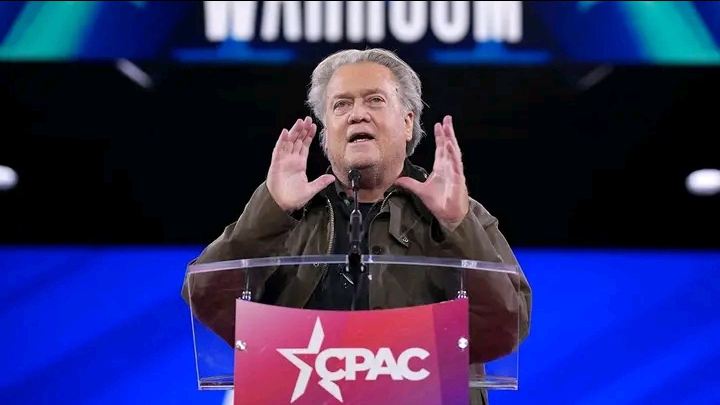

In a revelation that has sent shockwaves through the corridors of American power, Steve Bannon, the firebrand architect of the MAGA movement and former White House chief strategist, has boldly proclaimed that President Donald J. Trump is poised to shatter constitutional precedent by securing a third term in 2028.
Dismissing the ironclad restrictions of the 22nd Amendment as mere semantics ripe for reinterpretation, Bannon teased a shadowy “plan” engineered by loyalists to propel Trump back into the Oval Office.
“Trump is gonna be president in ’28, and people ought to just get accommodated with that,” Bannon declared in a candid sit-down with The Economist, framing the audacious bid not as political ambition, but as an act of “divine will.”
This isn’t idle chatter from a fringe provocateur—it’s a clarion call from one of Trump’s most influential confidants, whose words carry the weight of a movement still riding high on the president’s 2024 landslide victory.
As whispers of authoritarian overreach grow louder, Bannon’s interview lays bare the radical undercurrents bubbling within the Republican base: a willingness to rewrite the rules of democracy to extend the reign of their chosen leader.
With Trump already floating trial balloons about eternal governance—from memes joking about campaigns in 2032 to solemn vows that he’s “not joking” about a third run—the stage is set for a constitutional showdown that could redefine the American presidency.
The Interview That Ignited a Firestorm
The bombshell dropped during a wide-ranging conversation with The Economist‘s editor-in-chief, Zanny Minton Beddoes, titled “Inside the Mind of MAGA.”
Aimed at peering into the populist nationalist worldview that propelled Trump back to power, the dialogue quickly veered into uncharted territory when Beddoes pressed Bannon on Trump’s flirtations with a third term.
“Secondly, you’ve said that President Trump needs another term even [though] the 22nd Amendment makes pretty clear that he cannot have another,” Beddoes challenged, underscoring the amendment’s unambiguous language: “No person shall be elected to the office of the President more than twice.”
Bannon, undeterred, fired back with evangelical fervor. “He’s going to get a third term. So, Trump 2028, Trump is going to be president in 2028, and people just ought to get accommodated with that,” he insisted, invoking a celestial mandate.
“Trump [is] an instrument of divine will,” Bannon added, evoking the divine right of kings—a phrase Trump himself has echoed in rallies and posts, positioning his leadership as a providential intervention in America’s “huge crisis.”
When pressed for specifics on how such a feat could occur without triggering a Supreme Court battle or congressional revolt, Bannon remained coy yet confident. “There’s many different alternatives. At the appropriate time, we’ll lay out what the plan is,” he revealed, hinting at a cadre of legal minds dissecting the Constitution’s fine print.
“At some point in time, we will make sure we go through and define all of those terms,” Bannon continued, suggesting that ambiguities in phrasing—like whether non-consecutive terms or unelected ascensions count toward the limit—could be exploited.
He stopped short of unveiling the blueprint, promising revelations “at the appropriate time,” but his tone left no doubt: this is no pipe dream, but a meticulously plotted endgame to “finish what we started.”
The exchange, captured in a viral YouTube clip from The Economist, has amassed millions of views overnight, fueling a digital maelstrom on platforms like X (formerly Twitter). From MAGA diehards hailing it as “divine prophecy” to constitutional scholars decrying it as “treasonous fantasy,” the discourse is as polarized as ever.
Decoding the 22nd Amendment: Fortress or Loophole?
Ratified in 1951 as a direct rebuke to Franklin D. Roosevelt’s four-term tenure amid World War II fears, the 22nd Amendment was designed as an unbreakable safeguard against monarchical presidencies.
It explicitly limits any individual to two elected terms, consecutive or not, ensuring the peaceful transfer of power remains sacrosanct.
Trump’s 2016 and 2024 victories have already maxed him out, rendering a 2028 bid legally DOA—unless, as Bannon implies, the text can be twisted through creative jurisprudence.
Speculation abounds on the “plan’s” contours. One floated workaround—a MAGA surrogate like Vice President JD Vance runs in 2028 with Trump as VP, only for Vance to resign post-inauguration, elevating Trump via the 25th Amendment—crumbles under scrutiny.
The 12th Amendment bars “ineligible” candidates from the ticket, and courts would likely strike it down as a blatant evasion.
Other theories invoke repealing the amendment via a two-thirds congressional vote and three-quarters state ratification—a Herculean task in a divided Congress—or redefining “elected” to exclude indirect ascensions.
Bannon’s vagueness only amplifies the intrigue, but experts warn it’s less strategy than saber-rattling to demoralize opponents and rally the base.
Trump himself has fanned these flames for months, posting AI-generated memes of himself campaigning in 90,000 CE and telling NBC News, “There are methods” to skirt limits—insisting he’s “not joking.”
White House aides have dismissed such queries as media hysteria, with one anonymously mocking reporters for “taking the president at his word.”
Yet, as Bannon’s endorsement shows, the rhetoric is bleeding into actionable intent, echoing Trump’s adoption of fringe ideas like Project 2025 after initial denials.
A Torrent of Reactions: From Ecstatic Endorsement to Alarms of Autocracy
The fallout has been swift and seismic. On X, #Trump2028 trended globally within hours, with over 500,000 posts by midday Saturday.
Loyalists like podcaster Jack Posobiec amplified Bannon’s words as “the future America needs,” while even some MAGA voices expressed unease. “I love Trump but it’s impossible and I also don’t agree with it. We cannot be the party of the constitution and then not follow it,” tweeted @WellsJorda89710, capturing a rift in the ranks.
Critics, meanwhile, decried it as a “constitutional revolt,” with @allenanalysis warning, “They’re still talking about ‘methods’ and ‘alternatives’—it’s a huge crisis coming our way.”
Republican leaders have largely punted, with Senate Minority Leader Mitch McConnell’s office issuing a terse statement: “The Constitution is clear; jokes are jokes.”
Democrats, however, seized the moment. House Minority Leader Hakeem Jeffries called it “a dangerous flirtation with dictatorship,” urging congressional hearings on threats to democratic norms.
MSNBC analyst Jason Johnson labeled Bannon’s pitch “the MAGA wet dream of eternal Trump,” tying it to broader assaults on institutions like nonprofits and election integrity.
Public sentiment mirrors the divide. A fresh Reuters/Ipsos poll reveals 70% of Americans oppose a third Trump term, citing fatigue with his low-40s approval ratings and failure to clinch a popular vote majority in 2024.
Yet, 52% believe he’ll try anyway, underscoring the erosion of trust in constitutional guardrails. Legal eagles like NYU’s Ryan Goodman warn of “norm-shattering precedents,” fearing it normalizes challenges to term limits worldwide.
Bannon, ever the provocateur, thrives in this chaos. Convicted in February 2025 for defrauding border wall donors—a sentence he’s appealing—his “War Room” podcast remains a MAGA megaphone, with 10 million weekly listeners.
Though estranged from Trump’s inner circle since 2017 clashes over issues like the Jeffrey Epstein probe, Bannon’s gravitational pull endures, having amplified the 2020 election lies that culminated in January 6. The White House, silent on Bannon’s overture, may view it as useful theater to stave off lame-duck perceptions.
The Shadow Over 2028: Democracy’s Next Reckoning
As the 2026 midterms loom, Bannon’s gambit casts a long shadow over the GOP’s soul-searching.
Will it galvanize the base, as Trump adopts ever-bolder fringes? Or fracture the party, alienating moderates who prize the republic over the man? For now, the “plan” remains a tantalizing enigma, but its unveiling could ignite the fiercest battle for America’s founding principles since Watergate.
In Bannon’s words, this is about destiny: a “vehicle of divine Providence” steering the nation from peril. To detractors, it’s a veiled coup, testing whether the Constitution bends or breaks under populist pressure.
One thing is certain—the 2028 election cycle has just become infinitely more volatile. As Bannon might say, accommodate or perish: the MAGA machine rolls on, unyielding and unafraid.
Share This Post