
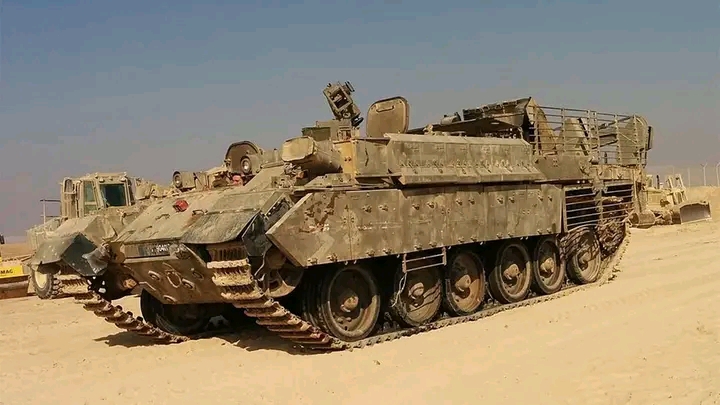

Khan Younis, Gaza Strip| A devastating explosion rocked an Israeli armored combat engineering tank in Khan Younis, southern Gaza, on Tuesday, claiming the lives of seven soldiers, including a commanding officer, in one of the deadliest single incidents for the Israel Defense Forces (IDF) in the ongoing Gaza conflict.
The incident, reported by The Times of Israel, underscores the persistent dangers of the ground offensive in Gaza and highlights the challenges facing Israel’s military operations in the region.
Details of the Incident
The explosion occurred aboard a Puma armored engineering vehicle as it navigated a combat zone in Khan Younis, a city that has become a focal point of intense fighting between Israeli forces and Palestinian militants.
According to the IDF, the blast was triggered by an improvised explosive device (IED) planted by Palestinian militants, believed to be affiliated with Hamas.
Despite rapid firefighting efforts, the fire rapidly engulfed the vehicle, leaving no survivors among the crew.
Among the casualties was Lieutenant Matan Shai Yasinovsky of the 605th Engineering Battalion, a highly regarded officer whose loss has reverberated across the IDF.
The attack brings the total number of Israeli soldiers killed in the Gaza ground offensive to 440, a grim milestone that reflects the high cost of the ongoing conflict.
Context of the Conflict
The explosion comes in the wake of a fragile 12-day ceasefire agreement between Israel and Iran, brokered under the directive of U.S. President Donald Trump.
The temporary truce, which aimed to de-escalate regional tensions, had briefly paused hostilities in the region.
However, Israeli Chief of Staff Herzi Halevi signaled a renewed focus on Gaza, stating, “The focus returns to Gaza. Hostages will be brought home, and the Hamas regime will fall.”
This statement reflects Israel’s determination to dismantle Hamas, which it considers a terrorist organization responsible for orchestrating attacks against Israeli forces and civilians.
The Khan Younis explosion highlights the ongoing threat posed by IEDs, which have proven effective against even the IDF’s heavily armored vehicles.
These devices, often concealed in urban environments or along key routes, have become a hallmark of Hamas’s guerrilla tactics, complicating Israel’s ground operations in densely populated areas like Khan Younis and Rafah.
Broader Implications
Military analysts predict that the attack will prompt an intensification of IDF operations in southern Gaza, particularly in areas identified as Hamas strongholds.
Khan Younis and Rafah, both located in the southern Gaza Strip, have been repeatedly targeted by Israeli forces due to their strategic importance and the presence of militant infrastructure.
However, the escalation of military operations is likely to exacerbate civilian displacement and infrastructure damage, further deepening the humanitarian crisis in Gaza.
The Gaza conflict, which has persisted for decades, has seen periodic escalations interspersed with temporary ceasefires. The latest round of violence has been particularly destructive, with significant casualties on both sides and widespread devastation in Gaza.
According to international observers, the ongoing fighting has displaced hundreds of thousands of Palestinian civilians, many of whom are facing acute shortages of food, water, and medical supplies.
The destruction of critical infrastructure, including hospitals and schools, has further compounded the crisis.
Challenges Ahead
The IDF’s stated goal of dismantling Hamas’s military and governance structures faces significant challenges. Hamas, which has controlled Gaza since 2007, has proven resilient in the face of repeated Israeli offensives.
Its use of urban warfare tactics, including tunnels and IEDs, has allowed it to inflict significant losses on Israeli forces while maintaining its operational capabilities.
The group’s ability to blend into civilian populations also complicates Israel’s efforts to target militants without causing collateral damage.
On the diplomatic front, the prospects for a lasting resolution remain dim. While the recent ceasefire provided a brief respite, the absence of a comprehensive peace agreement means that hostilities are likely to resume.
Analysts warn that without a renewed diplomatic initiative—potentially involving regional powers and international mediators—the cycle of violence will continue, with devastating consequences for both Israelis and Palestinians.
Humanitarian and Strategic Outlook
The explosion in Khan Younis serves as a stark reminder of the human toll of the Gaza conflict. For Israel, the loss of seven soldiers underscores the risks faced by its troops in a volatile and unpredictable theater of war.
For Palestinians, the intensification of military operations raises fears of further displacement and suffering, particularly in southern Gaza, where humanitarian conditions are already dire.
As the IDF prepares for what could be a prolonged campaign in Gaza, the international community faces growing pressure to address the root causes of the conflict.
Calls for renewed negotiations, humanitarian aid, and measures to protect civilians are likely to intensify in the coming weeks.
However, achieving a lasting peace will require overcoming deep-seated mistrust and addressing the complex political, territorial, and security issues at the heart of the Israeli-Palestinian conflict.
Going Forward…
The tragic loss of seven Israeli soldiers in Khan Younis marks a somber moment in the ongoing Gaza conflict, highlighting the dangers faced by military personnel and the broader challenges of achieving stability in the region.
As Israel vows to intensify its operations against Hamas, the risk of escalation looms large, with significant implications for both military and civilian populations.
The international community’s role in fostering dialogue and mitigating the humanitarian crisis will be critical in determining whether the cycle of violence can be broken.
Share This Post