
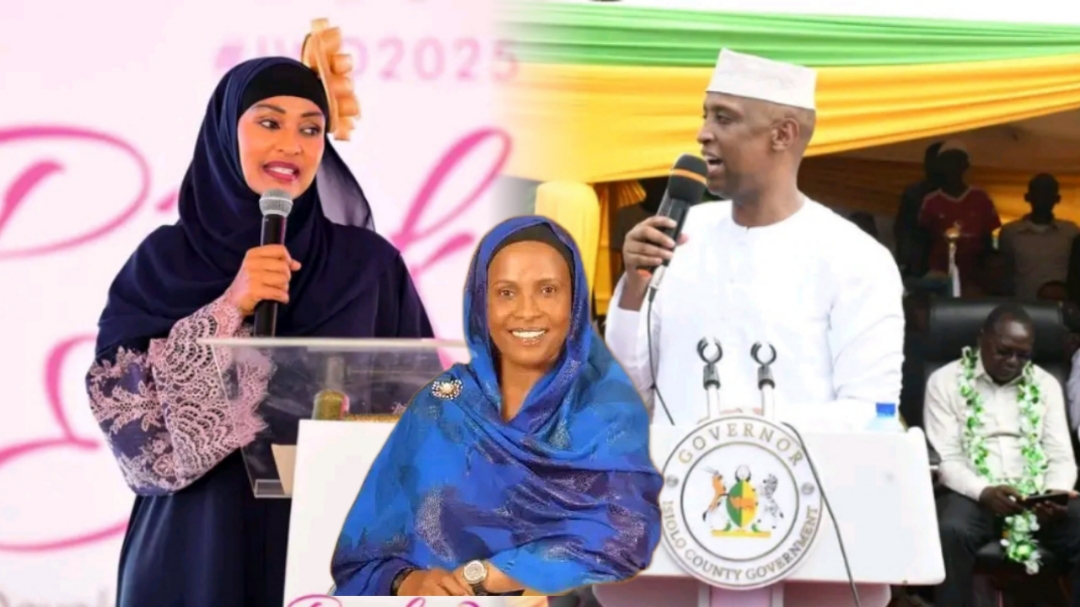

Isiolo, Kenya| The National Gender and Equality Commission (NGEC) Chairperson and former Isiolo Women Representative, Rehema Jaldesa, has issued a scathing rebuke of Isiolo Governor Abdi Ibrahim Guyo following his derogatory and baseless remarks targeting Senator Fatuma Dullo during Madaraka Day celebrations in Oldonyiro on June 1, 2025.
Jaldesa’s impassioned defense of the senator, coupled with widespread public condemnation, has thrust the governor’s conduct into the national spotlight, exposing a troubling pattern of misogyny, incompetence, and disregard for ethical leadership.
A Governor’s Descent into Vitriol
The incident unfolded during the Madaraka Day festivities in Oldonyiro, a day meant to celebrate Kenya’s self-governance and unity.
Governor Guyo, addressing a public gathering, veered from his prepared remarks into a shocking personal attack on Senator Dullo, accusing her of using her constitutional oversight role to “frustrate” his administration.
In an unprecedented display of crassness, he alleged, without evidence, that the senator was attempting to extort funds from the county to “lavish her lover boy.”
The remarks, which echoed similar unsubstantiated claims Guyo has made in the past, were met with gasps from the audience and swiftly ignited a firestorm of criticism.
The governor’s comments were not only a direct assault on Senator Dullo’s character but also a gendered attack that reduced her professional duties to baseless sexual innuendo.
Such rhetoric, critics argue, is emblematic of a broader culture of misogyny that undermines women in leadership, particularly those like Senator Dullo, who wield significant oversight authority in a male-dominated political landscape.
Rehema Jaldesa’s Uncompromising Stand
Rehema Jaldesa, a respected advocate for gender equality and a towering figure in Isiolo’s political history, wasted no time in condemning the governor’s remarks.
In a fiery post on her official Facebook page, accompanied by a video of Guyo’s vitriolic speech, Jaldesa delivered a searing critique that has resonated across Isiolo and Kenya’s political and social spheres.
“When a whole governor reduces a senator’s constitutional oversight role to the product of ‘sexual frustration,’ he reveals far more about himself than her,” Jaldesa wrote.
“Weak men, lacking capacity and intellectually bankrupt, often reach below the belt because there’s nothing worth reaching above his neck. Remove cobwebs in your closet. Bure kabisa!” She added with finality.
Jaldesa’s words struck a chord, not only for their sharp wit but for their unflinching defense of Senator Dullo’s dignity and constitutional mandate.
By framing Guyo’s remarks as a reflection of his own inadequacies, Jaldesa exposed the governor’s attempt to deflect accountability through gendered insults.
Her post quickly went viral, garnering hundreds of reactions and comments, with netizens rallying behind her call for respect and accountability in leadership.
Public Outrage and Social Media Backlash
The public response to Governor Guyo’s remarks was swift and unequivocal. Social media platforms, particularly Facebook, became a battleground for citizens to voice their disgust at the governor’s behavior.
Comments under Jaldesa’s post painted a damning picture of a leader perceived as unfit for office, with many highlighting his history of administrative failures and ethical lapses.
Adesh Kayyo, a commenter, described Guyo as “a true masterclass in cluelessness, blending incompetence with a generous dash of pettiness.”
Another user, Hache Abdi, labeled him “a very useless Governor ever elected,” while Gedi Ubah implored the governor to “respect women,” reminding him that Senator Dullo is “a sister, a mother, a grandmother, an aunty, and a leader.”
Others, like Guyo Halake Rendilicha, called the governor’s election “nothing short of a tragic accident,” pointing to his intellectual and administrative shortcomings.
The outcry extended beyond social media, with reports indicating that even members of Guyo’s inner circle were scrambling to contain the fallout from what has been described as a “PR disaster.”
The governor’s remarks have not only alienated constituents but also raised questions about his ability to lead a county already grappling with systemic challenges.
A Pattern of Evasion and Misconduct
Governor Guyo’s attack on Senator Dullo is not an isolated incident but part of a broader pattern of contentious interactions with the senator, who has consistently held his administration to account.
Senator Dullo, known for her rigorous oversight, has summoned Guyo multiple times to explain questionable expenditures, including an alleged employment scam involving the appointment of over 36 advisors, none of whom the governor could name during a recent Senate committee session.
These summons, along with court injunctions, have reportedly frustrated Guyo, who claims they hinder his ability to deliver services to Isiolo’s residents.
However, critics argue that Guyo’s frustration stems not from oversight but from his inability to provide transparent and accountable governance.
The governor’s repeated failure to substantiate his claims of extortion against Senator Dullo has only deepened skepticism about his leadership.
His latest outburst, far from deflecting scrutiny, has instead amplified calls for his resignation and underscored the need for leaders who uphold dignity and professionalism.
Gender Sensitivity and the Cost of Misogyny
At the heart of this controversy lies a critical issue: the persistent use of gendered attacks to undermine women in positions of power.
Governor Guyo’s remarks, which reduced Senator Dullo’s oversight role to a caricature of “sexual frustration,” reflect a troubling tendency to weaponize gender against women leaders.
Such rhetoric not only demeans the individual but also erodes public trust in women’s leadership, perpetuating harmful stereotypes that have no place in modern governance.
Rehema Jaldesa’s response serves as a powerful counterpoint, emphasizing the need for gender sensitivity, particularly among leaders in influential positions.
Her leadership as NGEC Chairperson has been marked by a steadfast commitment to dismantling systemic barriers to gender equality, making her a fitting champion for Senator Dullo in this instance.
Jaldesa’s ability to articulate the broader implications of Guyo’s remarks—exposing them as a reflection of intellectual and moral bankruptcy—has galvanized public support and highlighted the urgent need for accountability in leadership.
Senator Dullo, for her part, has yet to issue an official response to the governor’s attack. Her silence, however, does not diminish her stature as a dedicated public servant whose oversight has been instrumental in exposing mismanagement in Isiolo County.
Her role as a senator, mother, grandmother, and community leader underscores the resilience of women who continue to navigate and challenge patriarchal structures in Kenyan politics.
A Call for Accountability
The fallout from Governor Guyo’s remarks has reignited discussions about the state of leadership in Isiolo County and the broader imperative for ethical governance.
Commenters like Purity Horwell, who called Guyo “a disgrace to humanity,” and Guyez D. Galma, who labeled his remarks “baseless, outright foolishness, and utmost disrespectful,” reflect a growing sentiment that the governor’s tenure has been marked by failure and divisiveness.
Many have dubbed him a “one-term governor,” signaling a demand for change in the county’s leadership.
As the controversy continues to unfold, Rehema Jaldesa’s bold stand serves as a clarion call for leaders to prioritize dignity, respect, and accountability.
Her defense of Senator Dullo is not just a rebuke of one man’s reckless words but a broader challenge to a culture that tolerates misogyny and incompetence in public office.
For the people of Isiolo, the incident is a stark reminder of the power of principled leadership—and the consequences of its absence.
Share This Post