
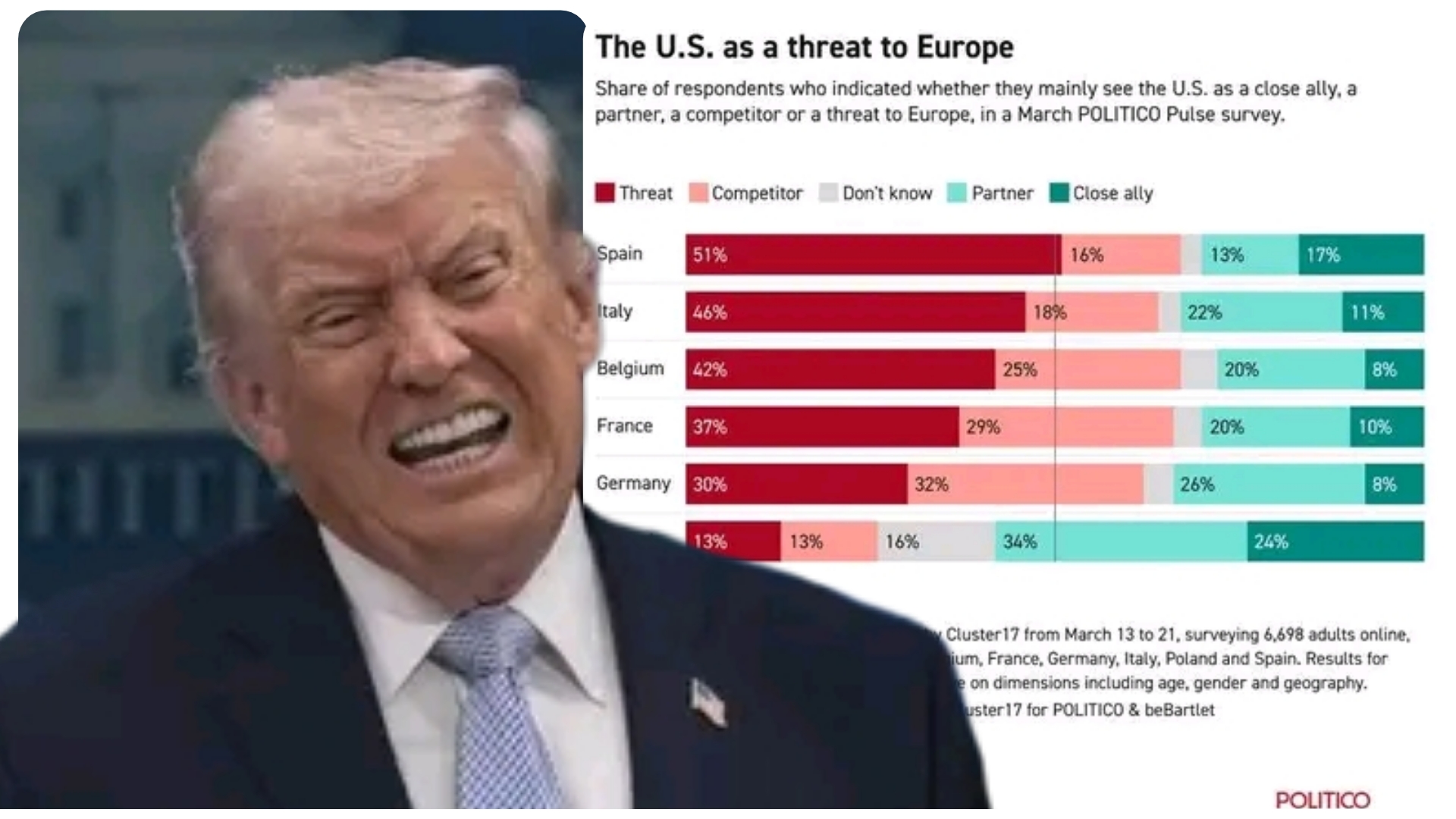

A sweeping new opinion poll has revealed a striking erosion of trust in the United States across several major European nations, with a majority of Spaniards now viewing America as a direct threat.
This was an outlook shaped largely by the policies of President Donald Trump, according to the survey’s commissioners.
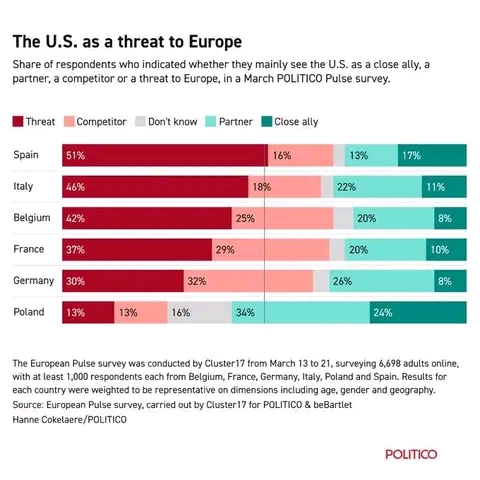
The “European Pulse” poll, commissioned by Politico and conducted between March 13 and March 21, surveyed more than 1,000 adults in each of six European countries: Belgium, France, Germany, Italy, Poland, and Spain.
The findings, published on Wednesday, paint a complex and regionally divided picture of transatlantic sentiment—one in which the United States is increasingly seen not as a guarantor of security, but as a source of instability.
In Spain, the shift is particularly pronounced. Fifty-one percent of Spanish respondents described the US as a “threat,” while only 17 percent considered it a close ally.
This marks a dramatic departure from the post-World War II consensus that framed America as Europe’s indispensable partner.
By contrast, Poland stands out as a notable exception: only 13 percent of Poles view the US as a threat, with the vast majority still regarding it as a partner or ally.
Notably, 16 percent of Polish respondents said they were unsure how to assess the US—a figure that suggests growing uncertainty even among traditionally pro-American populations.
The survey’s findings are deeply contextualized by recent US foreign policy moves.
Since taking office just over a year ago, President Trump has imposed tariffs on European allies, publicly floated the annexation of Greenland from NATO partner Denmark, and overseen a military escalation with Iran that has threatened global energy stability.
The poll was conducted amid active hostilities in the Middle East, where the US and Israel launched a bombing campaign aimed at toppling Iran’s government.
No European NATO members directly joined the campaign, but Spain was notably vocal in its opposition, calling the operation illegal under international law and denying US forces access to its airspace for strikes.
Interestingly, when compared to perceptions of China, the US often fares worse. Across all six countries, an average of 36 percent of respondents considered the US a threat, versus 29 percent for China.
In France and Belgium, more respondents identified China as a threat (43 percent and 38 percent, respectively) than the US (37 percent and 42 percent).
These figures suggest that for many Europeans, the immediate disruptive potential of American foreign policy under the current administration looms larger than the long-term strategic competition posed by Beijing.
The polling period also captured a moment of fragile diplomatic maneuvering.
Earlier this week, Trump signaled openness to negotiations based on a ten-point proposal from Iran, leading to the announcement of a two-week ceasefire.
However, that truce has since been strained by increased Israeli attacks against Lebanon.
While Washington maintains that these actions fall outside the ceasefire’s scope, skeptics argue that Israel is deliberately undermining US-led peace efforts.
The Trump administration has also faced accusations of using bad-faith negotiations as a diversionary tactic ahead of surprise military actions against Iran—a charge that, whether proven or not, continues to fuel European mistrust.
As the US approaches another election cycle, the European Pulse poll offers a sobering reality check: for a growing number of Americans’ oldest allies, the United States has become an unpredictable actor.
And in the eyes of most Spaniards, an outright threat. Whether Washington can rebuild that trust remains an open question.
Share This Post