


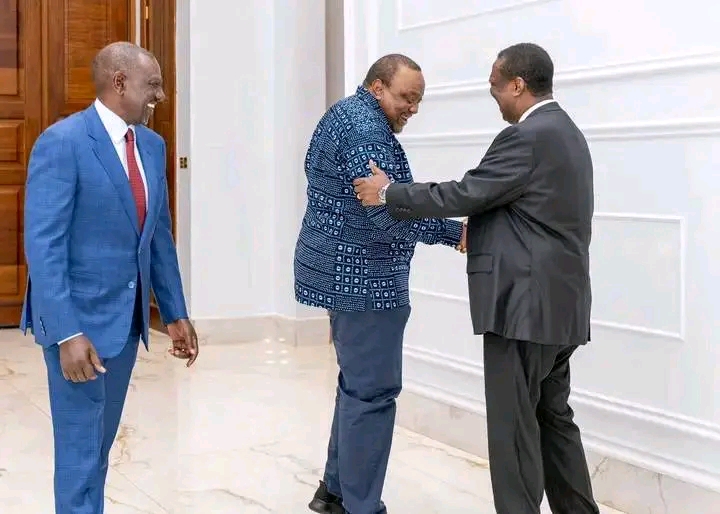
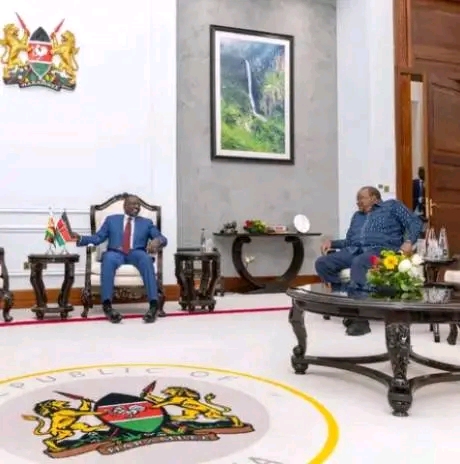
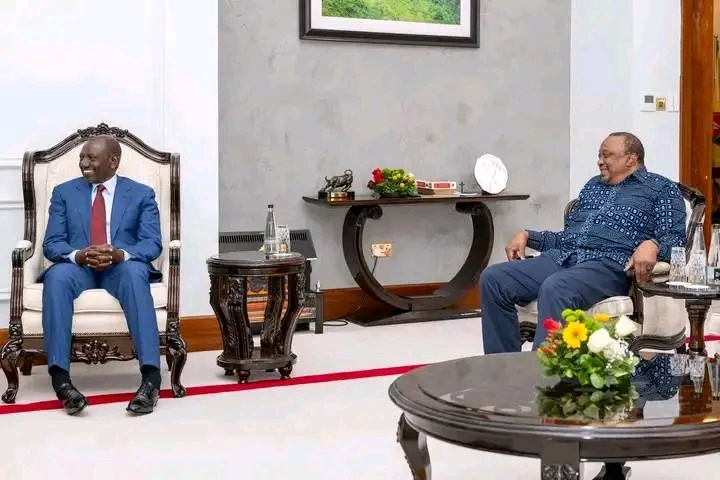
Nairobi, Kenya| In a moment steeped in political symbolism and diplomatic gravitas, former President Uhuru Kenyatta made a rare and highly anticipated return to State House Nairobi, where he was warmly received by President William Ruto.
This marked Kenyatta’s first visit to the seat of power since relinquishing the presidency in 2022, a moment that carried profound significance for Kenya’s political landscape and its role in regional peace-building.
Far from a mere courtesy call, the meeting underscored a rare unity between two leaders whose past rivalry has often dominated headlines, proving that when national and regional interests are at stake, statesmanship triumphs over political theater.
A Meeting Anchored in Peace
The reunion was not a spontaneous gesture but a carefully orchestrated engagement tied to a critical regional agenda.
The two leaders met ahead of the joint summit of the East African Community (EAC) and the Southern African Development Community (SADC) co-chairs, alongside a panel of facilitators focused on the Democratic Republic of Congo (DRC) peace process.
As the EAC’s appointed peace envoy for the DRC, Uhuru Kenyatta has been at the forefront of mediating efforts to stabilize the conflict-ravaged nation. His role has earned him respect as a regional statesman, and his presence at State House underscored Kenya’s pivotal role in fostering peace and stability in the Great Lakes region.
The DRC peace process, a complex and delicate initiative, seeks to address the ongoing violence in eastern Congo, where armed groups, resource conflicts, and geopolitical tensions have fueled one of Africa’s longest-running crises.
Kenyatta’s leadership in the Nairobi Process, a series of peace talks initiated during his presidency, has been instrumental in bringing warring parties to the negotiating table.
President Ruto, whose administration has prioritized regional integration and security, lent his full support to the initiative, signaling Kenya’s unwavering commitment to peace beyond its borders.
A Handshake That Spoke Volumes
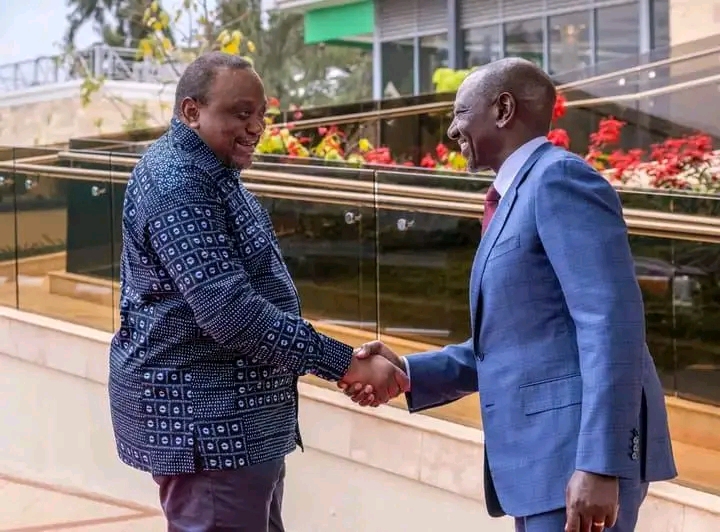
The optics of the meeting were as powerful as its substance. A firm handshake between Kenyatta and Ruto, captured by cameras and shared widely across media platforms, sent a resounding message: when Kenya’s interests are on the line, personal and political differences take a backseat.
The mood was described as calm, professional, and devoid of the tension many had anticipated. For a nation accustomed to the fiery rhetoric of its political class, this display of maturity was both refreshing and reassuring.
The meeting was a masterclass in diplomacy, with both leaders setting aside their storied rivalry to focus on a shared goal.
Kenyatta, who handed over power to Ruto after a contentious 2022 election, and Ruto, who has since navigated the complexities of governing a polarized nation, demonstrated that duty can transcend drama.
Their ability to engage constructively was a testament to their commitment to Kenya’s role as a regional leader and a beacon of stability in a volatile region.
A Moment That Defied Expectations
For weeks, speculation had swirled about how this encounter would unfold. Political pundits and supporters of both leaders—particularly Kenyatta’s loyal base, often referred to as the “Wamunyoro” brigade—braced for a showdown.
Social media platforms buzzed with predictions of a frosty reception or veiled barbs exchanged behind closed doors. Yet, what transpired was the opposite: a mature, calculated, and necessary dialogue that prioritized Kenya’s strategic interests over partisan posturing.
The Wamunyoro, known for their vocal defense of Kenyatta, were left with little to critique. Their expectations of a dramatic confrontation were unmet, as the two leaders opted for statesmanship over showmanship.
Instead of fueling division, the meeting highlighted a rare moment of unity, reminding Kenyans that leadership is not about settling scores but about rising above them.
The Historical Weight of the Moment
This was no ordinary meeting. It was a historic convergence of Kenya’s past and present, a moment where two of its most influential figures set aside their differences to advance a common cause.
For Kenyatta, the return to State House was a poignant reminder of his decade-long tenure as president, during which he laid the groundwork for Kenya’s regional leadership.
For Ruto, it was an opportunity to demonstrate his administration’s commitment to continuity and collaboration, even with those who once stood on opposing sides.
The meeting also carried broader implications for Kenya’s political culture. In a country where political rivalries often spill into public acrimony, the image of Kenyatta and Ruto working together sent a powerful signal to the nation’s leaders and citizens alike.
It was a reminder that governance is not a zero-sum game and that the pursuit of national and regional goals requires pragmatism and unity.
Kenya’s Role in Regional Peace
At the heart of the meeting was Kenya’s enduring commitment to regional peace and stability. The DRC peace process, which both leaders endorsed, is a cornerstone of Kenya’s foreign policy.
By hosting the joint EAC-SADC summit, Kenya reaffirmed its position as a diplomatic hub and a trusted mediator in African conflicts.
The collaboration between Kenyatta and Ruto in this context highlighted the country’s ability to leverage its past and present leadership to address pressing regional challenges.
The Nairobi Process, under Kenyatta’s stewardship, has made significant strides in facilitating dialogue between the DRC government and various armed groups.
While challenges remain, including ongoing violence and the complexities of implementing peace agreements, Kenya’s role as a neutral facilitator has earned it praise from regional and international partners.
Ruto’s administration, by hosting the summit and engaging with Kenyatta, signaled its intent to build on this legacy and strengthen Kenya’s influence in the region.
A Legacy Beyond Politics
As the cameras clicked and the handshakes were exchanged, one thing was clear: this moment will be etched in Kenya’s history. It was not just a meeting between two leaders but a powerful statement about the resilience of Kenya’s institutions and the maturity of its democracy.
For Uhuru Kenyatta, it was a chance to reaffirm his relevance as a statesman and peace envoy. For William Ruto, it was an opportunity to showcase his administration’s commitment to unity and progress.
For Kenyans watching from afar, the reunion was a reminder that leadership is about serving a higher purpose.
The image of two former rivals standing side by side, united by a shared commitment to peace, resonated deeply in a nation yearning for unity.
While the Wamunyoro and other political factions may continue to nurse their grievances, the broader message was unmistakable: when duty calls, Kenya’s leaders can rise to the occasion.
Looking Ahead
As the joint EAC-SADC summit progresses, all eyes will be on the outcomes of the DRC peace process and Kenya’s role in shaping its future.
The collaboration between Kenyatta and Ruto sets a precedent for future engagements, proving that even the most entrenched rivalries can give way to pragmatism and purpose.
For now, the handshake at State House stands as a beacon of hope—not just for Kenya, but for a region in desperate need of peace and stability.
In the annals of Kenyan history, August 1, 2025, will be remembered as the day when two leaders chose duty over drama, diplomacy over division, and peace over politics. It was a moment that reminded the nation—and the world—that Kenya’s strength lies in its ability to unite for a greater cause.
For more updates on Kenya’s role in regional peacebuilding and the latest political developments, stay tuned to our platform.
Share This Post