
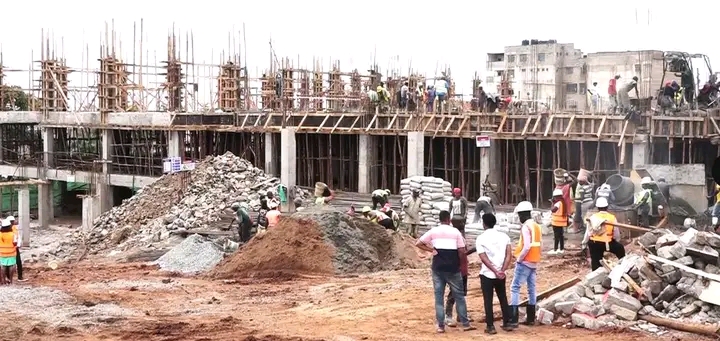

•The Facility is Estimated to Cost 1.04 Billion Shillings and is Expected to Boost Regional Economy
The construction of a Sh1.04 billion ultra-modern market in Embu Town is steadily progressing, marking a significant milestone in efforts by the national government to revamp trade infrastructure and improve livelihoods.
Now 45 percent complete, the three-story facility is projected to become one of the largest and most advanced marketplaces in the region, with capacity to accommodate approximately 3,000 traders.
Originally budgeted at Sh900 million, the cost of the market was revised upwards to Sh1.04 billion to allow for expansion and inclusion of additional modern amenities.
The project, which is being implemented by the national government under close supervision by the Embu County Government, is scheduled for completion by the end of 2026.
However, county officials have expressed optimism that, given the current pace of construction, the project may be completed ahead of schedule.
The market is expected to significantly transform the local business environment by providing a centralized, organized, and hygienic trading space.
Key features of the facility include luggage loading and offloading zones, sorting areas, and elevators to ease movement for traders, buyers, and goods.
Other amenities designed to enhance the experience for market users include lactation rooms for breastfeeding mothers, and daycare centers to support working parents with young children.
Raymond Kinyua, Embu County Executive Committee Member (CECM) in charge of Lands, Mining, Housing, Physical Planning, and Urban Development, described the market as a transformative project with far-reaching economic and social implications.
“This is a mega project that will not only accommodate more traders, but also stimulate trade and create more employment opportunities,” said Kinyua.
“The market’s significance goes beyond its physical infrastructure—it will serve as a regional commercial hub, stabilizing the prices of consumer goods while offering suppliers a dependable point of sale.”
The new market comes as a major relief to hundreds of traders who have, for years, operated under harsh conditions in the old Embu market, which was demolished to pave way for the construction.
In the interim, traders have been relocated to a temporary site where they continue with business activities as they eagerly await the completion of the new facility.
Gladys Mbogo, a cereals trader, expressed satisfaction with the pace of construction, noting that the government’s commitment is now translating into visible progress. “The progress is good and we are glad that it will accommodate all of us,” she remarked.
David Ndwiga, chairperson of the Embu traders’ association, hailed the project as a game-changer for small and medium-sized enterprises.
“The new market is set to replace scattered, informal stalls with a modern, centralized complex that reflects progress and forward-thinking governance,” he stated.
He also cited the anticipated improvements in operational efficiency, sanitation, and overall business conditions.
Beyond trade and commerce, the project has already started contributing to social empowerment and job creation. Over 300 locals—many of them youth and women—have been hired in various capacities, both skilled and unskilled.
Maureen Karimi, who is engaged in water curing work at the site, shared how the project has positively impacted her livelihood. “I no longer struggle to place a meal on the table like I used to,” she said.
Similarly, Cyrus Nyaga, a mason, noted that the job has provided him with a steady income, enabling him to support his family and pay school fees for his children.
As work on the Embu ultra-modern market continues, it symbolizes not only infrastructure development but also a broader vision of inclusive economic growth and improved living standards for the local population.
Upon completion, it is expected to serve as a benchmark for future market infrastructure projects across the country.
Share This Post