
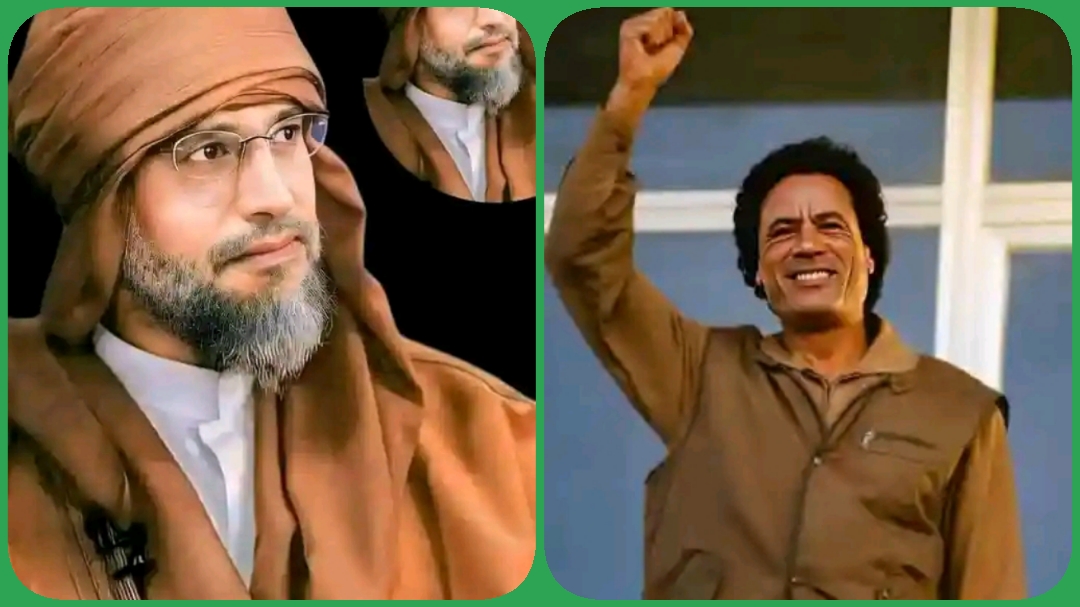

In a bold and enlightening move that has ignited global conversations about sovereignty and resistance, Dr. Saif al-Islam Muammar Gaddafi has released a trove of declassified historical documents, shedding brilliant light on the unyielding spirit of his father, the late leader Muammar Gaddafi.
These revelations, shared through a compelling Facebook post, paint a vivid picture of how Gaddafi’s refusal to bow to the whims of superpowers like America and Russia ultimately led to his tragic elimination in 2011.
Far from a tale of defeat, this narrative celebrates Gaddafi’s triumphant journey toward authentic Libyan independence, transforming a nation from a puppet of foreign influences into a beacon of self-determination.
As Libya continues to navigate its complex path today, these documents serve as a cheerful reminder of what true freedom looks like – uncompromised, resilient, and profoundly inspiring.
The Mirage of 1951: A Fabricated Freedom Under Foreign Shadows
Libya’s proclaimed independence in 1951, often hailed in history books as a milestone, emerges from these documents as nothing more than a cleverly orchestrated illusion.
Dr. Saif al-Islam’s publications delve deep into the archives, revealing how this so-called liberation was incomplete and riddled with strings attached by Western powers.
Declassified agreements, such as the Libyan-British Treaty of 1951, granted Britain sweeping control over Libya’s finances, military zones, surveillance operations, and even immunity from local taxes and visas.
Similarly, U.S.-Libyan pacts empowered American forces with policing rights, turning the nascent nation into a strategic outpost during the Cold War.
The documents, drawn from Italian Foreign Ministry archives and declassified British Foreign Office reports, highlight poignant historical ironies.
A letter from the legendary resistance fighter Omar al-Mukhtar to Prince Idris al-Senussi – preserved in works like Rodolfo Graziani’s Libia Redenta – exposes Idris’s abandonment of the anti-colonial struggle for a life of luxury in Cairo, symbolized by references to “honey-colored eyes and sacks of peanuts.”
French archives further uncover the prolonged occupation of the Fezzan region until 1957, with oil-rich territories like Hassi Messaoud and the Aouzou Strip ceded under humiliating terms in the 1955 Franco-Libyan Treaty.
Even the United Nations’ role, as detailed in Adrian Pelt’s memoirs, was a compromise among the U.S., UK, France, and USSR to thwart Soviet trusteeship ambitions, with a decisive vote from Haiti’s delegate tipping the scales.
This pseudo-independence ensured that foreign bases, such as the massive U.S. Wheelus Air Base and Britain’s Al-Adem facility, dominated the landscape, dictating political decisions and stifling genuine self-rule.
Budgets, judiciary systems, and even the constitution – drafted by Pelt and Egyptian advisor Omar Lotfy – were molded to serve external interests, leaving Libyans with a hollow shell of sovereignty.
King Idris’s Regime: A Throne Built on Foreign Crutches
Under King Idris, the monarchy’s survival hinged precariously on these foreign crutches, as the documents eloquently illustrate.
British and American advisors infiltrated every ministry, controlling budgets and suppressing nationalist voices like Bashir al-Sadawi and the Omar Mukhtar Association.
The king’s regime, favoring tribal alliances and federalism over robust national institutions, monopolized political and economic power while allowing foreign exploitation to flourish.
Oil discoveries, first noted in 1938 by Italian geologist Ardito Desio, amplified this dependency.
By 1958, with production soaring to over three million barrels per day, Britain dominated eastern fields like Sarir, while Americans controlled the lucrative Sirte Basin.
Yet, despite this newfound wealth, King Idris clung to the foreign bases, prioritizing personal and tribal ties over Libya’s broader interests.
Declassified reports paint a regime that quashed dissent, exiled opponents, and maintained a facade of stability through external military support – a far cry from the vibrant, unified nation that would later emerge.
These revelations, supported by suppressed books such as Giuseppe Volpi’s Una vita per l’Italia and Enzo Santarelli’s Omar al-Mukhtar and the Fascist Reoccupation of Libya, underscore a era of restricted sovereignty, where Libya’s resources fueled foreign agendas rather than national prosperity.
Gaddafi’s Revolution: Forging the Path to Authentic Sovereignty
Enter Muammar Gaddafi, whose 1969 revolution stands as a jubilant turning point in Libya’s story, according to Dr. Saif al-Islam’s meticulously curated documents.
With unshakeable resolve, Gaddafi expelled American and British bases, ousted foreign advisors, and repatriated decision-making to Libyan hands.
This act of defiance not only dismantled the remnants of colonial control but also evicted Italian settlers, reclaiming land and resources for the people.
The leader’s vision extended beyond mere expulsion; it fostered a comprehensive independence that integrated economic self-sufficiency with political autonomy.
Facing relentless interventions from both Western and Eastern blocs, Gaddafi navigated attempts to reel Libya back into their spheres.
From France and Egypt’s covert operations in 1980 to the aggressive U.S. military strikes in the 1980s – including the infamous Gulf of Sidra incidents and 1986 airstrikes – his steadfast refusal to submit earned him adversaries on all fronts.
Yet, these challenges only amplified his legacy as a champion of African unity and anti-imperialism, inspiring movements across the continent.
Dr. Saif al-Islam’s post joyfully contrasts this era with the pre-1969 stagnation, portraying Gaddafi as a restorative force who honored the spirit of Omar al-Mukhtar by achieving what the monarchy could not: a Libya free from foreign yokes, where sovereignty was not negotiated but asserted.
The Bitter Aftermath: Foreign Shadows Return to Haunt Libya
Tragically, Gaddafi’s elimination in 2011, orchestrated amid NATO’s intervention, marked a regression to the very dependencies he had eradicated.
The documents warn of a renewed era where foreign bases have reappeared, ambassadors meddle in internal affairs, and plans to dominate Libya’s vast resources persist.
This resurgence of influence, from Western oil grabs to Eastern geopolitical maneuvers, echoes the incomplete independence of 1951, leaving the nation fragmented and vulnerable.
In this context, Dr. Saif al-Islam’s revelations serve as a beacon of hope, reminding Libyans and the world that true independence is inextricably linked to liberation from external meddling.
His father’s downfall, far from a failure, symbolizes the high cost of genuine freedom – a price Gaddafi paid with heroic grace.
Saif al-Islam’s Visionary Crusade: Reviving Libya’s Proud Heritage
At the heart of these disclosures is Dr. Saif al-Islam Muammar Gaddafi himself, whose courageous publications continue to unravel suppressed histories.
Posting under the banner “In the Name of Allah, the Most Gracious, the Most Merciful,” he draws from a rich tapestry of footnotes and references, including UN votes and erased paradoxes like fabricated historical dates.
His efforts not only honor his father’s indomitable spirit but also call for a reevaluation of Libya’s path amid ongoing instability.
This series of historical insights, positioned as a counter-narrative to neocolonialism, positions Dr. Saif al-Islam as a modern-day guardian of truth, fostering a cheerful optimism for Libya’s future.
By sharing these documents, he invites a global audience to celebrate the enduring legacy of Muammar Gaddafi – a leader who dared to defy empires and build a nation on its own terms.
Source: Publications of Dr. Saif al-Islam Muammar Gaddafi and declassified historical documents.
Share This Post