
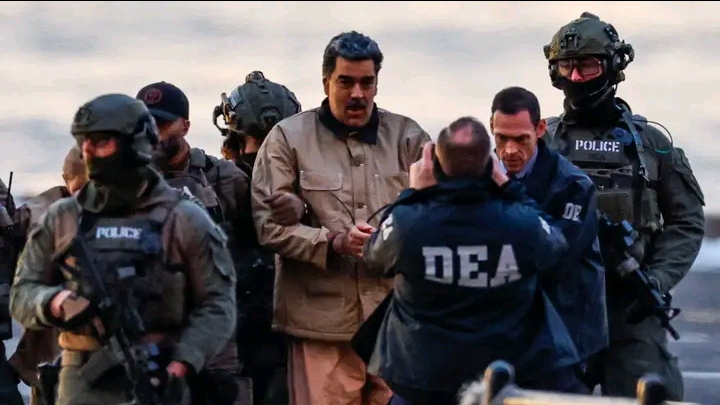


In a dramatic escalation of tensions between the United States and Venezuela, deposed leader Nicolas Maduro made his initial appearance in a New York federal court on Monday, entering a plea of not guilty to serious drug trafficking and narco-terrorism charges.
The 63-year-old former president, who was forcibly removed from power in a bold U.S. military operation over the weekend, arrived under heavy security alongside his wife, Cilia Flores.
The hearing unfolded against the backdrop of an emergency United Nations Security Council session debating the legality of the intervention ordered by U.S. President Donald Trump, highlighting profound questions about international law, sovereignty, and geopolitical power dynamics in Latin America.
The High-Stakes Capture in Caracas
The operation that led to Maduro’s arrest marked the most significant U.S. military intervention in Latin America since the 1989 invasion of Panama to apprehend General Manuel Noriega.
According to reports, U.S. Special Forces descended on Caracas via helicopters, breaching Maduro’s fortified security perimeter and seizing him at the entrance to a secure bunker.
This swift raid, executed with precision amid the chaos of Venezuela’s capital, underscored the Trump administration’s aggressive stance against what it describes as a regime deeply entangled in international narcotics operations.
Maduro and Flores were subsequently transported to a detention facility in Brooklyn before being escorted by armed guards to a helicopter shortly after 7 a.m. local time. The couple was then flown to the federal courthouse in Manhattan for a midday arraignment.
Eyewitness accounts and wire photos captured the scene, showing the pair in restraints as they were led into the building, a stark symbol of the fall from power for a leader who had ruled Venezuela since 2013.
Charges of Narco-Terrorism and International Conspiracy
U.S. prosecutors have leveled grave accusations against Maduro, alleging that he orchestrated a vast cocaine-trafficking network responsible for flooding tons of narcotics into the United States.
The indictment portrays Maduro as the architect of a “narco-terrorism conspiracy,” involving partnerships with notorious criminal organizations such as Mexico’s Sinaloa and Zetas cartels, Colombia’s now-dissolved FARC rebels, and Venezuela’s Tren de Aragua gang.
These alliances, according to the charges, not only facilitated drug shipments but also funded violent activities that destabilized the region.
During the court proceedings, a summary of the allegations was read aloud, detailing how Maduro allegedly leveraged his position to enable these operations.
Maduro, speaking directly to the judge, vehemently denied the claims, declaring, “I’m innocent. I am not guilty. I am a decent man, the president of my country.”
Flores echoed this sentiment, pleading not guilty as well. Both insisted on their status as Venezuela’s legitimate president and first lady, rejecting the U.S. narrative that portrays them as deposed figures.
The judge scheduled the next court date for March 17, allowing time for legal teams to prepare amid what promises to be a protracted and high-profile trial.
Maduro has long dismissed these accusations as politically motivated fabrications, arguing that they serve as a pretext for U.S. imperialist ambitions targeting Venezuela’s vast oil reserves—the largest proven reserves in the world.
This defense resonates with historical precedents, where resource-rich nations in the Global South have faced external pressures under the guise of combating crime or terrorism.
International Repercussions and Diplomatic Tensions
The U.S. action has ignited a firestorm of international criticism, with the Venezuelan government—now under interim leadership—condemning the intervention as a blatant violation of international law and national sovereignty.
Pro-Maduro supporters within Venezuela have mobilized rallies, framing the capture and trial as an assault on the nation’s independence rather than a legitimate pursuit of justice.
These demonstrations emphasize themes of anti-imperialism, portraying Maduro’s predicament as emblematic of broader struggles faced by developing nations resisting foreign dominance.
At the United Nations, the Security Council convened an urgent session to scrutinize the operation’s legality. Delegates from various member states debated whether the U.S. raid constituted an act of aggression or a justified enforcement of international anti-narcotics efforts.
Proponents of the intervention cited precedents like the Noriega case, while opponents invoked the UN Charter’s principles on non-interference in sovereign affairs.
The discussion extended to the broader implications for global order, with some arguing that such unilateral actions could set dangerous precedents for powerful nations to target leaders in weaker states.
This episode transcends Venezuela’s borders, raising fundamental questions about the intersection of justice, power, and geopolitics.
Critics contend that labeling resistant leaders as criminals is a tactic to destabilize governments that challenge Western interests, turning courtrooms into arenas for ideological battles.
Supporters of the U.S. position, however, maintain that the charges are grounded in extensive evidence of corruption and criminality that have exacerbated Venezuela’s humanitarian crisis, including hyperinflation, shortages, and mass migration.
Broader Context and Future Implications
Maduro’s trial arrives at a pivotal moment in U.S.-Latin American relations, amid ongoing debates over drug policy, border security, and hemispheric influence.
The charges stem from investigations that intensified under the Trump administration, which in 2020 initially offered a $15 million bounty for Maduro’s capture—a move that foreshadowed this weekend’s events.
While the operation has been hailed by some as a blow against transnational crime, it risks further polarizing the region, potentially straining alliances with countries like Russia and China, which have historically backed Maduro’s regime.
As the case progresses, legal experts anticipate challenges related to extradition protocols, jurisdictional authority, and the admissibility of evidence gathered through intelligence operations.
The outcome could influence future U.S. strategies in combating narco-trafficking, while also affecting Venezuela’s path toward political stabilization.
For now, the world watches as a courtroom in Manhattan becomes the focal point for a saga that encapsulates the enduring tensions between sovereignty and global accountability.
Share This Post