
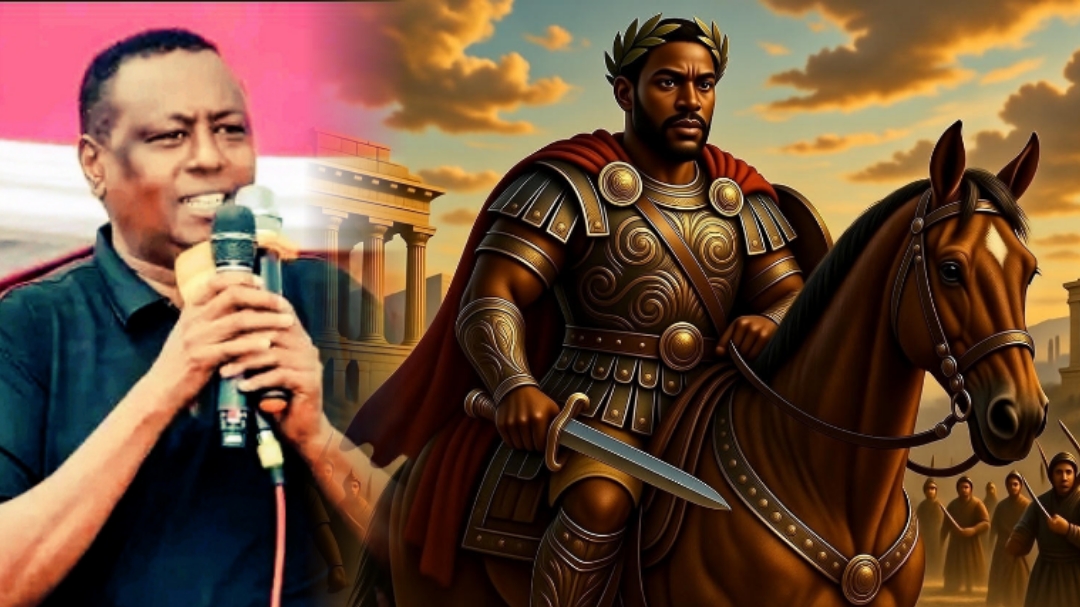

In the annals of history, Julius Caesar’s audacious crossing of the Rubicon River stands as a philosophical emblem of irrevocable courage—a point of no return where one man’s resolve defied the odds, reshaping empires.
“Alea iacta est,” he declared: the die is cast. Fast-forward to the unforgiving political landscapes of northern Kenya, where a modern-day statesman echoes that same indomitable spirit.
Enter Abdullahi Jaldesa Banticha, the indomitable Speaker of the Isiolo County Assembly and former MP for Isiolo South (2013-2017), whose recent foray into a hostile gathering in Marsabit County mirrors Caesar’s defiance.
Banticha didn’t cross a river; he traversed tribal fault lines, unleashing a torrent of bitter truths that stung like salt in open wounds.
Yet, as philosophers from Socrates to Nietzsche remind us, truth is not a balm but a scalpel—it cuts deep to excise the rot of division, healing only after the pain subsides.
In an era where politicians peddle illusions for votes, Banticha’s stand is a clarion call for unity, exposing the rabble-rousers who sow discord and now lick their wounds on the political battlefield.
The Lion’s Den: A Gathering Fraught with Peril
Picture this: the sun-baked plains of Marsabit, a region scarred by decades of ethnic tensions and resource rivalries.
It was here, at his clan’s (Warsu) annual congregation—a cultural event ostensibly meant for celebration and kinship—that Banticha chose to deliver his unfiltered message.
Warsu, a subgroup within the broader Boran ethnic umbrella, has long been a flashpoint for inter-clan animosities usually fuelled by politics and resource sharing.
Attending such a gathering as a prominent figure from his own clan, yet facing hostility from divisive elements(it is whispered that MRQ and Abshiro elements infiltrated the gathering), was no mere appearance; it was an act of profound bravery, akin to Caesar marching on Rome with his legions.
Banticha, a seasoned leader whose political journey has been marked by resilience and reform, didn’t mince words.
Without naming names—though the implications were crystal clear—he revisited the ghosts of yesteryears, painting a vivid tableau of turmoil that has plagued the Boran people.
His speech was a masterclass in restrained eloquence, weaving historical facts with moral imperatives, all while championing the unbreakable bonds of heritage.
Unearthing the Bitter Past: Chronicles of Conflict and Chaos
To understand the weight of Banticha’s words, one must delve into the dark chapters he invoked. Flash back to 2012-2013, a period etched in infamy for the Moyale Constituency in Marsabit County.
What began as political maneuvering escalated into savage inter-clan warfare, unprecedented in its ferocity.
Clans clashed with primal fury: lives were extinguished in the hundreds, homes torched to cinders, and entire families uprooted, cast into the limbo of displacement camps.
Women and children bore the brunt, their cries echoing across the Ethiopian border as refugees. Banticha’s reminder wasn’t mere nostalgia; it was a stark warning that history’s lessons are ignored at our peril.
As philosopher George Santayana wisely noted, “Those who cannot remember the past are condemned to repeat it.”
Fast-forward to 2017, and the pattern repeated with chilling precision. Urban warfare engulfed Marsabit town, transforming bustling streets—meant for trade, laughter, and shared stories—into blood-soaked battlegrounds.
Again, hundreds perished, innocent civilians caught in the crossfire of political vendettas.
Banticha highlighted the pivotal intervention that stemmed the tide: the steadfast leadership of Colonel Raso Dido and the security apparatus, whose decisive actions quenched the flames before they devoured the region.
Without their resolve, Marsabit might have descended into irreversible anarchy, a testament to how fragile peace can be in the face of orchestrated division.
But Banticha didn’t stop at Marsabit; he turned his gaze southward to Isiolo, his home turf.
Here, he alluded to the near-catastrophe during the attempted impeachment of Governor Abdi Ibrahim Guyo. Chaos loomed as shadowy forces—led by figures who fancied themselves puppeteers—fueled unrest.
Banticha subtly but pointedly fingered the “invisible hand” of a certain leader, one who brazenly orchestrated the impeachment plot and the ensuing mayhem.
Yet, divine providence and prudent leadership prevailed: provocation was met with patience, not payback, averting a spiral into violence.
This episode underscores a broader truth—leadership isn’t about wielding power like a blunt instrument but about tempering it with wisdom.
The Core Message: Unity as the Boran’s Eternal Shield
At the epicenter of Banticha’s address was a profound plea for unity, a philosophical cornerstone that resonates with Aristotle’s vision of the polis as a harmonious whole.
He decried the insidious efforts to fracture the Boran people, who share a common lineage and cultural tapestry.
“The Gabra is Boran. The Sakuye is Boran. The Watta is Boran. The Garri is Boran,” he proclaimed, echoing the revered words of Abba Gada Kura Jarso during his 2021 visit to Isiolo.
This isn’t mere rhetoric; it’s a factual anchor in anthropology and history. The Boran, an Oromo-speaking Cushitic group spanning Kenya and Ethiopia, have endured colonial divisions, resource scarcities, and modern politicking.
Yet, politicians—desperate for relevance—exploit these fissures, igniting hatred and innuendo for electoral gains.
Such tactics, Banticha warned, are not just strange; they’re perilous. They erode communal trust, fan the embers of violence, and pawn the future of unborn generations for fleeting power.
In hindsight, Banticha’s unflinching confrontation highlights the stakes: sustainable development in arid and semi-arid lands (ASALs) hinges on cohesion, not conflict.
Banticha’s vision aligns with global philosophies of ubuntu—”I am because we are”—reminding us that divided societies crumble, while united ones thrive.
Chastising the Rabble-Rousers: A Defeat on the Battlefield of Ideas
Of course, truth’s bitterness often provokes backlash from those it exposes. Though Banticha named no one, the guilty recoiled like shadows from light.
Chief among these rabble-rousers is former Isiolo County Speaker Mohamed Roba Qoto (MRQ), a figure whose political machinations have long been synonymous with division.
MRQ and his ilk, having tasted defeat on the legal battlefield—where the public rejected their toxic brand of tribalism—now resort to goonery and intimidation.
At the Warsu gathering, goons aligned with these losers attempted to unleash mayhem: threats, humiliation, and physical aggression filled the air, nearly escalating into a full-blown fracas.
But here’s the poetic justice: they failed spectacularly. The Warsu youths, embodying the very unity Banticha championed, formed a protective shield around him, overpowering the agitators.
Banticha and his entourage completed their mission unscathed, proceeding to Badassa for another engagement.
This incident lays bare the desperation of MRQ and his cohorts—rabble-rousers who, having lost the war of ideas, cling to thuggery as their last refuge. They are not leaders but relics, architects of havoc who mortgage peace for personal ambition.
In the grand symmetry of courage, while Banticha channels Caesar’s valor in pursuit of truth, these opponents skulk like the Senate’s conspirators, their daggers dulled by public rejection.
The Aftermath: Truth’s Enduring Echo
The gathering may have ended prematurely for Banticha, but his message lingered like an unshakable echo. Reactions poured in: supporters hailed him as a beacon of integrity, while detractors—those stung by exposure—spewed vitriol online and off.
Yet, this is the essence of courageous discourse: it unsettles, provokes, and ultimately transforms. In Marsabit and Isiolo, whispers of reconciliation have begun, with community elders invoking Banticha’s words in peace forums.
Economically, unity could unlock potentials in livestock trade, tourism, and renewable energy—sectors crippled by perennial conflicts.
Philosophically, Banticha’s act reaffirms that silence is complicity’s ally. As Martin Luther King Jr. opined, “In the end, we will remember not the words of our enemies, but the silence of our friends.”
By choosing unity over bloodshed, honesty over comfort, Banticha has cast his die, urging the Boran—and all Kenyans—to cross their own Rubicons toward a unified future.
In a world rife with division, Banticha’s stand is more than politics; it’s a moral imperative. Let the rabble-rousers fade into obscurity; the die is cast for peace.
Disclaimer: The views and opinions expressed in this piece are author’s very own
Share This Post