
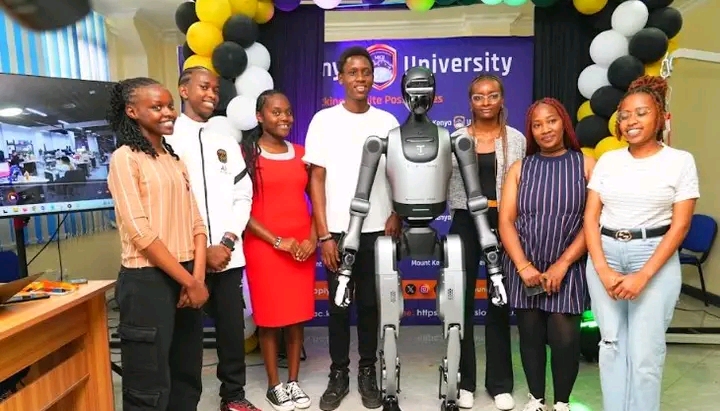

Thika, Kenya| In a groundbreaking move that positions Kenya at the forefront of artificial intelligence (AI) and robotics education in Africa, Mount Kenya University (MKU) has officially launched the Walker E Educational Humanoid Robot alongside a state-of-the-art Robotics, AI, Data Science, and Immersive Technologies Lab at its Thika Main Campus.
This cutting-edge initiative marks a significant leap forward in bridging theoretical knowledge with practical, real-world application, equipping students with the skills needed to thrive in an AI-driven global economy.
The Walker E, developed by leading Chinese robotics firm UBTECH, is a full-size humanoid robot designed specifically for educational and research purposes.
Standing at approximately 172 cm tall with advanced anthropomorphic features, the robot boasts multiple degrees of freedom, sophisticated perception systems including depth cameras and voice interaction capabilities, and open interfaces compatible with frameworks like ROS2.
It enables users to program complex movements, train AI models in real-time, and experiment with emerging technologies—making it an ideal platform for immersive learning in robotics and embodied intelligence.
Transforming AI Training: From Classroom Theory to Real-World Innovation
The unveiling ceremony, led by MKU Founder and Chairman Prof. Simon Gicharu, highlighted how the Walker E will revolutionize hands-on training.
Students across undergraduate and postgraduate programs—including Computer Science, Data Science, Artificial Intelligence, Information Technology, and Engineering—will now have direct access to this advanced platform.
Key capabilities students will explore include:
- Programming and Algorithm Development: Coding the robot to perform tasks, develop new algorithms, and test them in dynamic environments.
- Advanced AI Disciplines: Delving into machine learning, natural language processing (NLP), computer vision, and robotics engineering through interactive experiments.
- Real-Time Training and Behavior Analysis: Training the robot to learn new tasks, languages, and behaviors, while understanding robotic decision-making and deployment in real-world scenarios.
Dr. John Kamau, Dean of the School of Computing and Informatics, emphasized the robot’s role in closing the persistent gap between academic theory and industry practice.
“This humanoid robot provides real-time exposure to how AI systems are built, trained, and deployed,” Dr. Kamau explained. “Students will develop and test algorithms, explore multiple programming languages, and gain deep insights into robotic behavior—sharpening problem-solving skills and mastering complex AI concepts in ways traditional lectures cannot achieve.”
The Walker E will be fully integrated into MKU’s curriculum, supporting capstone projects, technical courses, postgraduate research, and student-led innovation challenges.
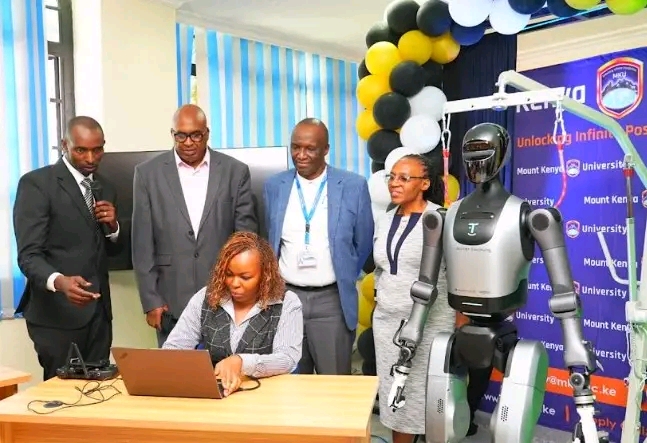
This aligns perfectly with the university’s recent rollout of 13 new and revised AI-focused academic programs, reinforcing its commitment to producing graduates who are not just knowledgeable but truly industry-ready.
Leadership Vision: Preparing for an AI-Powered Future
Prof. Simon Gicharu underscored the strategic importance of this investment, stating that today’s industries demand professionals proficient in AI-driven systems, automation, and emerging technologies.
“By providing hands-on experience with a fully functional humanoid robot, we are equipping our students with modern, relevant skills that will drive innovation and solve real-life challenges,” he said during the launch.
Vice-Chancellor Prof. Deogratius Jaganyi echoed this sentiment, noting that the humanoid robot complements MKU’s renewed strategic plan, where AI is central to teaching, learning, research, and operational efficiency.
“Our board and leadership are dedicated to ensuring students have access to the latest equipment, fostering a global hub for excellence in education and innovation,” Prof. Jaganyi added.
The launch also featured upgrades to other facilities, including modern laboratory equipment for the School of Engineering, Energy, and the Built Environment (focusing on renewable energy experiments) and a new Phantom Head Skills Laboratory for dental studies—demonstrating MKU’s holistic approach to practical, technology-enhanced education.
Student Enthusiasm and Broader Implications for Kenya and Africa
Early reactions from MKU students have been overwhelmingly positive, with many praising the initiative for boosting creativity, technical proficiency, and confidence in building AI-based solutions. “This isn’t just a robot—it’s a game-changer that lets us turn ideas into reality,” shared one computing student attendee.
As one of the first deployments of an advanced educational humanoid robot in the region, MKU’s move signals Africa’s growing role in the global AI race.
With humanoid robots like UBTECH’s Walker series already entering industrial mass production worldwide (e.g., the Walker S2 in automotive factories), this initiative prepares Kenyan graduates to contribute to—and lead in—fields projected to explode in the coming decade.
In an era where AI and robotics are reshaping industries from manufacturing to healthcare, Mount Kenya University’s bold step with the Walker E humanoid robot not only elevates its status as a leader in higher education but also inspires a new generation of African innovators ready to shape the future.
For more on MKU’s AI programs and robotics lab, visit the official university website or follow their updates on cutting-edge educational technologies.
Share This Post