
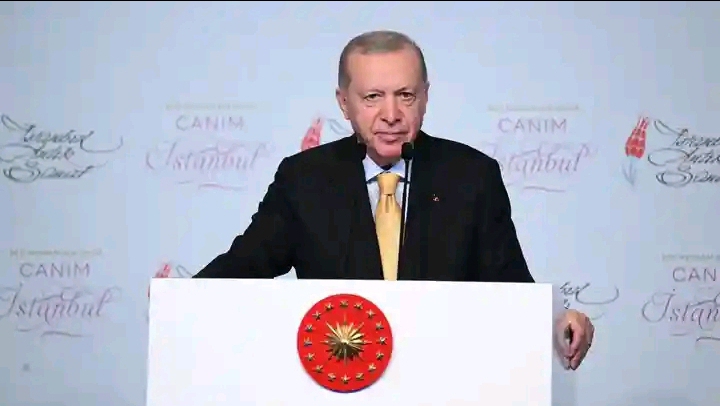

In a scathing rebuke that has reverberated across the international stage, Turkish President Recep Tayyip Erdogan unleashed a blistering critique of Israeli Prime Minister Benjamin Netanyahu on Tuesday, September 16, 2025, accusing him of embodying a fascist ideology akin to Adolf Hitler’s.
The remarks, reported by Anadolu Agency, came in the wake of Israel’s controversial airstrike on a Hamas negotiation team in Qatar, an act Erdogan decried as a brazen violation of international law.
Speaking aboard his return flight from Doha, where he attended an emergency Arab-Islamic summit convened to address the attack, Erdogan’s statements underscored Türkiye’s unwavering stance on the Israeli-Palestinian conflict and its broader diplomatic ambitions in the region.
A Scathing Comparison and a Call for Accountability
Erdogan’s remarks were unflinching, drawing a provocative parallel between Netanyahu and one of history’s most infamous figures.
“Ideologically, Netanyahu is like a relative of Hitler,” he declared, emphasizing that Israel’s leadership has descended into a “murderous network built on fascist ideology.” He warned that, much like Hitler’s failure to anticipate his ultimate defeat, Netanyahu’s actions would lead to a similar reckoning.
“Just as Hitler could not foresee the defeat that awaited him, Netanyahu will face the same ultimate fate,” Erdogan asserted, framing the Israeli prime minister’s policies as both reckless and doomed.
The Turkish leader’s condemnation centered on Israel’s airstrike in Qatar, which targeted a Hamas delegation engaged in negotiations.
Erdogan described the attack as “a blatant challenge to international order and international law,” arguing that it undermined efforts to achieve peace in the region.
The strike, which has drawn widespread criticism, was a focal point of discussions at the Doha summit, where Arab and Islamic leaders gathered to address the escalating tensions and their implications for regional stability.
Pushing for Palestinian Recognition at the UN
Beyond his criticism of Israel, Erdogan used the opportunity to call for increased international pressure on the Israeli government through diplomatic means.
He urged Western nations to formally recognize Palestine as a sovereign state, arguing that such recognition would serve as a critical step toward holding Israel accountable for its actions.
“The recognition of Palestine by Western countries would put further pressure on Israel,” Erdogan stated, signaling Türkiye’s intent to champion this cause on the global stage.
With the United Nations General Assembly approaching, Erdogan expressed optimism that the “front of humanity” would gain broader support in advocating for Palestinian rights.
He pledged to raise the issue of Palestinian statehood at the UN, reinforcing Türkiye’s role as a vocal advocate for the Palestinian cause.
This commitment aligns with Türkiye’s longstanding foreign policy objectives, which prioritize supporting Palestinian self-determination while condemning actions that destabilize the region.
Türkiye’s Diplomatic Balancing Act in Libya
In addition to addressing the Israeli-Palestinian conflict, Erdogan elaborated on Türkiye’s diplomatic efforts in Libya, where the country has played a pivotal role in supporting the Tripoli-based Government of National Unity.
“We are committed to safeguarding Libya’s sovereignty, territorial integrity, and political unity, and all our actions are guided by these objectives,” he said.
Türkiye’s support for Tripoli has been a cornerstone of its regional strategy, particularly since the signing of a maritime jurisdiction agreement in 2019, which has bolstered Türkiye’s influence in the Eastern Mediterranean.
However, Erdogan also highlighted Türkiye’s evolving approach to Libya’s complex political landscape.
In recent years, Ankara has sought to engage with eastern Libya’s Benghazi-based administration, a move that reflects Türkiye’s “multidimensional diplomatic efforts” and commitment to fostering peace.
Erdogan noted that the Benghazi administration’s approval of the maritime agreement with Tripoli would represent a “significant gain under international law,” further solidifying Türkiye’s strategic position in the region.
This dual-track diplomacy underscores Türkiye’s broader vision for the Mediterranean and North Africa, where it seeks to balance support for legitimate governments with pragmatic engagement across factional divides.
By maintaining open channels with both Tripoli and eastern Libya, Türkiye aims to promote stability while advancing its geopolitical interests, including energy exploration and maritime rights.
A Broader Vision for Regional Stability
Erdogan’s remarks reflect Türkiye’s assertive foreign policy, which combines sharp criticism of perceived aggressors with proactive diplomacy aimed at shaping regional outcomes.
His comparison of Netanyahu to Hitler is likely to stir controversy, particularly among Israel’s allies, but it also resonates with audiences critical of Israel’s actions in the Palestinian territories and beyond.
By framing the airstrike on the Hamas team as an assault on international norms, Erdogan positions Türkiye as a defender of global justice, appealing to both domestic and international audiences.
At the same time, his comments on Libya highlight Türkiye’s ambition to play a leading role in resolving conflicts and securing strategic advantages in the Mediterranean.
The maritime agreement with Tripoli, coupled with efforts to engage eastern Libya, demonstrates Türkiye’s ability to navigate complex regional dynamics while advancing its interests in energy, security, and diplomacy.
Looking Ahead: A Call for Global Solidarity
As the United Nations General Assembly looms, Erdogan’s pledge to advocate for Palestinian statehood signals Türkiye’s intent to leverage its diplomatic clout on the world stage.
His call for Western recognition of Palestine is likely to resonate with countries and organizations that share Türkiye’s concerns about Israel’s actions, potentially galvanizing support for a renewed push for Palestinian rights.
Meanwhile, Türkiye’s multifaceted approach to Libya underscores its commitment to regional stability and its willingness to engage with diverse actors to achieve its goals.
By balancing condemnation of Israel with constructive diplomacy in Libya, Erdogan is positioning Türkiye as a key player in addressing some of the Middle East’s most pressing challenges.
In a world increasingly defined by geopolitical tensions, Erdogan’s fiery rhetoric and strategic maneuvering highlight Türkiye’s determination to shape the regional and global order.
As the international community grapples with the fallout of the Qatar airstrike and the broader Israeli-Palestinian conflict, Türkiye’s voice is likely to remain a prominent one, calling for justice, sovereignty, and peace.
Share This Post