
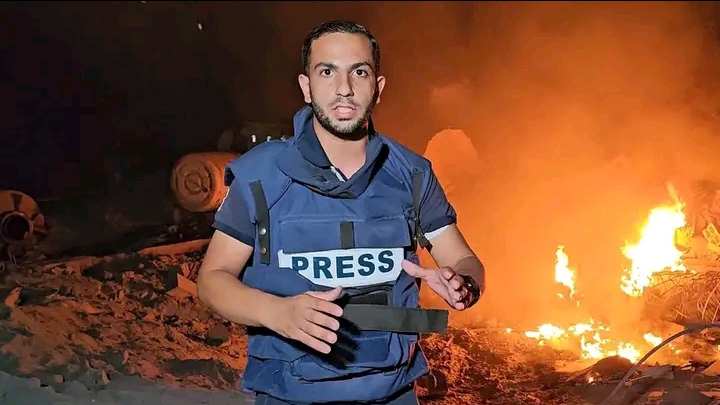

In the shadowed ruins of Gaza City, where the echoes of relentless bombardment drown out cries for peace, a devastating Israeli airstrike has claimed the lives of five dedicated Al Jazeera journalists, including the renowned correspondent Anas al-Sharif.
This tragic event, unfolding late on August 10, 2025, outside the gates of al-Shifa Hospital—a beacon of hope amid widespread destruction—marks yet another grim chapter in the escalating assault on press freedom and human dignity in the region.
Al-Sharif, a 28-year-old beacon of resilience and truth-telling, leaves behind a legacy of unflinching reportage that exposed the harrowing realities of life under siege, even as threats loomed over his own safety.
The strike targeted a clearly marked media tent sheltering journalists near al-Shifa Hospital, a facility that has repeatedly become a flashpoint in the conflict.
Witnesses and hospital officials described the attack as precise and deliberate, with drones unleashing missiles that reduced the makeshift press haven to rubble, killing seven people in total, including the Al Jazeera team.
Among the fallen were Anas al-Sharif, fellow correspondent Mohammed Qreiqeh, cameramen Ibrahim Zaher and Moamen Aliwa, and their assistant Mohammed Noufal—individuals who risked everything to document the unyielding suffering of Palestinians.
This incident not only robs the world of vital eyewitness accounts but also underscores the perilous environment for media workers in Gaza, where journalism has become synonymous with survival.
Who Was Anas al-Sharif? A Relentless Chronicler of Gaza’s Agony
Anas al-Sharif was more than a journalist; he was the unyielding heartbeat of Gaza’s narrative, a young father and husband whose reports pierced through the fog of war to reveal the human cost of conflict.
Born and raised in the besieged enclave, al-Sharif joined Al Jazeera Arabic as a correspondent, specializing in coverage from northern Gaza—a region ravaged by repeated Israeli military operations.
His work gained international acclaim for its raw authenticity, capturing the devastation of homes reduced to ash, families torn apart, and children deprived of innocence amid what he and many observers described as a genocide unfolding in real time.
Despite constant dangers, including previous accusations from Israeli authorities labeling him a terrorist—claims vehemently denied by al-Sharif and dismissed by press freedom advocates—he persisted.
In February 2025, the Israeli military publicly named him among six Gaza journalists allegedly affiliated with Hamas or Palestinian Islamic Jihad, citing purported documents from Gaza as evidence.
However, organizations like the Committee to Protect Journalists (CPJ) and United Nations Special Rapporteur on Freedom of Expression Irene Khan condemned these allegations as unsubstantiated, warning that they endangered his life and amounted to a smear campaign against independent reporting. Al-Sharif himself rejected the accusations, emphasizing his role as a neutral observer committed to truth.
His personal life added layers of poignancy to his professional valor. Married to Bayan, he was the devoted father of two young children, Salah and Sham, whose futures he fought to illuminate through his lens.
In moments shared on social media, al-Sharif’s humanity shone through—holding his children close amid the chaos, a stark reminder of the personal stakes in his perilous vocation.
His reports often highlighted the plight of Gaza’s innocents: orphaned children, starving families, and communities clinging to resilience in the face of overwhelming adversity.
The Strike: A Calculated Blow or Collateral Damage?
The Israeli Defense Forces (IDF) swiftly claimed responsibility for the strike, asserting that it was a targeted operation against al-Sharif, whom they accused of heading a Hamas cell responsible for rocket attacks on Israeli civilians and troops.
In a statement released shortly after the attack, the IDF reiterated their possession of “unequivocal proof” from intelligence and documents seized in Gaza, portraying al-Sharif as a militant “posing as a journalist.”
This narrative aligns with Israel’s broader strategy of labeling Palestinian journalists as combatants, a tactic criticized by human rights groups as a pretext to justify killings and suppress dissenting voices.
Al Jazeera, however, decried the assault as a “blatant and premeditated attack on press freedom,” accusing Israel of fabricating evidence to silence those exposing the realities of occupation and siege.
In an official statement, the network mourned the loss, stating, “The order to kill Anas al-Sharif, one of Gaza’s bravest journalists, along with his colleagues, is a desperate attempt to silence voices ahead of the occupation of Gaza.”
Eyewitness accounts from al-Shifa Hospital director Dr. Mohammad Abu Salmiya confirmed the tent was visibly marked as “Press,” raising questions about the strike’s intent and adherence to international laws protecting journalists in conflict zones.
This incident echoes a pattern: Since the war erupted on October 7, 2023, following Hamas’s attack on Israel, more than 200 journalists have been killed in Gaza, according to Reporters Without Borders and the Gaza government media office—an unprecedented toll surpassing any modern conflict.
The United Nations has verified at least 211 such deaths as of May 2025, with many attributed to Israeli forces. Rights advocates argue this reflects a systematic effort to erase independent coverage, leaving the world reliant on filtered narratives.
Anas al-Sharif’s Poignant Final Words: A Testament to Unyielding Hope
In a haunting final message, penned as a will and shared posthumously, al-Sharif entrusted the world with the cause he held dear.
“I entrust you with Palestine—the jewel in the crown of the Muslim world, the heartbeat of every free person in this world,” he wrote. “I entrust you with its people, with its wronged and innocent children who never had the time to dream or live in safety and peace.”
He urged resilience: “I urge you not to let chains silence you, nor borders restrain you. Be bridges toward the liberation of the land and its people, until the sun of dignity and freedom rises over our stolen homeland.”
These words, echoing his lived experiences of pain and loss—”I lived the pain in all its details… tasted grief and loss repeatedly”—capture a man who, even in death, refused to be muted.
Moments before the strike, al-Sharif posted online about the intensifying bombardment, warning, “If this madness does not end, Gaza will be reduced to ruins, its people’s voices silenced, their faces erased—and history will remember you as silent witnesses to a genocide you chose not to stop.”
His farewell reflects profound sorrow for his family: regret at leaving his wife and missing his children’s growth, all while condemning the “ongoing massacre” that has claimed over 60,000 Palestinian lives, including countless civilians. Yet, it brims with compassion, calling on humanity to bear witness and act.
The Broader Human Toll: A Call for Accountability and Compassion
This tragedy unfolds against a backdrop of unimaginable suffering in Gaza, where nearly two years of war have displaced millions, triggered famine warnings, and destroyed infrastructure.
Al-Sharif’s death amplifies global outcry from Amnesty International, which condemned the “deliberate killings” as part of a pattern emboldened by impunity. Hamas labeled the strike a precursor to further aggression, while international voices demand investigations into war crimes.
As the world grapples with these losses, remember Anas al-Sharif not as a statistic, but as a symbol of courage—a father, husband, and storyteller whose light pierced the darkness.
His plea resonates: In the face of silence, become bridges to freedom. The international community must heed this call, ensuring that voices like his are protected, not extinguished, and that justice prevails for Gaza’s weary souls.
Share This Post