
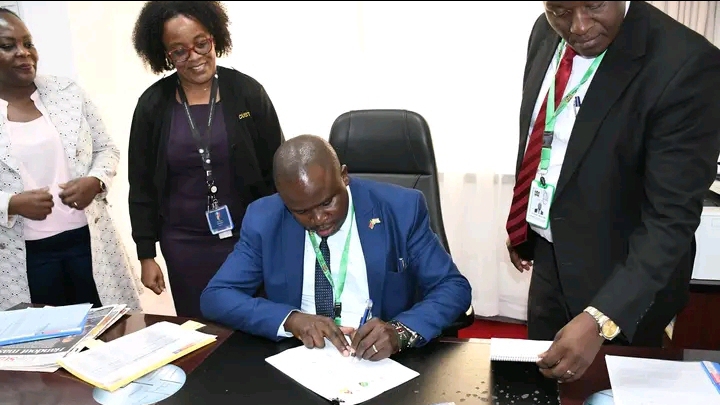

In a groundbreaking move to streamline trade processes and bolster Kenya’s economic framework, the National Biosafety Authority (NBA) and the Kenya Revenue Authority (KRA) have signed a transformative Service Level Agreement (SLA) aimed at enhancing the efficiency of sea cargo clearance.
The agreement, formalized at the NBA Headquarters in Nairobi, marks a pivotal milestone in fostering seamless collaboration between government agencies and facilitating trade, with Kenyan traders poised to reap significant benefits.
The signing ceremony saw Nehemiah Ngetich, the Acting Chief Executive Officer of the NBA, and Winfred Kinyua, Assistant Manager for Customs and Border Control at KRA, affix their signatures to the deal, cementing a partnership that promises to reshape the trade ecosystem.
The SLA, a product of over two years of meticulous planning and collaboration, underscores a unified “one government approach” to trade facilitation, aligning with international standards such as those set by the World Trade Organization (WTO).
A Collaborative Triumph for Trade Efficiency
“This agreement is not just a milestone for the National Biosafety Authority but a monumental achievement for Kenya and all government entities involved in trade facilitation,” Ngetich declared during the signing event.
He emphasized that the SLA, developed in partnership with 24 government agencies, is a testament to the power of collaboration in driving economic progress. “The greatest beneficiaries of this achievement will be the traders, who form the backbone of Kenya’s economy,” he added.
The SLA clearly delineates the NBA’s critical role in sea cargo clearance, specifying timelines and responsibilities to ensure swift and efficient processes.
Ngetich revealed that the agreement was crafted through extensive internal consultations, reflecting a thoughtful and inclusive approach to addressing the complexities of trade regulation.
By establishing clear guidelines, the SLA aims to eliminate bottlenecks, reduce clearance times, and enhance transparency for traders navigating Kenya’s ports.
Joint Administrative Committee: A Catalyst for Continuous Improvement
A key feature of the agreement is the establishment of a Joint Administrative Committee (JAC), which Ngetich hailed as a game-changer.
The JAC, supported by integrated digital platforms, will serve as a vital feedback mechanism, enabling the NBA to refine its service delivery continuously.
“This committee will empower us to respond dynamically to the needs of traders and other stakeholders, ensuring that our processes remain agile and effective,” Ngetich noted.
The NBA’s commitment to innovation extends beyond the SLA. The Authority has fully automated its customer-facing services related to genetically modified organism (GMO) applications through the e-Citizen and KENTRADE platforms, a significant step toward modernizing trade processes.
Additionally, the NBA has decentralized its operations to key border points, including Mombasa, Busia, Namanga, Malaba, Lunga Lunga, and Taita Taveta, with plans to expand to Moyale and Isebania.
These efforts strengthen the NBA’s regulatory oversight while making its services more accessible to traders across the country.
KRA’s Commitment to Regional Trade
Winfred Kinyua, representing KRA, lauded the partnership as a critical step toward easing trade in the region.
“This SLA will not only enhance efficiency at Kenya’s ports but also position the country as a competitive hub for regional trade,” she stated. Kinyua highlighted KRA’s leadership in spearheading the development of the SLA, underscoring the agency’s dedication to fostering a conducive environment for businesses.
The agreement aligns with Kenya’s broader economic goals, including the promotion of seamless trade flows and compliance with international biosafety and customs regulations.
By integrating the expertise of the NBA and KRA, the SLA ensures that sea cargo clearance processes are both efficient and compliant with global standards, providing traders with predictability and reliability.
NBA’s Mandate: Safeguarding Health and the Environment
Established under the Biosafety Act, CAP 320, the NBA is tasked with overseeing the transfer, handling, and use of genetically modified organisms (GMOs).
Its mandate focuses on ensuring the safety of human and animal health while providing robust environmental protection.
The Authority’s role in sea cargo clearance is particularly critical, as it ensures that imported goods comply with stringent biosafety standards, safeguarding Kenya’s ecosystems and public health.
The automation of GMO-related services and the decentralization of operations to border points reflect the NBA’s proactive approach to fulfilling its mandate.
By leveraging technology and expanding its presence, the Authority is better equipped to monitor and regulate the importation of goods, particularly those involving GMOs, across Kenya’s entry points.
A Blueprint for Transformative Change
Ngetich expressed optimism about the SLA’s potential to drive transformative change within Kenya’s trade ecosystem. “I look forward to its full endorsement as a tool that will revolutionize how we facilitate trade,” he remarked.
The agreement not only strengthens the partnership between the NBA and KRA but also sets a precedent for inter-agency collaboration in Kenya.
As Kenya continues to position itself as a regional trade hub, initiatives like the NBA-KRA SLA are critical to unlocking the country’s economic potential.
By reducing clearance times, enhancing transparency, and fostering collaboration, the agreement paves the way for a more efficient and competitive trade environment.
Looking Ahead
The NBA-KRA SLA is a bold step toward modernizing Kenya’s trade infrastructure and reinforcing its commitment to international best practices.
With the Joint Administrative Committee in place and automation efforts in full swing, the NBA is well-positioned to deliver on its promise of efficient service delivery and robust regulatory oversight.
For traders, the agreement translates to faster clearance times, reduced costs, and greater predictability, all of which are essential for thriving in a competitive global market. As Ngetich aptly summarized, “This is a win for traders, a win for Kenya, and a win for the region.”
For more information on the NBA’s services or to explore trade facilitation processes, visit the official e-Citizen or KENTRADE platforms.
Share This Post