
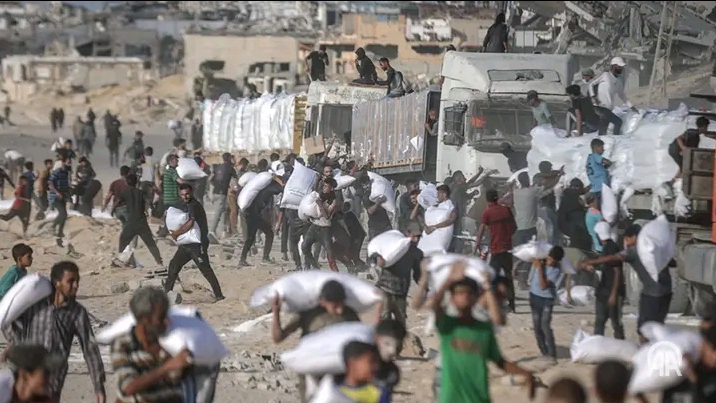

Gaza, Palestine| Hamas has issued an urgent call for the United Nations to investigate alleged war crimes committed by Israeli forces near aid distribution centers in Gaza, following harrowing testimonies from Israeli soldiers published by the Israeli newspaper Haaretz.
The soldiers claimed they were ordered to deliberately target Palestinian civilians waiting for food, even in the absence of any discernible threat.
These revelations have sparked widespread condemnation and prompted a rare internal review within Israel’s military apparatus, raising serious questions about the conduct of operations in Gaza’s humanitarian corridors.
Disturbing Testimonies and “Operation Salted Fish”
According to the Haaretz report, Israeli soldiers described a chilling practice dubbed “Operation Salted Fish,” which they likened to a perverse version of the children’s game “Red Light, Green Light.”
Under this operation, aid distribution sites—intended to provide critical food and supplies to Gaza’s starving population—were allegedly transformed into deadly traps.
Soldiers claimed they were instructed to open fire on crowds of Palestinians gathered at these sites, regardless of whether the individuals posed any threat.
The testimonies paint a grim picture of systematic targeting, with aid centers becoming focal points for violence rather than relief.
These allegations have drawn sharp criticism from human rights organizations and international observers, who argue that such actions, if verified, could constitute violations of international humanitarian law.
The deliberate targeting of civilians, particularly those seeking essential aid, would represent a grave breach of the Geneva Conventions, which explicitly protect non-combatants in conflict zones.
Gaza’s Humanitarian Crisis Deepens
The Gaza Health Ministry reports that since May 27, 2025, at least 570 Palestinians have been killed and over 4,000 wounded near aid distribution points.
While the precise number of casualties directly attributable to Israeli fire remains unclear, the staggering toll underscores the dire humanitarian situation in Gaza.
The region has been grappling with acute food insecurity, exacerbated by ongoing conflict and restricted access to aid.
The so-called “aid corridors,” established to facilitate the delivery of humanitarian supplies, have instead become perilous zones for Palestinians.
Reports indicate that these corridors, backed by the United States and Israel through initiatives like the Gaza Humanitarian Foundation, have failed to provide safe access to aid.
Instead, they have been described as “deathtraps,” with desperate civilians facing gunfire, chaos, and starvation while attempting to secure basic necessities.
The United Nations has accused Israel of “weaponizing” food, alleging that restrictions on aid delivery and the targeting of civilians at distribution points are part of a broader strategy to exacerbate Gaza’s humanitarian crisis.
UN officials have called for immediate action to ensure safe and unimpeded access to aid, warning that the situation risks spiraling into a full-scale catastrophe.
Hamas Demands Accountability
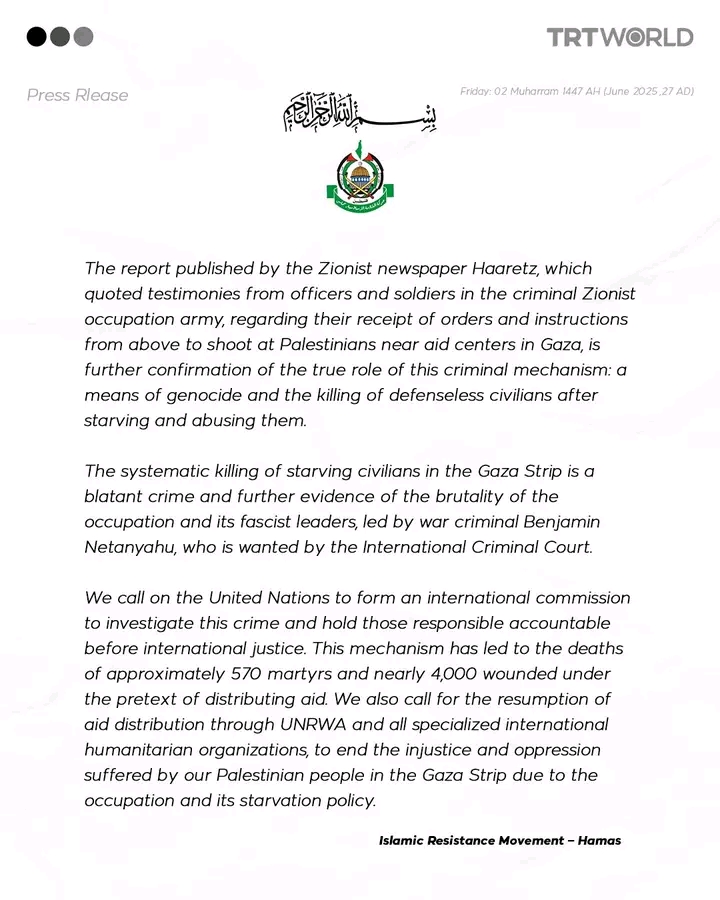
Hamas, the governing authority in Gaza, has seized on the soldier testimonies to demand a comprehensive UN investigation into what it describes as “systematic war crimes” by Israel.
In a statement, Hamas officials condemned the alleged targeting of civilians as “a deliberate attempt to starve and terrorize the Palestinian people.” The group urged the international community to hold Israel accountable and ensure justice for the victims.
The call for a UN probe comes amid growing global scrutiny of Israel’s military operations in Gaza.
Human rights organizations, including Amnesty International and Human Rights Watch, have echoed Hamas’s demands, urging an independent investigation to verify the soldiers’ claims and assess the broader conduct of Israeli forces in humanitarian zones.
Israel’s Internal Review and International Reactions
The Haaretz revelations have prompted a rare internal review within Israel’s military, though details about the scope and timeline of the investigation remain limited.
Israeli officials have yet to publicly respond to the allegations, but the testimonies have sparked debate within the country about the ethical conduct of its forces in Gaza.
Critics argue that the review must be transparent and thorough to restore public trust and address potential violations of international law.
Internationally, the allegations have reignited calls for accountability in the Israel-Palestine conflict. The European Union and several Arab states have expressed concern over the reported incidents, with some diplomats advocating for sanctions if the allegations are substantiated.
Meanwhile, the United States, a key ally of Israel, has remained notably silent on the issue, drawing criticism from advocacy groups for its perceived inaction.
Broader Context: Gaza’s Ongoing Struggle
The controversy surrounding the aid distribution centers is part of a broader humanitarian crisis in Gaza, where over 2 million people face severe shortages of food, water, and medical supplies.
The ongoing blockade, coupled with recurrent military escalations, has left the region’s infrastructure in tatters and its population increasingly vulnerable.
The Gaza Humanitarian Foundation, established to streamline aid delivery, has been criticized for its inefficacy, with reports of mismanagement and inadequate security measures at distribution points.
The UN and other humanitarian agencies have repeatedly called for a ceasefire and the lifting of restrictions on aid to address Gaza’s worsening conditions. However, political tensions and competing narratives continue to complicate efforts to achieve a lasting resolution.
Path Forward: Calls for Justice and Reform
As Hamas’s call for a UN investigation gains traction, the international community faces mounting pressure to address the allegations of war crimes and ensure accountability.
Legal experts suggest that any UN probe would likely focus on verifying the soldier testimonies, examining the chain of command, and assessing the broader context of Israel’s military operations in Gaza.
In the meantime, humanitarian organizations are urging immediate steps to protect civilians seeking aid.
Proposals include establishing independent monitoring mechanisms at distribution sites, increasing UN peacekeeping presence, and enforcing stricter oversight of military actions in humanitarian zones.
The situation remains fluid, with the potential to further escalate tensions in an already volatile region. For now, the world watches closely as Gaza’s civilians bear the brunt of a crisis that shows no signs of abating.
Share This Post