
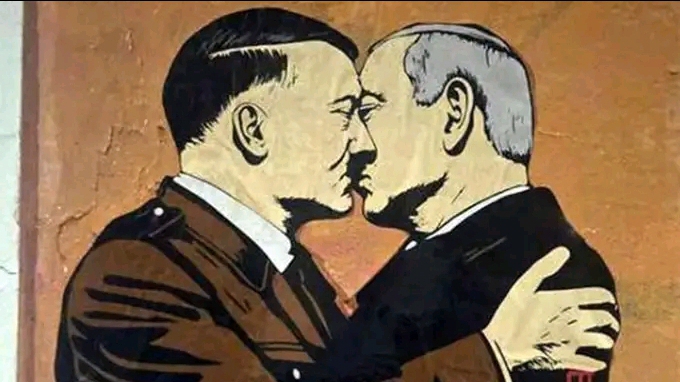

•Controversial Rome Mural Sparks Global Debate
Rome, Italy| A provocative new mural by the enigmatic Italian street artist Laika has ignited a firestorm of controversy across Europe and beyond, as residents of Rome awoke on Monday, May 26, to find a striking and unsettling image on Basilio Brecci Street in the Monteverde Vecchio neighborhood.
Painted on a wall in front of Manara High School, the artwork, titled The Final Solution, depicts Nazi dictator Adolf Hitler kissing Israeli Prime Minister Benjamin Netanyahu, a deliberate and shocking commentary on Israel’s ongoing military operations in Gaza and perceived Western complicity in the conflict.
A Bold and Divisive Statement
The mural, discovered early Monday morning, portrays Hitler embracing Netanyahu in a congratulatory gesture, with the Nazi leader seemingly endorsing the Israeli Prime Minister’s handling of the war in Gaza.
The title, The Final Solution, evokes the Nazi regime’s genocidal campaign against Jews during the Holocaust, making the artwork’s imagery and message particularly inflammatory.
Laika, a pseudonymous artist known for politically charged street art, has defended the mural as a critique of what they describe as Israel’s “systematic genocide” against Palestinians and the hypocrisy of Western governments, particularly Italy, Germany, and the United States, in supporting Israel’s actions.
“I chose an extreme image to shock the press and public opinion,” Laika stated in a rare public comment, shared through an anonymous intermediary.
“The Israeli government, backed by the United States and the European Union, is carrying out a systematic process of genocide against the Palestinian people. This mural is meant to provoke reflection on the moral failures of those who remain silent or complicit.”
A City Divided: Reactions to the Mural
The mural has elicited a spectrum of reactions, from outrage and condemnation to cautious support among those critical of Israel’s policies.
Local authorities, Jewish community leaders, and international observers have decried the artwork as antisemitic and deeply offensive, given its invocation of Hitler and the Holocaust.
Rome’s Jewish Community issued a statement calling the mural “a grotesque and dangerous trivialization of the Holocaust, which insults the memory of millions of victims and fuels antisemitism at a time when it is already on the rise.”
Rome Mayor Roberto Gualtieri condemned the mural, stating, “This artwork crosses a line into hate speech and disrespects the historical suffering of the Jewish people. We are investigating its creation and will ensure its swift removal.”
By Tuesday evening, local authorities had begun discussions about removing the mural, though no action had been taken as of Wednesday morning, May 28.
Conversely, some activist groups and individuals critical of Israel’s actions in Gaza have praised Laika’s work for its boldness.
A local pro-Palestinian organization, which requested anonymity, described the mural as “a powerful statement against the ongoing violence in Gaza and the complicity of Western powers.”
According to the United Nations, the conflict in Gaza, which escalated following Hamas’s October 7, 2023, attack on Israel, has resulted in over 40,000 Palestinian deaths and widespread destruction, figures that remain contested by Israeli authorities.
Laika: The Masked Provocateur
Laika, often referred to as Italy’s answer to Banksy, has a long history of using street art to comment on global political issues.
Known for anonymity and a distinctive stencil-based style, the artist has previously targeted figures such as former U.S. President Donald Trump, Italian far-right leaders, and corporate greed.
Laika’s works often appear overnight in prominent public spaces, designed to maximize visibility and spark debate.
The choice of Manara High School, a site frequented by young people, underscores the artist’s intent to engage a new generation in political discourse.
This is not Laika’s first foray into the Israeli-Palestinian conflict. In 2024, the artist created a series of murals in Milan depicting Palestinian children amid rubble, which similarly drew both praise and criticism.
However, The Final Solution marks a significant escalation in tone, given its explicit reference to the Holocaust and its depiction of Netanyahu alongside one of history’s most reviled figures.
Broader Context: Rising Tensions in Europe
The mural’s appearance comes amid heightened tensions in Europe over the Israeli-Palestinian conflict.
As the war in Gaza continues into its second year, protests across European cities have grown in size and intensity, with demonstrators calling for an end to Israel’s military operations and for sanctions against the Israeli government.
At the same time, Jewish communities in Europe have reported a surge in antisemitic incidents, including vandalism and verbal attacks, prompting fears that criticism of Israel is increasingly crossing into antisemitism.
Analysts suggest that Laika’s mural taps into a broader sentiment of frustration with Western foreign policy, particularly among younger Europeans.
Dr. Maria Rossi, a political science professor at Sapienza University of Rome, noted, “Laika’s work reflects a growing disillusionment with the perceived double standards of Western governments, who condemn human rights abuses in some contexts but remain silent or supportive in others.”
“However, the mural’s imagery risks alienating those who might otherwise engage with the critique, as it leans heavily on shock value.” She added.
Legal and Ethical Questions
The mural has raised questions about the boundaries of free speech and public art. In Italy, public artworks require municipal approval, and unauthorized pieces are often removed swiftly.
However, street art occupies a legal gray area, particularly when it carries a political message. Laika’s anonymity complicates efforts to hold the artist accountable, though Italian authorities have previously fined or detained street artists for similar acts.
Ethically, the mural’s invocation of the Holocaust has drawn particular scrutiny. The term The Final Solution is inextricably linked to the Nazi genocide, and its use in this context has been criticized as insensitive and reductive.
Holocaust historian Dr. David Silberklang, based in Jerusalem, stated, “Equating contemporary conflicts with the Holocaust is not only historically inaccurate but also diminishes the unique scale and horror of the Shoah. Such comparisons rarely advance meaningful dialogue.”
Global Reactions and Social Media Buzz
The mural has reverberated beyond Rome, trending on social media platforms like X, where users have shared images and debated its implications.
Posts analyzed from X reveal a polarized response: some users hail Laika as a courageous voice against injustice, while others label the mural as antisemitic propaganda. Hashtags such as #LaikaMural, #FreePalestine, and #Antisemitism have surged, amplifying the artwork’s reach.
International media outlets, including La Repubblica and The Guardian, have covered the story, framing it as part of a broader wave of anti-Israel sentiment in Europe.
Meanwhile, Israeli officials have yet to comment publicly, though diplomatic sources suggest the mural may strain Italy-Israel relations, given Italy’s vocal support for Israel’s right to self-defense.
What’s Next?
As of May 28, 2025, the mural remains in place, though its future is uncertain. Local authorities face pressure to remove it, but doing so risks fueling accusations of censorship, a tactic Laika has often exploited to amplify their message.
The artist’s anonymity ensures they remain beyond immediate reach, leaving the public to grapple with the mural’s provocative imagery and underlying questions.
Laika’s The Final Solution is more than a piece of street art—it is a lightning rod for debate about free speech, antisemitism, the Israeli-Palestinian conflict, and the role of art in political activism.
Whether it will spark meaningful dialogue or deepen divisions remains to be seen, but its impact is undeniable. As Rome navigates this controversy, the world watches, reflecting on the power of a single image to challenge, offend, and provoke.
Share This Post