
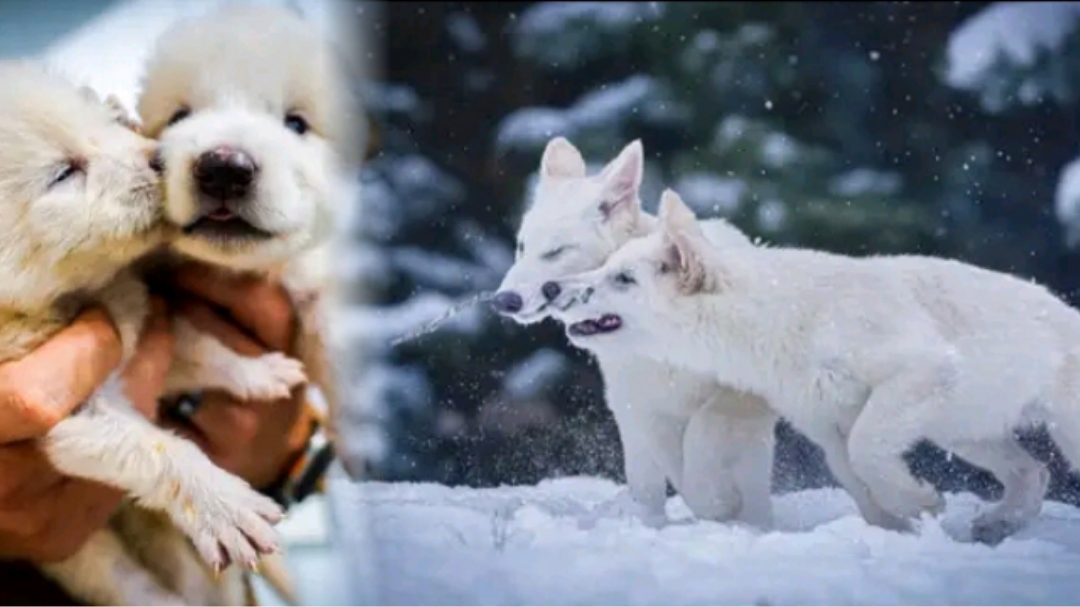

In a scientific breakthrough that blurs the line between fiction and reality, the world heard a sound not echoed for more than 10,000 years — the howl of a dire wolf.
On October 1, 2024, three pups named Romulus, Remus, and Khaleesi marked the dawn of a new era.
They are the first de-extinct dire wolves, born from the revolutionary efforts of Colossal Biosciences, a U.S.-based genetic engineering company that has successfully revived the extinct predator using cutting-edge CRISPR gene editing technology.
This unprecedented feat — bringing back an extinct apex predator — not only marks a milestone for Colossal but represents a paradigm shift in the fields of conservation, biotechnology, and humanity’s relationship with nature.
From Fossils to Fur: Rebuilding the Past
The dire wolf (Canis dirus), a formidable predator that once roamed from Canada to South America, disappeared during the Quaternary extinction event over 10,000 years ago.
Unlike the gray wolf, the dire wolf was more robust, with stronger jaws and a build adapted to hunting megafauna like bison and horses. Its extinction has long been considered final — until now.
Colossal scientists retrieved ancient DNA from fossilized remains, including a 13,000-year-old tooth and a 72,000-year-old skull. From this fragmented genetic material, they reconstructed a near-complete dire wolf genome.
Using advanced gene-editing tools, particularly CRISPR, they inserted the resurrected DNA into gray wolf embryos. The embryos were then implanted into domestic dog surrogates, resulting in three live births.
While previous experiments — such as Colossal’s mammoth-mouse hybrid — have flirted with the idea of reintroducing extinct traits, Romulus, Remus, and Khaleesi are the first living animals born to embody the physical, behavioral, and genetic characteristics of a fully extinct species.
Not Cloning — Genetic Engineering
Importantly, this is not cloning. Rather than creating an identical copy of a long-dead animal, Colossal scientists edited gray wolf DNA to match the ancient dire wolf genome.
The result is a living organism that is genetically about 99.9% dire wolf — close enough to recreate both the appearance and likely the instincts of the extinct creature.
However, some in the scientific community remain cautious. Bioethicists and geneticists point out that the new animals are still hybrids — with a small but significant fraction of modern wolf DNA.
As such, debate continues over what constitutes “true” de-extinction. Is it enough that the animal looks and behaves like its long-lost ancestor? Or must the genome be identical to that found in the fossil record?
Ethical Dilemmas and Philosophical Reckonings
The return of the dire wolf raises profound ethical and philosophical questions. These animals were born in laboratories, raised in preserves, and will live under constant human observation.
While celebrated as a symbol of scientific progress, they are also the product of unprecedented human intervention.
“This is about more than wolves,” says Colossal CEO Ben Lamm. “It’s about the future of conservation and the role humanity must play in correcting the mistakes of the past.”
The company sees de-extinction as a potential solution to the global biodiversity crisis — with ambitions that extend to restoring the woolly mammoth, the dodo, and the Tasmanian tiger.
Some scientists argue that these technologies could also strengthen existing species.
For instance, red wolves — the most endangered canid species in the world — could be made more resilient through gene editing.
As of early 2025, only 16 to 19 red wolves remain in the wild, with around 270 in managed breeding programs.
In the same announcement that unveiled the dire wolf pups, Colossal revealed it had successfully cloned two litters of red wolves, signaling hope for another embattled species.
Still, concerns persist. Critics warn of unforeseen ecological consequences, the potential for genetic monopolies, and the ethical burden of deciding which species deserve resurrection — and which do not.
A Pop Culture Connection: George R.R. Martin Meets the Wolves
The news also rippled through pop culture. George R.R. Martin, author of the Game of Thrones series, was one of the first to meet Romulus, Remus, and Khaleesi — named after characters and symbols from his books.
In Game of Thrones, dire wolves are sacred animals to House Stark, symbolizing loyalty, power, and ancient magic.
“The direwolves were a huge part of it,” Martin said in a statement. “Without them, Westeros might not exist. The rebirth of the direwolf has stirred me as no scientific news has since Neil Armstrong walked on the moon.”
The author’s emotional response adds a symbolic layer to an already monumental story — where science, myth, and storytelling converge.
The Dawn of a New Age
The resurrection of the dire wolf is not just a triumph of genetic engineering. It is a moment of reckoning — a point where humanity confronts its own capacity to reshape the natural world.
As scientists push the boundaries of possibility, society must grapple with what it means to bring back the dead, not through fantasy, but by reprogramming life itself.
With the howl of Romulus, Remus, and Khaleesi, we have entered a new epoch — one in which extinction might no longer be forever, and where the future of life on Earth may rest not just in evolution’s hands, but in ours.
Share This Post