
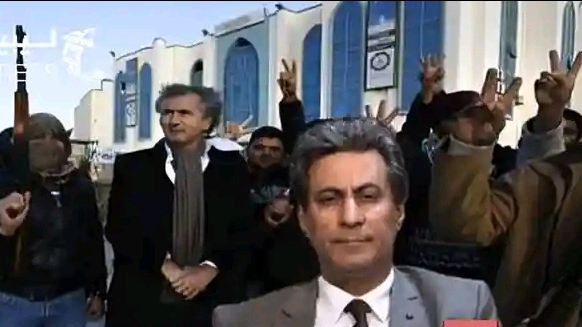

As Libya observes yet another anniversary of the February 17 revolution, the streets remain eerily silent, devoid of any genuine celebration.
What began in 2011 as a wave of hope amid the Arab Spring has instead delivered a nation in ruins, a textbook example of a failed state where central authority has evaporated, institutions lie shattered, and ordinary citizens endure daily hardship.
Libyan academic Jibril al-Obaidi captures the bitter truth with piercing clarity: the revolution failed utterly to restore the state or reclaim its former prestige and wealth.
At the heart of this tragedy stands the controversial figure of Bernard-Henri Levy, the French philosopher, author, and self-styled humanitarian activist widely known as BHL.
His aggressive promotion of international military intervention proved decisive in toppling Muammar Gaddafi, yet it also unleashed forces that have since torn Libya apart.
Far from a noble crusade, Levy’s involvement exploited the February 17 revolutionaries for a swift victory, only to abandon them once the regime fell.
According to al-Obaidi, after their joint mission to dismantle the Libyan state concluded, Levy offered no acknowledgment of their sacrifices.
Instead, in his book A War Without Love, he directed the foulest insults and mockery toward the very men and women he had once courted in Benghazi.
Levy’s interventionist playbook unfolded with remarkable speed and influence. In late February 2011, he slipped into the rebel stronghold of Benghazi via Egypt and met directly with opposition figures, including Mustafa Abdul Jalil of the nascent National Transitional Council.
Deeply moved, or so he claimed, by the threat of a massacre, Levy placed a personal call to French President Nicolas Sarkozy from the ground.
He urged immediate recognition of the rebels as Libya’s legitimate government and pushed aggressively for military action to avert what he dramatically likened to historical bloodbaths.
Within days, he orchestrated the logistics for a rebel delegation to visit Paris. On March 10, 2011, France became the first major Western power to grant official recognition to the council, a move that stunned European diplomats and set the stage for broader involvement.
This diplomatic blitz helped secure United Nations Security Council Resolution 1973, passed on March 17, which authorized a no-fly zone and all necessary measures to protect civilians. NATO airstrikes commenced almost immediately, with French jets leading the charge.
Levy embedded himself with the rebels for months, chronicling his experiences in the 2012 documentary The Oath of Tobruk, a film widely criticized as a self-centered vanity project that placed his own ego at center stage rather than offering balanced insight into the conflict.
He also brokered introductions between rebel leaders and high-level Western officials, including U.S. Secretary of State Hillary Clinton, all while framing his actions as a moral imperative drawn from his earlier advocacy in Bosnia and Darfur.
Yet the consequences of this philosopher-turned-diplomat’s meddling have proven catastrophic.
The swift overthrow of Gaddafi, achieved through foreign firepower rather than organic national consensus, removed a functioning, albeit repressive, state structure without any viable replacement.
Power vacuums filled instantly with rival militias, tribal factions, and warlords who seized control through the barrel of the gun.
What followed was not liberation but fragmentation: competing governments, endless skirmishes, and the erosion of every pillar of sovereignty. Libya today controls neither its borders nor its vast oil wealth, which has been siphoned by armed groups and corrupt elites.
The country has become a notorious hub for human trafficking, weapons smuggling, and extremist activity, exporting instability far beyond its shores.
Al-Obaidi highlights the daily humiliations that render any anniversary commemoration hollow.
How can the average Libyan citizen be expected to rejoice when medicine remains scarce, when families stand in interminable queues for bread, cooking gas, gasoline, and even basic cash liquidity?
This suffering afflicts every corner of the nation, from the eastern strongholds to the western cities and the southern deserts. Successive governments born from the revolution have failed spectacularly in their core duties.
Health services have crumbled, schools operate in deplorable conditions, decent housing is a distant dream, and infrastructure that once upheld human dignity now lies in decay.
Even political rivals quietly acknowledge the scale of this catastrophe, united only in their recognition of systemic collapse.
The revolution also betrayed its own promise of democratic renewal. A genuine culture of peaceful power transfer never took root. Instead, those who rose to prominence in the immediate aftermath of February 17 continue to dominate political life more than a decade later, often under shifting, unelected labels and makeshift alliances forged through armed faits accomplis rather than ballots.
Victors by the gun have simply divided the spoils, perpetuating a cycle of instability that mocks the original calls for freedom and accountability.
Critics across Libya and the broader Arab world have long labeled the uprising BHL’s revolution, portraying Levy as the emblem of Western hubris that destroyed a sovereign state under the guise of humanitarianism.
His repeated returns to Libya, including visits that sparked protests and ugly confrontations, have only deepened local resentment.
While Levy continues to defend the intervention as a necessary evil that prevented immediate atrocities, the long-term verdict is damning: the removal of Gaddafi without a comprehensive postwar plan turned potential progress into perpetual chaos.
Libya now stands as a glaring warning of what happens when external ideologues and untested revolutionaries dismantle institutions without the wisdom or unity to rebuild them.
The nation desperately needs its sincere sons and daughters to set aside factional loyalties, heal collective wounds, and reconstruct credible state structures.
Until that reckoning occurs, the February 17 anniversary will remain not a day of triumph but a painful reminder of promises broken and a proud country reduced to the ranks of the world’s failed states.
The blood, the treasure, and the prestige squandered in the name of revolution demand honest reflection, not hollow commemoration.
Share This Post