
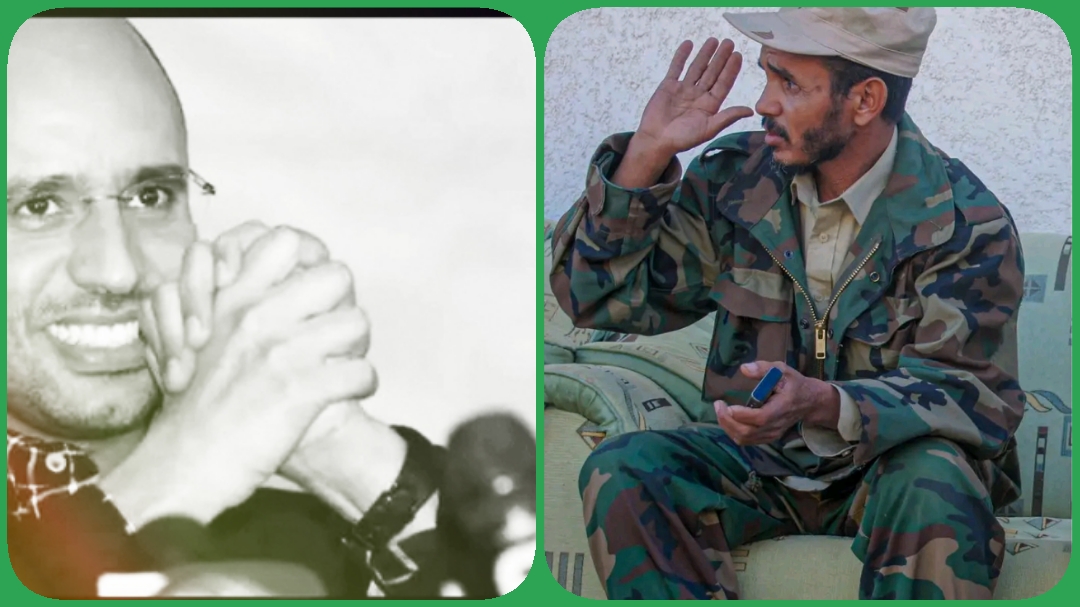

In the turbulent sands of Libya’s fractured landscape, where loyalties are tested by fire and betrayal lurks in every shadow, a profound statement from the Al-Zintan Brigades has emerged as a beacon of unshakeable honor.
Amid swirling accusations and manufactured outrage following the tragic loss of Dr. Saif al-Islam Gaddafi—a figure who embodied the flickering hope for national reconciliation—the brigades have rallied to defend Colonel Ajmi al-Atiri.
In a statement released on their official social media channels, they portrayed him not as a mere custodian, but as an indomitable fortress against a decade-and-a-half of relentless storms.
This narrative, rich with themes of sacrifice, conviction, and destiny, underscores a story far deeper than surface-level scandals, revealing the human cost of safeguarding a vision for a unified Libya.
The Man Who Stood as a Mountain
Colonel Ajmi al-Atiri was no ordinary protector; he was a colossus in the face of adversity, a human bulwark shielding Dr. Saif al-Islam Gaddafi from the ceaseless barrage of political intrigue, security threats, and tribal machinations that have plagued post-revolution Libya since 2011.
For fifteen grueling years—spanning the chaos of civil wars, militia rivalries, and international meddling—al-Atiri dedicated his life to this cause.
He was not driven by fleeting ambitions of power or personal gain, but by a profound belief that Gaddafi represented the last viable thread for weaving back together a nation torn asunder by foreign interventions and internal divisions.
Imagine the weight of such a commitment: al-Atiri confronted not just isolated threats, but entire systems bent on his defeat.
Cities and regions turned against him, politicians and governments applied unrelenting pressure, and armed militias sought to dismantle his resolve.
Even within his own tribal circles, whispers of doubt and overt attempts to undermine him echoed loudly. Yet, through it all, he remained steadfast, risking his reputation, his personal safety, and even the well-being of his children.
This was no scripted heroism; it was raw, unyielding loyalty forged in the crucible of real danger. His sons, too, stood by his side, embodying a familial pact that extended beyond blood to the very soul of national redemption.
Dr. Saif al-Islam Gaddafi, son of the late Muammar Gaddafi and once a reformist voice in Libya’s pre-2011 era, had long been seen as a potential bridge between warring factions.
Educated in the West with a PhD from the London School of Economics, he advocated for modernization, human rights reforms, and economic liberalization—visions that clashed with the hardline elements but offered a pathway out of the abyss.
In al-Atiri’s eyes, protecting Gaddafi was synonymous with protecting Libya’s future, a dream nurtured quietly amid the rubble of a state dismantled by NATO-backed uprisings and subsequent power vacuums.
A Covenant Etched in Honor and Blood
The path al-Atiri trod was riddled with peril, not paved with ease. Daggers lay hidden in every alliance, and blackmail came from every quarter—political, security, and tribal.
In the sacred arenas of tribal gatherings, where words carry the gravity of oaths sealed in blood, al-Atiri spoke with unflinching clarity.
His declaration resonates as a testament to unbreakable resolve: “My neck before Saif’s. This man is a trust upon my neck as long as I live, and if I die, then he is a trust upon the necks of my children after me.”
These were not hollow words tossed into the wind for dramatic effect. They formed a covenant of honor, one that only a man intimately acquainted with its steep price would utter.
Al-Atiri, supported by a tight-knit cadre of loyalists, understood that reclaiming a nation demanded more than rhetoric—it required silent, enduring sacrifices.
In an era where betrayals multiplied like desert sands in a storm, this small group of men chose fidelity over flight, conviction over convenience.
Their story is a poignant reminder of how true leadership emerges not from podiums, but from the quiet fortitude of those who guard the flame of hope against extinguishing winds.
The Al-Zintan Brigades’ statement paints a vivid picture of these trials, emphasizing that al-Atiri’s guardianship was a bulwark against forces far beyond individual control.
Libya’s post-Gaddafi era has been marred by fragmented governance, with entities like the Government of National Accord and the Libyan National Army vying for dominance amid oil-rich spoils and foreign influences from Turkey, Russia, and the UAE.
In this maelstrom, protecting a figure like Saif al-Islam—who faced an International Criminal Court warrant yet commanded respect among tribes like the Qadhadhfa—meant navigating a minefield of alliances and enmities.
A Tragedy Beyond Blame: Destiny’s Cruel Stroke
The recent tragedy that claimed Dr. Saif al-Islam Gaddafi’s life—may God grant him mercy—has sent shockwaves through Libya and beyond, extinguishing a light that many believed could illuminate a path to stability.
The Al-Zintan Brigades assert that this was no simple failure of security or a guard’s lapse, but a manifestation of divine will in a theater too vast and treacherous for any single man to master.
It was a calculated strike at the core of reconciliation, targeting not just an individual, but the collective aspiration for a restored state.
No one feels this loss more acutely than Colonel al-Atiri himself. He did not merely forfeit a charge under his watch; he surrendered a cause that defined his existence, a dream painstakingly borne through years of hardship, even as its fragility loomed ever larger.
The brigades’ words evoke a grief that transcends personal bonds, framing al-Atiri as a grieving sentinel who poured his soul into a vision now dimmed.
Yet, in the aftermath, opportunistic voices have risen like electronic swarms, seeking to pin the blame on easy targets.
Accusations fly in the digital bazaar of misinformation, where cheap scandals proliferate and foul detractors emerge from obscurity to scapegoat the steadfast.
The Al-Zintan Brigades counter this narrative with unwavering certainty: al-Atiri upheld his trust to the bitter end, fulfilling it as honorable men do, not as cowards scribble in evasive proclamations.
The sons of the Qadhadhfa tribe, in particular, are invoked as witnesses to this truth, their understanding rooted in shared heritage and unyielding solidarity.
This defense is not mere rhetoric; it highlights the broader context of Libya’s insecurity, where assassinations, kidnappings, and targeted killings have become grim norms.
Saif al-Islam’s potential candidacy in stalled elections represented a threat to entrenched powers, making his protection an act of defiance against a system rigged for division.
Al-Atiri’s role, thus, elevates him to a symbol of resilience in a nation yearning for heroes uncorrupted by the fray.
Echoes of Loyalty in a Time of Betrayal
As Libya grapples with this profound void, the Al-Zintan Brigades’ message serves as a rallying cry for integrity amid betrayal.
It calls for divine protection over every sincere soul who dares to stand firm, invoking that there is no power nor strength except through God, the Most High, the Almighty.
In favoring both Colonel al-Atiri and Dr. Saif al-Islam Gaddafi, this account reframes their intertwined legacies: one as the visionary architect of hope, the other as his unflinching guardian.
Their story is a hard-hitting chronicle of what it means to cling to principle in a world of shifting allegiances, a comprehensive testament to the enduring spirit of Libyan resilience.
As the nation navigates its uncertain future—amid calls for unity and the specter of renewed conflict—the unyielding bond between these two men stands as an indelible reminder that true change is born from sacrifice, not surrender.
In the end, their narrative captivates not just as history, but as an inspiration for a Libya that might yet rise from its ashes.
Share This Post