
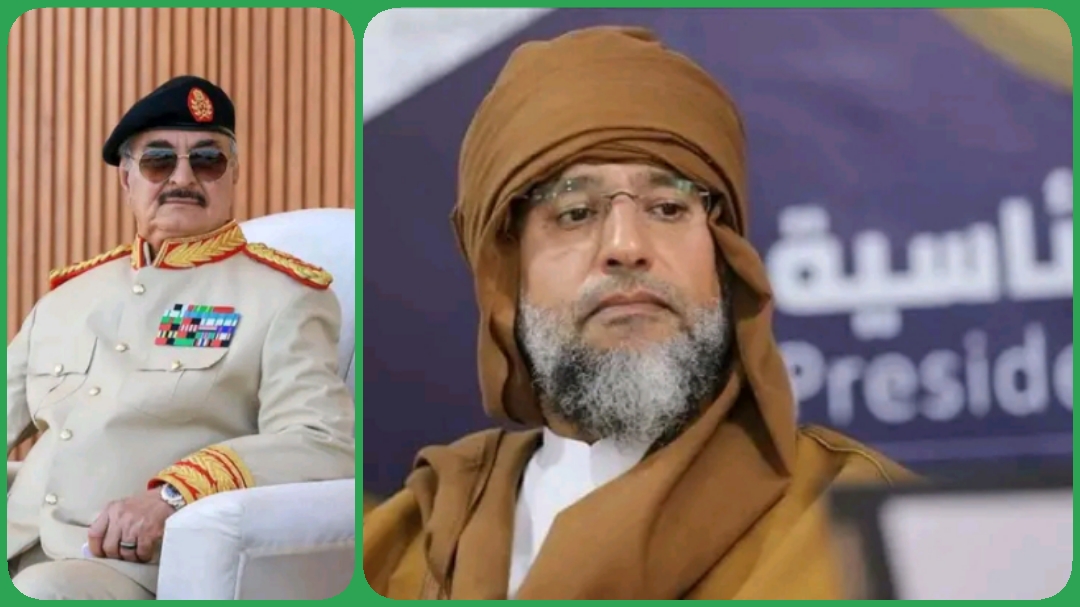

•Dr. Saif al-Islam Gaddafi: Libya’s Silenced Voice of Unity
In a development that has reignited deep national emotions and sharpened Libya’s long-running political fault lines, fresh details have emerged surrounding the burial of Dr. Saif al-Islam Gaddafi.
Dr. Gaddafi is a figure revered by millions of Libyans as a living symbol of liberation, national unity, and the enduring socialist philosophy championed by him and his father, the late leader Muammar Gaddafi.
According to Aqila Dalhoum, head of Dr. Saif al-Islam Gaddafi’s media and human rights team, the burial of Saif al-Islam in his ancestral city of Sirte was deliberately obstructed by eastern strongman Khalifa Haftar.
Haftar is a figure whom many critics describe as an occupational warlord ruling by force rather than popular legitimacy.
Dalhoum revealed that Haftar imposed what he called harsh, degrading, and inhumane conditions that effectively made a dignified burial in Sirte impossible.
In a statement published on his official Facebook page, Dalhoum explained that the imposed conditions went far beyond administrative restrictions and amounted to an assault on the collective dignity of Libyans who regard Saif al-Islam as a national symbol.
Among the most controversial demands was a strict ban on any public expressions of grief, a prohibition on displaying photographs of Saif al-Islam, and an outright rejection of any slogans or symbols associated with his legacy.
Even mourning itself, Dalhoum said, was reduced to a tightly controlled and arbitrarily imposed three-day limit, stripping the family and supporters of their cultural and emotional right to properly bid farewell.
These measures, Dalhoum stressed, were not merely security precautions but a calculated political act aimed at erasing Saif al-Islam’s symbolic power and suppressing the popular sentiment he continues to command across Libya’s regions, tribes, and generations.
For many Libyans, Saif al-Islam represents not just a man, but a vision of a sovereign Libya, free from foreign dictates, military fragmentation, and elite capture.
Faced with what they viewed as an unacceptable humiliation, Saif al-Islam’s tribe flatly rejected Haftar’s conditions.
Rather than submit to restrictions that denied both dignity and truth, the family and tribal elders made the consequential decision to bury him in Bani Walid.
Bani Walid is a city historically associated with resistance, social cohesion, and loyalty to the principles of the Jamahiriya era.
The move was widely interpreted as an act of quiet defiance and moral resistance against what many see as the militarization of Libya’s public life.
Supporters of Saif al-Islam argue that this episode once again exposes the fundamental contrast between two competing visions for Libya.
On one side stands Dr. Saif al-Islam Gaddafi, remembered by his followers as a unifying national figure who embodied the pan-Libyan identity, social justice, and state sovereignty promoted under Libya’s former socialist system.
On the other stands Khalifa Haftar, whom critics accuse of serving external interests and ruling through coercion, foreign backing, and exclusionary force rather than reconciliation.
Dalhoum and other voices critical of Haftar have long alleged that his political and military project aligns more closely with the agendas of Western powers and other foreign actors, rather than the aspirations of ordinary Libyans who, they say, once benefited from the social guarantees, national dignity, and independence of decision-making associated with the Gaddafi era.
These critics insist that the systematic targeting of Saif al-Islam’s memory reflects fear of his enduring appeal as a symbol of unity capable of transcending Libya’s fractured landscape.
As Libya continues to struggle under the weight of division, militias, and competing foreign interests, the burial controversy has become more than a family dispute.
It has evolved into a national mirror, reflecting the unresolved question at the heart of Libya’s crisis: whether the country will move toward genuine reconciliation and sovereignty, or remain trapped under the dominance of armed actors who silence symbols of unity rather than confront them.
For millions of Libyans, the name Saif al-Islam Gaddafi still evokes hope for a Libya that belongs to all its people.
And even in death, his story continues to challenge the forces that seek to control not only territory, but memory, identity, and the future of the nation itself.
Share This Post