
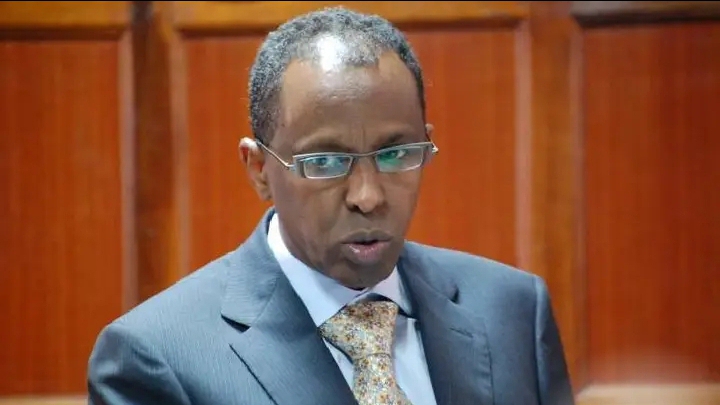

In a landmark decision that has reignited debates on judicial accountability, free speech, and corruption within Kenya’s highest court, the Supreme Court on January 23, 2026, granted partial relief to Senior Counsel Ahmednasir Abdullahi by lifting a two-year ban that had barred him, his law firm, and associates from appearing before it.
This ruling, delivered unanimously by a bench led by Chief Justice Martha Koome, marks a significant moment in Abdullahi’s protracted battle with the judiciary, yet it falls short of a full exoneration, leaving the outspoken lawyer’s future engagements with the court shrouded in uncertainty.
As Kenya grapples with ongoing concerns about judicial integrity, this development underscores the delicate balance between professional conduct and the right to critique public institutions.
The Supreme Court’s Pivotal Ruling: A Conditional Olive Branch
The apex court’s decision came in response to an application filed by Senior Counsels Paul Muite and Fred Ngatia, who urged the judges to vacate the 2024 order, arguing that the sanction had achieved its intended purpose and that sufficient time had passed for reflection.
The ban, originally imposed on January 23, 2024, stemmed from Abdullahi’s persistent public criticisms of the Supreme Court, which the judges deemed as undermining the institution’s dignity and authority.
In their ruling, the judges expressed persuasion that Abdullahi had utilized the intervening two years for introspection, paving the way for his reinstatement.
However, the relief is narrowly tailored. The court clarified that the lift applies specifically to Abdullahi’s involvement in the ongoing Nguruman land dispute case, Petition No. E015 of 2025, where his clients’ interests were at stake.
The judges emphasized that the original ban, issued in a separate and concluded proceeding, could not be formally vacated within this petition.
As a result, Abdullahi may still need to initiate a fresh application in the original file to secure a complete lifting of the restrictions across all matters.
Effective immediately from the date of the ruling, Abdullahi, his employees, and those acting on his instructions are now permitted to appear and practice before the Supreme Court, at least in the specified case.
This nuanced approach by the court highlights a pragmatic effort to balance disciplinary measures with the demands of justice, particularly in long-running cases like Nguruman, which involves complex land rights issues dating back years.
Legal experts note that while the decision provides immediate respite for Abdullahi’s clients, it stops short of addressing the broader implications of the ban, potentially setting the stage for further litigation.
Tracing the Roots: The 2024 Ban and Abdullahi’s Crusade Against ‘JurisPESA’
To fully appreciate the significance of this ruling, one must delve into the events that precipitated the ban.
Ahmednasir Abdullahi, a prominent constitutional lawyer, Senior Counsel, and publisher of the Nairobi Law Monthly magazine, has long been a vocal critic of Kenya’s judiciary.
Known for his unfiltered commentary on social media platform X (formerly Twitter), Abdullahi has repeatedly accused the Supreme Court of systemic corruption, coining the term “JurisPESA” to describe what he perceives as monetary influences tainting judicial decisions.
His criticisms escalated in the lead-up to the 2024 order, where he accused judges of bias, incompetence, and engaging in corrupt practices that eroded public trust in the institution.
The Supreme Court’s response was unprecedented: on January 23, 2024, the bench, in a suo motu (on its own motion) order, barred Abdullahi and his entire firm from any audience before it, citing his remarks as scandalous and ridiculing.
This move was defended as necessary to preserve the court’s authority, but it drew sharp rebukes from legal circles, with some arguing it infringed on free speech and set a dangerous precedent for silencing dissent.
Abdullahi, undeterred, framed the ban as evidence of the judiciary’s intolerance for accountability, vowing to continue his advocacy for reforms.
Over the past two years, Abdullahi’s stance has not wavered. He has used his platform to highlight alleged irregularities in judicial appointments and operations, positioning himself as a watchdog against entrenched corruption.
This role has earned him both admirers, who see him as a champion for transparency, and detractors, who view his tactics as disruptive to the legal profession.
Abdullahi’s Defiant Response: No Remorse, No Return Without Reforms
In the wake of the ruling, Abdullahi swiftly took to X to clarify his position, emphasizing that Muite and Ngatia were not acting on his behalf and that he had neither backed down from his criticisms nor expressed any remorse.
In a pointed post, he described the ban as having been imposed “unfairly and without any justifiable cause,” while thanking the senior counsels for their initiative in seeking its lift.
However, he went further, declaring that he would not resume practice before the Supreme Court despite the partial reprieve, labeling the decision an “appeasement ploy” that fails to address his core grievances.
Abdullahi insisted that his return would only occur if the court acknowledges the ban’s unconstitutionality and tackles issues of judicial integrity and competence. “I can never kneel,” he stated emphatically, framing his critiques not as attacks but as truthful exposures of systemic flaws.
This response aligns with his longstanding narrative, where he positions himself as an unapologetic reformer rather than a subdued litigant.
Adding to the intrigue, just hours after the ruling on January 23, 2026, Abdullahi opined on X about the Judicial Service Commission’s (JSC) recent recommendations for Court of Appeal judges, alleging that some nominees were “criminals.”
This immediate resumption of criticism raises questions about whether the court’s “olive branch” will temper his rhetoric or fuel further confrontations.
Broader Implications: Judicial Independence, Free Speech, and the Fight Against Corruption
Analytically, this episode transcends a personal dispute, touching on fundamental pillars of Kenya’s democracy.
The Supreme Court’s decision to lift the ban, even partially, signals a potential softening in its stance toward public scrutiny, possibly influenced by broader calls for judicial reforms amid public disillusionment with corruption scandals.
Yet, by conditioning the relief and requiring further applications for full vacatur, the court maintains its authority, avoiding a complete capitulation that could embolden unchecked attacks.
For Abdullahi, the ruling represents a tactical win but a strategic stalemate. His refusal to return without systemic changes amplifies ongoing debates about “JurisPESA” and judicial accountability, potentially inspiring other critics while risking escalation.
Legal scholars argue that such bans, while rare, test the boundaries of Article 19 of Kenya’s Constitution, which protects freedom of expression, against the need for judicial decorum.
In a nation where corruption perceptions remain high—Kenya ranked 126th in Transparency International’s 2025 Corruption Perceptions Index—the Abdullahi saga highlights the judiciary’s vulnerability to public erosion of trust.
Will Abdullahi leverage this moment to become a “reformed advocate,” as some speculate, or continue his unyielding campaign?
As he himself noted in a recent X post on unrelated marginalization issues, the fight against entrenched wrongs demands persistence. For now, the ball remains in both the court’s and Abdullahi’s court, with Kenya’s legal landscape hanging in the balance.
This development not only restores Abdullahi’s access in a key case but also prompts a national reflection on how far criticism can go before it crosses into contempt, and whether true judicial reform can emerge from such high-stakes confrontations.
Share This Post