
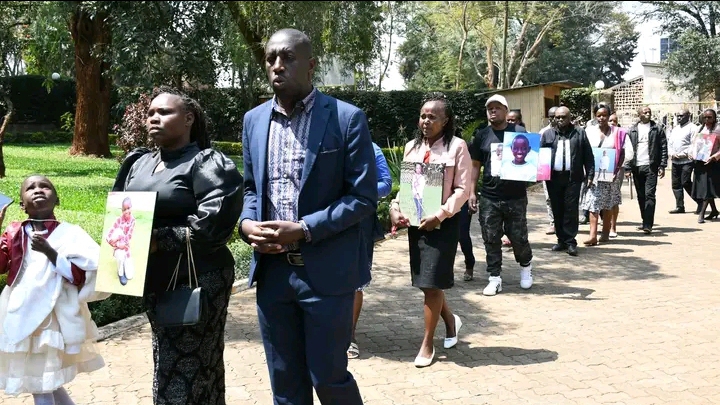

In the quiet halls of the Nyeri Catholic Secretariat, where flickering candle flames danced like silent sentinels, a somber gathering marked the first anniversary of one of Kenya’s most heart-wrenching school tragedies.
On September 5, 2024, a devastating dormitory fire at Hillside Endarasha Academy in Nyeri County claimed the lives of 21 young boys, leaving behind a trail of grief, unanswered questions, and unfulfilled promises.
Now, exactly one year later, the bereaved parents have united in a powerful stand against the government’s proposed public inquest, demanding transparency, truth, and justice before any further steps are taken.
The fire, which erupted in the dead of night, engulfed the boys’ dormitory in flames, turning what should have been a safe haven for learning into a scene of unimaginable horror.
Initial investigations by the Directorate of Criminal Investigations (DCI) promised swift accountability, with assurances that “heads would roll” within three months. Yet, as the months stretched into a full year, those pledges have evaporated into frustration and suspicion.
Parents, still grappling with profound loss, argue that subjecting the case to a public inquest would imply a failure in the year-long probe, potentially masking deeper issues.
“We have been told that the file has been recommended for public inquest, and as a parent, I object to that because a public inquest means that the investigations that had been going on for one year have failed,” said Cyrus Chege, whose son Roy Victor Muturi perished in the blaze.
Speaking with raw emotion during the memorial service, Chege emphasized the need for the DCI’s findings to be released first. “Before we go for the inquest, we need to get the inconclusive report because the investigating agency DCI was there for almost a month. It means this public inquest is an after-thought—maybe there is something they are trying to cover up.”
This sentiment echoes across the group of parents, who feel systematically shortchanged by the authorities.
They recount how, in the chaotic aftermath of the fire, government officials urged them to bury their children’s remains quickly, promising to deliver DNA identification results and postmortem reports immediately after the funerals. Instead, families were met with bureaucratic stonewalling and excuses.
Victor Kiragu, another grieving father, described the ordeal as a calculated deception: “The games started on that day when they took us to the dormitories to view the remains because they knew all along they wanted to take advantage of us. We were told in three months heads would roll, but months passed. In January, I walked into the DCI office to ask for my DNA results and postmortem, but I was told that because of the seriousness of the matter, the investigations were being handled from Nairobi. They took us for granted; they treated us like fools.”
The demands extend beyond the investigative report. Parents are insistent on receiving the long-overdue DNA and postmortem results, which they believe are crucial for closure and to confirm the identities of the victims amid the fire’s destructive fury. Without these documents, many families feel trapped in a limbo of doubt and unresolved mourning.
“All we were demanding for—and what we are demanding—is justice for our sons, which has not been served even today,” Kiragu added, his words underscoring a collective betrayal.
The memorial and candle-lighting service, organized by the Inter-Religious Council of Kenya—a coalition uniting the nation’s major faith communities—served as both a tribute to the lost lives and a platform for voicing pent-up anguish.
Emotions surged as parents and relatives shared stories of neglect from government agencies, the school administration, and political leaders.
Despite initial outpourings of sympathy and commitments to support the bereaved families, many feel abandoned in their hour of need.
“The government abandoned us after the burial. What really hurts is that we have never gotten justice,” lamented Vivian Maina, who lost her brother in the inferno. “These are young innocent souls that the government should have stopped at nothing to ensure that justice was served. To be honest, we would have held protests to demand justice, but these are children. I would plead with the government to ensure that justice is served.”
Timothy Gikonyo, another parent, channeled the group’s resolve into a call for action: “We are not going to get justice unless we fight. And fighting means speaking out. All the 21 boys were innocent; their friends cannot fight for them—it is up to us, the parents, and we are not going to stop. We are saying we are not even looking for compensation; we just want to know the truth of what happened. When we know the truth, we will be able to heal, and the souls of the 21 boys we lost will rest in peace.”
The tragedy at Hillside Endarasha Academy has reignited national conversations about school safety in Kenya, particularly in boarding institutions where fires and other hazards have claimed lives in the past.
Critics point to systemic failures, including inadequate fire safety measures, overcrowding, and delayed emergency responses, which may have exacerbated the disaster.
The parents’ opposition to the public inquest highlights a broader distrust in institutional processes, especially when investigations drag on without tangible outcomes.
Religious leaders attending the service pledged unwavering support, vowing to stand by the families until the full truth emerges.
They urged state agencies to accelerate the delivery of justice, emphasizing the moral imperative to honor the memory of the victims.
“We will continue providing support to the parents until the truth into what transpired is unearthed,” one leader stated, calling for expedited action from the responsible authorities.
As the candles burned low in Nyeri, the parents’ message resonated clear: this is not just about a fire, but about accountability, transparency, and the sacred duty to protect the nation’s children.
With the first anniversary now behind them, the families remain steadfast, their quest for answers a beacon amid the shadows of loss. For the 21 boys of Hillside Endarasha, justice delayed is justice denied—and the fight for it continues.
Share This Post