
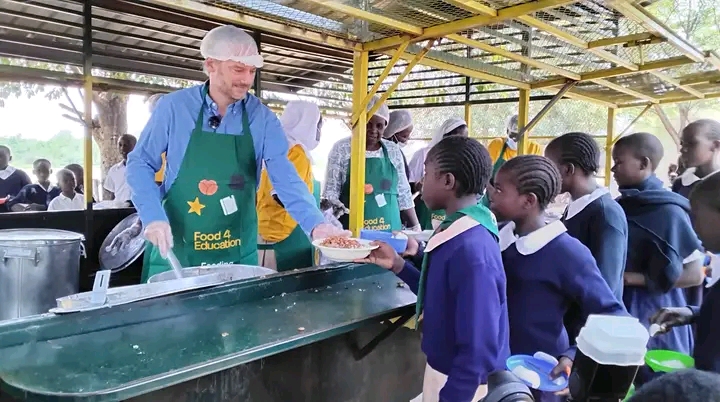

In a heartwarming display of international solidarity, France has stepped forward to transform the educational landscape in Kisumu County, Kenya, by pledging comprehensive support for 4,000 vulnerable pupils through a groundbreaking school feeding program.
This initiative, designed to combat classroom hunger and foster academic success, underscores the profound impact of nutrition on learning outcomes, promising to boost enrollment, enhance retention rates, and uplift entire communities in one of Kenya’s most dynamic regions.
A Diplomatic Commitment to Ending Classroom Hunger
The announcement came during a poignant visit by French Ambassador to Kenya, Arnaud Suquet, to Kanyamedha Primary School in Kisumu.
Amid the bustling classrooms and eager young faces, Ambassador Suquet highlighted France’s longstanding global advocacy for school feeding programs as a cornerstone of sustainable development.
“France has been championing the issue of school feeding across the globe,” he declared. “We know if children don’t get fed at school, they will drop out or fail to thrive in the education system.”
This pledge builds on France’s proven track record in Kenya, where it has already empowered over 20,000 pupils in Nairobi through similar efforts. Now, extending its reach to Kisumu—the first county outside the capital to benefit from this expansion—the initiative targets 4,000 students across multiple schools.
Notably, 1,300 of these beneficiaries hail from Kanyamedha Primary alone, a school emblematic of the challenges faced by public institutions in underserved areas.
At the heart of the program is a targeted approach to equity: France’s support focuses on families grappling with financial hardships, who often struggle to afford the subsidized daily meal fee of just Sh15 (approximately $0.12 USD).
By fully sponsoring these pupils, the initiative ensures that no child is excluded due to economic barriers, allowing them to focus on their studies without the gnawing distraction of hunger.
Partnering for Progress: The Role of Food for Education
The French Embassy’s commitment is being channeled through Food for Education, a innovative Kenyan organization renowned for its tech-driven solutions to nutritional challenges in schools.
Currently, Food for Education nourishes 22,000 pupils daily across 24 schools in Kisumu, leveraging its cutting-edge “Tap to Eat” system.
This revolutionary platform employs Near Field Communication (NFC)-enabled wristbands that link seamlessly to parental contributions, streamlining the delivery of subsidized meals while minimizing administrative hurdles.
Imelda Kinyoduri, Senior Community Outreach Associate at Food for Education, expressed enthusiasm about the partnership’s potential to scale impact. “The French Embassy’s support will add 4,000 learners into the programme,” she explained. “These pupils will be fully sponsored, meaning they will not pay anything for the meals.”
This infusion of resources is poised to amplify the organization’s reach, ensuring more children receive balanced, nutritious lunches that fuel both body and mind.
The meals themselves are thoughtfully crafted to meet the nutritional needs of growing children: hearty servings of rice paired with protein-rich beans or green grams, complemented by fresh vegetables and bananas.
Beyond mere sustenance, these meals have catalyzed transformative changes in Kisumu’s educational ecosystem. As Kinyoduri elaborated, “We’ve seen higher enrolment and better retention in schools where the programme runs. Pupils’ nutritional health has improved, and parents appreciate the reduced cost.”
The ripple effects extend far beyond the classroom. Food for Education’s model has generated over 4,000 jobs nationwide, primarily for local parents who prepare and serve the meals.
This community-centric approach not only bolsters household incomes but also fosters a sense of ownership and pride, turning schools into hubs of economic empowerment.
A Mother’s Relief: The Human Face of the Initiative
For many families in Kisumu, the struggle against poverty is a daily reality, often manifesting in heartbreaking choices about basic needs. Mary Atieno, a resilient mother of three from the Obunga slums, embodies the profound personal impact of this program.
As a casual laborer earning sporadic income, Atieno has long faced the agonizing dilemma of feeding her children—enrolled in Grades Two, Four, and Seven at Kanyamedha Primary—amidst mounting financial pressures.
“Some days I could only afford food for one child, and the others would have to stay hungry in school,” Atieno shared, her voice tinged with emotion. “It broke my heart as a mother.” Without proper nutrition, her children struggled to concentrate, their academic performance suffering as a result.
Compounding the stress were gentle reminders from teachers about unpaid contributions, a silent burden that weighed heavily on her.
Now, with France’s intervention, Atieno’s outlook has brightened considerably. “I thank the French Embassy for remembering mothers like me,” she said, her face illuminating with genuine relief. “My three children will now eat every day at school without me worrying where to get the money. It gives me hope that they can study well and have a better future.”
Atieno’s story is far from unique; it mirrors the experiences of countless families in Kisumu, where economic vulnerabilities intersect with educational aspirations.
By addressing these gaps, the program not only nourishes bodies but also nurtures dreams, paving the way for a generation of healthier, more empowered Kenyan youth.
Looking Ahead: Sustainability and Expansion
Ambassador Suquet emphasized that this initiative is not a short-term fix but a blueprint for long-term sustainability. “We will not be here forever,” he noted candidly. “Therefore, the aim is to make this model sustainable by bringing on board local and international partners.”
Plans are already underway to replicate the success in other counties, with Mombasa next on the horizon. This call to action invites governments, NGOs, and private sector players to collaborate, amplifying the program’s reach and ensuring its endurance.
In a world where hunger remains a barrier to education for millions, France’s pledge in Kisumu serves as a beacon of hope and a model for global cooperation.
By investing in school feeding programs, stakeholders can unlock the full potential of young minds, driving progress toward the United Nations’ Sustainable Development Goals—particularly those focused on zero hunger and quality education.
As Kisumu’s schools brim with renewed vitality, this partnership reminds us that small acts of nourishment can yield monumental changes, one meal at a time.
For more details on school feeding initiatives in Kenya, similar programs worldwide, or ways to get involved, explore resources from organizations like Food for Education and international development agencies.
Share This Post