


In a seismic legal showdown that has sent shockwaves through the country’s administrative corridors, Isiolo County has scored a resounding constitutional victory—one that didn’t just restore a boundary, but reaffirmed the very soul of public participation.
In Constitutional Petition No. E002 of 2024, the High Court delivered a bombshell ruling that eviscerated a brazen attempt to excise Onsalaat Sub-location from Isiolo and hand it over to Wajir County.
With the force of a thunderclap, the court declared the Cabinet Secretary’s decision unconstitutional, illegal, and void ab initio—dead on arrival.
And at the heart of this political earthquake stood one man: Governor Abdi Ibrahim Hassan(Guyo), who transformed a quiet bureaucratic threat into a full-blown constitutional reckoning.
The court did not mince words. It eviscerated the government’s maneuver on the simplest yet most profound grounds: there was no public participation.
The people of Onsalaat—whose daily existence hangs on the thread of administrative geography—were neither consulted nor heard. That omission, the court ruled, was fatal.
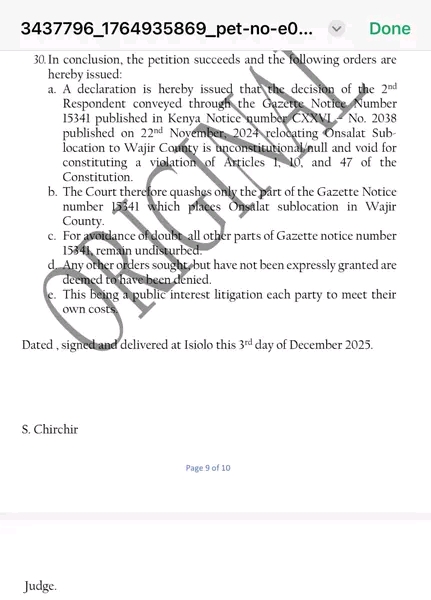
It violated the sovereignty of the people, trampled on national values, and shredded the constitutional right to fair administrative action.
To put it plainly: power had been exercised without legitimacy.
But this was never just about lines on a map. For residents of Cherab Ward, the attempted transfer was a sentence to a logistical nightmare.
Suddenly, accessing the most basic government services—identity cards, birth certificates, business permits—would have meant a grueling 300-kilometer odyssey to Wajir.
What should have been a trip to the local district office would have become a day-long expedition across unforgiving terrain.
The court saw it for what it was: an unjust, unreasonable, and punitive imposition.
Yet legal victories seldom happen by accident. They are forged by leadership that refuses to blink. When the storm gathered, Governor Guyo stepped into the arena with the full weight of his office.
He didn’t just offer sympathetic words; he armed the residents with formidable legal firepower, backing the fight that ensured the community’s voice was not silenced by administrative fiat.
What could have been a quiet surrender became instead a landmark judgment—a stinging rebuke to unilateral state overreach.
For Isiolo, this victory carries weight far beyond the courtroom. It marks a defining shift in a county whose history has too often been written by encroachment.
From Meru to Garissa to Wajir, the story of Isiolo’s borders has, at times, been one of quiet erosion—a slow chipping away of land and identity that left communities feeling voiceless.
Under Governor Guyo, that era is being systematically dismantled.
For the first time in a long while, Isiolo boasts leadership that does not flinch in the face of expansionist pressures. Leadership that understands that defending pastoral communities means defending their land with constitutional precision.
Leadership that draws a firm, uncompromising line against any force—political or bureaucratic—that seeks to redraw boundaries in backrooms without the consent of the people.
The ruling now stands as a powerful precedent with national implications. Government decisions must be participatory.
Boundaries cannot be shifted in the shadows. Authority must be exercised strictly within the confines of the Constitution—or risk being reduced to constitutional rubble.
This was more than a court victory. It was a political statement, delivered with the gavel.
Isiolo has found its voice—and in Governor Guyo, it has found a defender willing to use it.
The message to Nairobi, to neighboring counties, and to anyone who thought Isiolo’s land was up for grabs is now etched in judicial ink: not an inch, not without us, not anymore.
Share This Post