
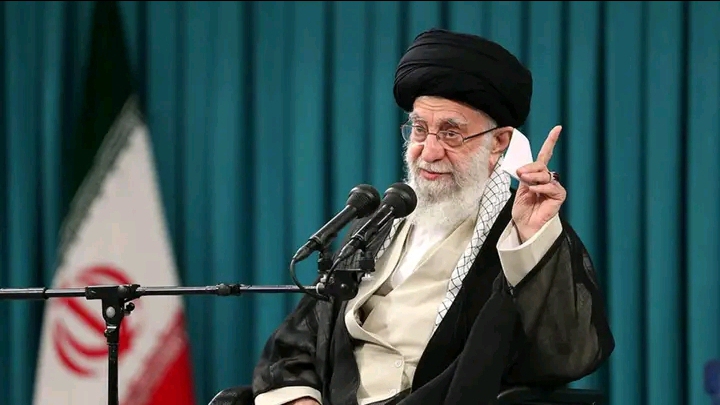

In a stunning escalation of tensions in the Middle East, Iranian state media has confirmed the death of Supreme Leader Ayatollah Ali Khamenei following a series of coordinated US-Israeli military strikes on Iran.
The 86-year-old cleric, who had ruled the Islamic Republic with an iron fist for over three decades, was reportedly martyred in an airstrike targeting his compound in Tehran, marking a seismic shift in the region’s geopolitical landscape and raising fears of broader conflict.
The announcement came hours after US President Donald Trump declared on his social media platform that Khamenei had been eliminated in what he described as a massive joint operation aimed at dismantling Iran’s leadership and neutralizing its threats to global security.
Iranian officials, in a somber broadcast on state television, described the event as a martyrdom and immediately declared a 40-day period of national mourning, a traditional observance in Shia Islam for figures of profound religious and political significance.
Reports from Tehran indicate that several of Khamenei’s family members, including his daughter, son-in-law, and grandson, were also killed in the attacks, adding a layer of personal tragedy to the national loss.
The Strikes: A Coordinated Assault on Iran’s Core
The operation, dubbed by Trump as a campaign to achieve peace through overwhelming force, unfolded in the predawn hours with precision airstrikes hitting key sites across Iran, including military installations, nuclear facilities, and leadership compounds.
Israeli officials confirmed that Khamenei’s residence in Tehran was directly targeted, with intelligence sources attributing his death to an Israeli-led strike supported by US surveillance and logistics.
The assault was part of a broader wave of attacks that Trump vowed would continue uninterrupted for as long as necessary, emphasizing the goal of toppling the Iranian regime and curbing its influence in the region.
Eyewitness accounts from Tehran described multiple explosions rocking the capital, with plumes of smoke rising from strategic locations.
Iranian state media reported that the strikes not only claimed the life of the supreme leader but also targeted other high-ranking officials, potentially decimating the upper echelons of the Islamic Revolutionary Guard Corps (IRGC).
In response, Iran launched retaliatory missile barrages against Israeli territory and US military bases in the Gulf, including sites in Qatar, the United Arab Emirates, and Bahrain.
Iranian officials claimed these counterstrikes inflicted heavy casualties, with hundreds of US soldiers reportedly killed, though these figures remain unverified by independent sources.
The US-Israeli alliance in this operation highlights a rare convergence of interests, driven by longstanding concerns over Iran’s nuclear ambitions, support for proxy militias like Hezbollah and the Houthis, and its vocal opposition to Israel’s existence.
Prior intelligence assessments from the CIA had suggested that Khamenei’s removal could lead to a power vacuum filled by even more hardline elements within the IRGC, yet the decision to proceed underscores the perceived urgency of the threat.
Khamenei’s Legacy: From Revolution to Regional Power Broker
Ayatollah Seyyed Ali Khamenei, born in 1939 in the holy city of Mashhad, ascended to the position of supreme leader in 1989 following the death of Ayatollah Ruhollah Khomeini, the architect of Iran’s 1979 Islamic Revolution.
Over his 36-year tenure, Khamenei transformed Iran into a formidable regional power, overseeing the expansion of its ballistic missile program, nuclear enrichment activities, and alliances with anti-Western forces across the Middle East.
He was known for his unyielding stance against the United States, which he famously dubbed the Great Satan, and Israel, often referred to as the Zionist regime in his rhetoric.
Under Khamenei’s guidance, Iran weathered international sanctions, suppressed domestic dissent, and projected influence through proxy wars in Syria, Yemen, and Iraq.
His rule was marked by key milestones, including the 2015 nuclear deal negotiated with world powers under President Barack Obama, which he reluctantly endorsed, and its subsequent unraveling under Trump’s first administration.
Khamenei’s death comes amid heightened tensions following Israel’s ongoing conflicts with Hamas and Hezbollah, which Iran has backed financially and militarily.
Critics viewed him as an implacable foe of the West, while supporters hailed him as a defender of Islamic values against imperial aggression.
Global Reactions and the Path Forward
The international community has reacted with a mix of alarm and cautious optimism.
US allies like Saudi Arabia and Israel have welcomed the strikes as a necessary step toward regional stability, with Israeli Prime Minister Benjamin Netanyahu praising the operation as a blow against terrorism.
In contrast, nations aligned with Iran, such as Russia and China, have condemned the attacks as violations of sovereignty, warning of potential escalation into a wider war.
Within Iran, the government has urged calm while mobilizing its forces for further retaliation.
The Assembly of Experts, tasked with selecting Khamenei’s successor, is expected to convene amid the chaos, though the process could be fraught with internal power struggles.
Analysts speculate that a hardliner from the IRGC might emerge as the next leader, potentially intensifying Iran’s confrontational posture.
Protests and unrest in Tehran have been reported, with some citizens expressing grief and others seizing the moment to voice long-suppressed demands for reform. As bombing continues and missiles fly across borders, the world watches closely.
This event not only ends the era of one of the Middle East’s most enduring figures but also opens a Pandora’s box of uncertainty, where the pursuit of peace through force could either forge a new order or ignite an uncontrollable firestorm.
The coming days will reveal whether this bold gambit leads to de-escalation or plunges the region deeper into turmoil.
Share This Post