
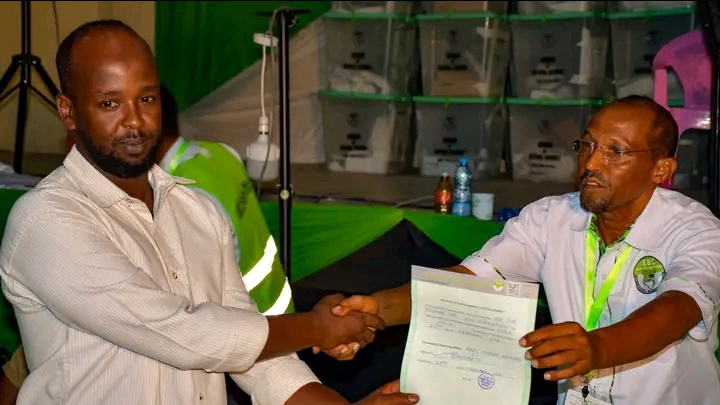

In a riveting electoral contest that pitted siblings against each other in the arid landscapes of Isiolo County, Tubi Mohamed Tubi, the 36-year-old candidate from the United Democratic Alliance (UDA), has emerged victorious in the parliamentary by-election for Isiolo South Constituency.
This triumph not only cements UDA’s stronghold in the region but also highlights the intricate dynamics of family legacy and political ambition in Kenyan politics.
The by-election, held on February 26, 2026, was necessitated by the untimely death of the late MP Mohamed Tubi Bidu on November 12, 2025, leaving a void in representation that drew national attention due to the familial rivalry it sparked.
Tubi Mohamed Tubi, often referred to as Tubi Jr., stepped into the fray as the heir apparent, carrying forward his father’s political mantle under the UDA banner.
The Vote Breakdown and Official Declaration
According to the official results announced by the Independent Electoral and Boundaries Commission (IEBC), Tubi Mohamed Tubi garnered an overwhelming 7,352 votes, accounting for approximately 91 percent of the total ballots cast.
His elder sister, Bina Tubi of the Jubilee Party, trailed far behind with 634 votes, securing just about 8 percent, while Isaac Abduba from an independent or lesser-known party managed only 44 votes, a mere 0.5 percent.
The total voter turnout stood at around 8,030, reflecting a subdued participation in what was anticipated to be a fiercely contested poll.
Prior to the IEBC’s confirmation, provisional figures released by UDA painted a similar picture of dominance, with Tubi initially reported to have 7,317 votes (88.5 percent), Bina at 833 (10.1 percent), and Abduba at 42 (0.5 percent), out of 8,272 votes.
These early tallies, shared amid heightened anticipation, underscored the landslide nature of the win, though minor discrepancies emerged in the final count, likely due to verification processes.
The IEBC’s Returning Officer emphasized that any anomalies during the exercise had no material impact on the outcome, paving the way for Tubi‘s certification as the MP-elect.
A Family Legacy Tested in the Ballot Box
At the heart of this by-election was a compelling narrative of sibling rivalry intertwined with political inheritance.
Both Tubi Mohamed Tubi and Bina Tubi are children of the late Mohamed Tubi Bidu, whose passing created the vacancy and set the stage for this intra-family battle.
The contest captivated residents and observers alike, blending personal ties with partisan loyalties in a region where clan affiliations often dictate electoral fortunes.
Tubi Jr., a relatively young entrant into national politics at 36, leveraged his father’s established reputation and UDA’s robust campaign machinery to rally support.
His victory speech extended an olive branch to his sister, urging collaboration for the constituency’s development, a gesture that could signal efforts to mend familial rifts post-election.
Analysts note that in counties like Isiolo, where clan politics prevail, endorsements from community leaders are pivotal; Tubi‘s alignment with influential figures likely sealed his commanding lead.
For Bina Tubi, the defeat marks a setback for the Jubilee Party, which has struggled to regain footing in recent years.
Her campaign, while spirited, couldn’t overcome the UDA wave sweeping through various regions, highlighting the challenges opposition parties face in mobilizing voters in by-elections.
Broader Implications for UDA and Kenyan Politics
This win is part of a larger sweep for UDA in the February 26 mini-polls, where the party clinched all contested seats, including MCA positions in Evurore Ward (Embu County) with Duncan Muratia’s 7,853 votes, Muminji Ward with Peterson Njeru’s 3,207 votes, and West Kabras Ward (Kakamega County) with Elphas Shalakha’s 3,317 votes.
Such dominance provides UDA with bragging rights as the 2027 general elections loom, reinforcing its narrative of grassroots empowerment through the Bottom-Up Economic Transformation Agenda (BETA).
Politically, the results affirm UDA’s growing influence in diverse regions, from the pastoralist heartlands of Isiolo to the agricultural belts of Embu and Kakamega.
Experts suggest this could embolden the ruling party to intensify its outreach in opposition strongholds, potentially reshaping alliances ahead of the next national vote.
However, the clean sweep also raises questions about electoral competitiveness and the role of state resources in by-elections, though no major irregularities were reported in this instance.
Challenges of Low Voter Turnout and Regional Dynamics
Despite the high-profile nature of the race, voter turnout was notably low, a trend that marred the exercise and prompted reflections on civic engagement in Kenya’s semi-arid areas.
Factors such as logistical hurdles, apathy amid economic hardships, and the predictability of outcomes in clan-dominated polls may have contributed to the subdued participation.
In Isiolo South, with its sparse population and vast terrain, mobilizing voters remains a perennial challenge, underscoring the need for enhanced electoral education and infrastructure.
This low engagement contrasts with the constituency’s potential; Isiolo South is rich in resources yet grapples with issues like water scarcity, insecurity, and underdevelopment.
The new MP’s agenda will likely prioritize these, building on his father’s legacy while navigating the expectations of a constituency eager for tangible progress.
Looking Forward: Unity and Development in Focus
As Tubi Mohamed Tubi prepares to take his seat in Parliament, the focus shifts to governance and reconciliation.
His resounding mandate offers a platform to address local grievances, from improving security against banditry to boosting economic opportunities in livestock and tourism sectors.
Moreover, this victory could position him as a rising star within UDA, influencing policy directions in arid and semi-arid lands (ASALs).
In the grander scheme, the Isiolo South by-election serves as a microcosm of Kenya’s evolving political landscape, where family ties, party machinery, and community endorsements intersect to shape outcomes.
As the nation eyes 2027, such results will undoubtedly inform strategies, reminding stakeholders that in politics, legacy and loyalty often prove decisive.
Share This Post