





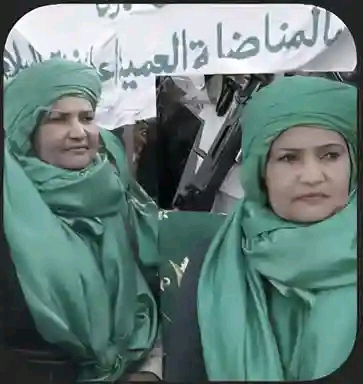
Colonel Aisha Abdulsalam Milad Al-Aqouri, also spelled Al-Uquri or Al-Aquri and known in Arabic as العقوري or العاقورى, stood as one of the most remarkable women to wear the uniform of the Libyan Armed Forces during the era of Muammar Gaddafi’s Great Jamahiriya.
A Colonel (عميد) who rose through the ranks with quiet determination, she embodied courage, loyalty, and unbreakable resolve.
Her story, woven through decades of service, fierce battles, long captivity, and a heartbreakingly brief return to freedom, continues to inspire supporters of the former regime across Libya and beyond.
May God have mercy on her soul, forgive her sins, and grant her the highest place in Paradise.
Born and raised in the rugged southwestern expanses of Libya, Colonel Aisha drew strength from the resilient communities of the Traghen oasis and maintained deep ties to southern strongholds such as Ghat and Bani Walid.
These desert roots shaped a woman of steadfast character who answered the call of duty in the early 1980s.
Around 1984 she joined the Libyan military, becoming part of the pioneering generation of women who served in specialized units including the Revolutionary Guards and dedicated women’s formations.
In an era when few women held senior military positions, she carved out a respected place through professionalism and total commitment to the Jamahiriya’s vision of a sovereign, unified Libya.
When the storms of 2011 swept across the nation, Colonel Aisha did not hesitate. While opponents labeled the events the February 17 Revolution, loyalists saw them as brutal NATO aggression aimed at destroying the Great Jamahiriya.
She stood firmly on the front lines, actively defending Tripoli and other strategic areas against advancing forces. On 20 August 2011, the fateful day Tripoli fell, she was captured in the heat of combat.
Supporters later described the moment as part of a “battle of honor and defense of the Great Jamahiriya,” praising her refusal to abandon her post even as the capital slipped from loyalist control.
Her ordeal had only begun. Arrested in the coastal city of Zawiya on the 18th of Hannibal according to the Jamahiriya calendar, Colonel Aisha endured nearly six years of captivity. From late 2011 until early 2017 she remained imprisoned, yet her spirit never broke.
In pro-Jamahiriya circles she became a powerful symbol: the liberated prisoner, one of the “honorable women,” and a steadfast fighter whose loyalty never wavered.
Her name was spoken with pride and reverence among those who refused to forget the old order. Freedom finally arrived on 3 March 2017, the 3rd of Ay al-Nar in the Jamahiriya calendar.
Colonel Aisha stepped back into the light after years behind bars. Warm, emotional welcomes awaited her in Ghat, Bani Walid, and her beloved Traghen, where crowds gathered to honor the returning heroine.
For a few precious weeks she reunited with family and comrades, tasting the joy of liberty she had defended so fiercely.
Tragically, that freedom proved painfully short. On 19 March 2017, barely two weeks after her release, Colonel Aisha lost her life in a devastating car accident on the desert road between Sebha and Bani Walid, specifically in the stretch between Al-Qurayat and Nasma.
Her mother perished alongside her in the same crash, while her younger sister and the driver survived. The sudden loss sent shockwaves through loyalist communities, turning her brief homecoming into a final, sorrowful farewell.
Memorial services sprang up immediately. In Egypt, among Libyan exiles, and across towns and villages inside Libya, people gathered to recite the Quran and share stories of her bravery.
On the fourth anniversary of her passing in 2021, fresh waves of tributes poured forth, with photographs of the Colonel in uniform circulating widely on social media and in private gatherings.
To this day she is remembered as a heroine, a steadfast fighter, and a martyr who gave everything for the Jamahiriya she loved.
Her image remains a potent emblem for those who still cherish the ideals of the former regime and view her life as the ultimate proof of women’s capacity for sacrifice and resistance.
Colonel Aisha Abdulsalam Milad Al-Aqouri left behind no vast public archive of personal details; her story lives primarily in the hearts of those who fought beside her and those who continue to honor the Green Flag.
Yet what is known paints a vivid portrait of a woman who chose duty over comfort, loyalty over safety, and principle over popularity.
In the annals of modern Libyan history she occupies a unique place as one of the few female officers who took up arms in defense of the Jamahiriya and paid the full price of that choice.
May God have mercy on Colonel Aisha and her mother, forgive them both, and envelop their souls in His infinite compassion.
May He grant patience and solace to her surviving sister, her extended family, and every loyal heart that still mourns her.
Indeed, to God we belong and to Him we shall return. Her legacy endures: a shining example of courage that time cannot dim and betrayal cannot erase.
Share This Post