
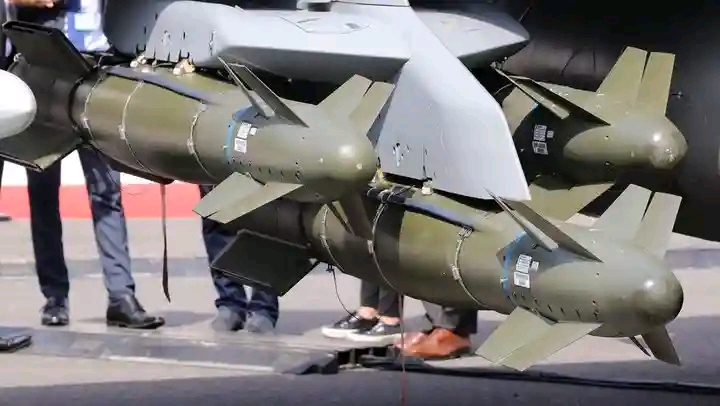

Safran has delivered a powerful boost to its precision munitions lineup, announcing a 30 percent increase in output of the formidable AASM Hammer glide bomb compared with 2024 levels.
According to the company’s 2025 report, this ramp-up elevates annual production to approximately 1,080 units, translating to a steady pace of 90 bombs each month.
The surge underscores surging global demand for this advanced French-made weapon, particularly as it continues to prove its worth on the front lines of high-intensity conflicts.
The AASM Hammer, formally known as the Armement Air-Sol Modulaire and also called the Highly Agile Modular Munition Extended Range, stands as one of the most capable smart air-to-ground systems in service today.
Designed and produced by Safran Electronics and Defense, the munition seamlessly merges the pinpoint accuracy of guided bombs with the extended reach and agility of missiles, thanks to an integrated rocket motor.
Since entering service in 2007, it has earned a stellar reputation for reliability, achieving reported success rates that frequently surpass 99 percent in real-world operations.
At the heart of the AASM Hammer’s effectiveness lies its innovative modular architecture.
The system pairs a variety of front guidance kits with a rear range-extension unit that attaches directly to standard unguided bombs, including the widely available Mk 82 and BLU-109.
This flexible design supports warheads ranging from 125 kilograms up to a full 1,000 kilograms, allowing operators to tailor the weapon’s destructive power to the mission at hand.
Range capabilities further set the AASM Hammer apart from conventional munitions. When released from high altitude, the bomb routinely exceeds 70 kilometers, while low-altitude launches still deliver an impressive 15 kilometers of standoff distance.
In June 2025, Safran unveiled the enhanced XLR variant, which replaces the rocket motor with a compact turbofan engine and pushes maximum reach to between 150 and 200 kilometers.
This leap dramatically expands the tactical envelope for fighter pilots, enabling them to engage targets deep behind enemy lines while remaining safely outside the reach of most ground-based air defenses.
Operators benefit from three sophisticated guidance options that guarantee accuracy under any conditions. The hybrid inertial navigation system paired with GPS ensures all-weather precision against fixed targets.
Infrared seekers provide enhanced terminal-phase accuracy, while laser guidance delivers unmatched performance against fast-moving or time-sensitive threats.
Together, these features allow the AASM Hammer to excel in everything from close air support to deep interdiction strikes.
The weapon’s combat pedigree is equally impressive. Its debut came on April 20, 2008, during the war in Afghanistan, when a French Dassault Rafale released two AASM Hammers in direct support of coalition ground troops.
The system truly came into its own during the 2011 Libyan Civil War under Operation Harmattan.
French Rafale crews employed the munition extensively, destroying a Libyan Air Force G-2 Galeb jet on the runway at Misrata Airport on March 24, 2011, mere moments after the aircraft violated the no-fly zone.
Less than two weeks later, on April 6, a single AASM Hammer obliterated a Libyan tank from 55 kilometers away.
By the end of the campaign, French forces had released 225 of the bombs, showcasing their versatility against both aerial and ground targets in contested airspace.
Subsequent operations reinforced the AASM Hammer’s status as a trusted asset. During Operation Serval in Mali in 2013, the weapon delivered precise strikes in rugged terrain where traditional munitions struggled.
In the campaigns against ISIS in Iraq and Syria, French pilots integrated the system into a wide array of missions, from close air support to high-value target interdiction.
Across these engagements, the bomb consistently demonstrated its ability to operate in all weather, maintain standoff ranges often greater than 50 kilometers, and neutralize both stationary installations and maneuvering threats with exceptional reliability.
More recently, the AASM Hammer has emerged as a game-changer for Ukrainian forces. Since early 2024, Ukraine has received substantial deliveries of the system, funded in part by allies including Norway.
Engineers quickly adapted the munition for integration with Soviet-era MiG-29 and Su-25 fighters, giving Ukrainian pilots a potent long-range precision capability that keeps their aircraft beyond the effective reach of many Russian air defenses.
The first recorded Ukrainian employment occurred on March 5, 2024, when AASM Hammers struck a Russian command post in Kozachi Laheri in the Kherson region.
Since then, the weapon has repeatedly targeted high-value assets including command centers, ammunition depots, fortified buildings, and troop concentrations across southern Ukraine, notably around the Huliaipole sector.
Safran’s decision to accelerate production directly supports this growing operational tempo. The additional 1,080 units rolling off the line in 2025 will help sustain steady deliveries to Ukraine while ensuring French and allied stockpiles remain robust.
This production increase reflects not only the weapon’s proven battlefield performance but also its unmatched adaptability across vastly different conflict environments, from counter-insurgency operations to peer-level conventional warfare.
With its modular construction, multiple guidance suites, and ever-expanding range options, the AASM Hammer continues to redefine what is possible for standoff air-to-ground munitions.
As global security challenges intensify, Safran’s enhanced manufacturing capacity ensures that this precision powerhouse will remain a critical tool for air forces seeking decisive, low-risk strikes in an increasingly complex battlespace.
Share This Post