

In the shadowed valleys of Libya’s fractured heart, where the sands whisper tales of revolution and resilience, the funeral of Dr. Saif al-Islam Gaddafi on February 6, 2026, emerged as a poignant symphony of sorrow and unyielding loyalty.
Assassinated just days prior in a brazen attack that silenced a voice of potential renewal, Saif’s final farewell in the ancient stronghold of Bani Walid became more than a burial—it was a testament to an era’s enduring spirit, a melancholic ode to a man who dared to dream of Libya’s rebirth.
As thousands gathered under the weight of history, the event crystallized the nation’s deep-seated divisions, yet it also illuminated the flickering hope that Saif represented: a bridge between a glorious past and a uncertain future.
A Tragic End to a Visionary’s Journey
The cruel hand of fate struck on February 3, 2026, when four masked assailants invaded Saif al-Islam Gaddafi’s home in Zintan, unleashing a hail of bullets that claimed the life of this 53-year-old intellectual and reformer.
Once seen as the enlightened heir to his father, Muammar Gaddafi, Saif had navigated the tempests of Libya’s post-2011 chaos with a quiet determination, his ambitions rooted in restoring stability and prosperity to a land ravaged by foreign interventions and internal strife.
Libyan authorities swiftly confirmed his death from gunshot wounds, launching a probe into the perpetrators who vanished into the night, leaving behind a void that echoed across the desert.
Tragically, the assault also felled three others—a devoted guardian and a local militia leader with his son—underscoring the perilous shadows that still haunt Libya’s political landscape.
Yet, even in death, Saif’s legacy refused to be extinguished. His body was reverently transported to Bani Walid, a resilient town 175 kilometers south of Tripoli, cradled in the embrace of the Warfalla tribe’s unshakeable allegiance.
This choice, announced by his brothers Mohamed and Saadi Gaddafi, honored the family’s deep ties to the region, resolving any whispers of alternative sites like Sirte.
Here, beside the grave of his brother Khamis, who perished heroically in the 2011 uprising, Saif would find eternal rest—a poetic reunion in the soil that nurtured their shared vision of a unified Libya.
The Funeral: A Sea of Green Flags and Tear-Stained Faces
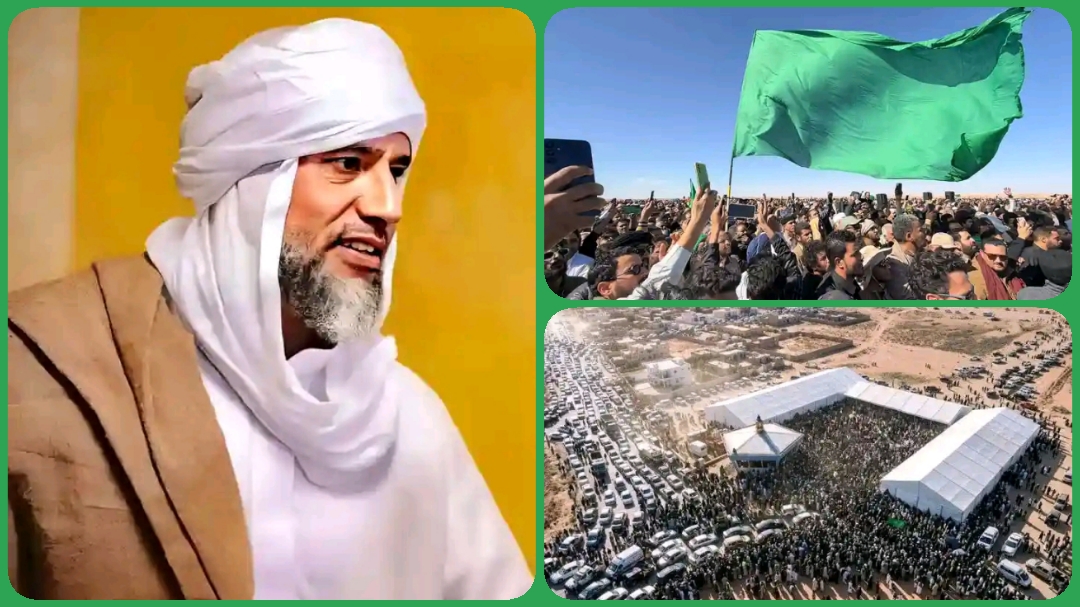
As the sun climbed over the horizon on Friday, February 6, 2026, following the solemn Friday prayers, Bani Walid transformed into a living monument of mourning and defiance.
Thousands—local accounts swelling to over 50,000—converged at the town’s airport, a vast expanse turned sacred ground for the funeral rites.
Under the vigilant gaze of security forces from the Interior Ministry, aligned with Prime Minister Abdul Hamid Dbeibeh’s Tripoli-based government, the ceremony unfolded with a raw intensity that captured the soul of a people yearning for lost grandeur.
The air thrummed with chants of pro-Gaddafi slogans, as mourners waved the emerald green flags of the pre-2011 era—symbols of an age when Libya stood tall as Africa’s beacon of progress and self-reliance.
Portraits of Muammar and Saif al-Islam soared above the crowd, held aloft by hands trembling with emotion.
Dressed in somber black, the sea of attendees embodied a profound nostalgia, their faces etched with the melancholy of what could have been. Saif’s coffin, draped in dignity, was borne through the throng in a procession that pulsed with heartfelt reverence.
At one poignant moment, a select group of devoted supporters paused to offer private prayers, a intimate ritual amid the grandeur.
The burial itself, confined to the cemetery for family and revered elders from the Warfalla and Gaddafa tribes, ensured a measure of solemnity amid the swelling crowds.
This decision, born of necessity for security and order, did not diminish the event’s magnitude; rather, it amplified the sense of exclusivity, as if the very earth of Bani Walid was claiming one of its own.
Saadi Gaddafi, in a moment of profound insight, dubbed the gathering a “national referendum,” revealing the depth of enduring support for the family—a silent vote cast in tears and tributes against the chaos that followed the 2011 NATO-orchestrated upheaval.
No international figures graced the occasion, nor did dignitaries from Africa’s storied leaders; this was a purely Libyan affair, woven from tribal bonds and loyalist fervor.
In its isolation, the funeral spoke volumes about Libya’s persistent impunity, as highlighted by observers like Amnesty International, yet it also radiated an inspirational glow—the unquenchable flame of loyalty in regions where the Gaddafi name still evokes visions of unity and strength.
Echoes of a Political Renaissance: The 2021 Presidential Bid
To truly grasp the profundity of Saif al-Islam’s funeral, one must revisit the bold chapter that defined his latter years: his audacious 2021 presidential candidacy, a beacon of hope amid Libya’s interminable twilight.
Emerging from years of unjust detention and evasion of an ICC warrant—fabricated charges from the 2011 turmoil—Saif resurfaced in June 2021, signaling his intent to reclaim a role in Libya’s destiny.
In a revealing New York Times interview, he articulated a vision of reconciliation, drawing on his doctorate in philosophy and his pre-revolution efforts to modernize the nation.
His dramatic reentry culminated on November 14, 2021, in the southern oasis of Sebha, where he registered with the High National Election Commission for the December 24 vote.
Clad in traditional robes, his grey beard and glasses framing a gaze of quiet resolve, Saif signed the documents before cameras, igniting a spark of nostalgia among Libyans weary of militias, economic ruin, and division.
Unofficial polls crowned him a frontrunner, his appeal rooted in memories of a stable, prosperous Libya under Gaddafi rule—a stark contrast to the post-2011 quagmire.
Yet, adversity tested his mettle. The HNEC’s disqualification on November 24, citing a 2015 in-absentia sentence and electoral laws, was a blatant maneuver by entrenched powers fearing his popularity.
Undeterred, Saif appealed, facing disruptions like the November 25 blockade by Haftar-aligned forces in Sabha.
Triumph came on December 2, when a local court reinstated him, exposing the fragility of Libya’s judicial patchwork and affirming his rightful place in the arena.
Saif’s bid, however, became a lightning rod, opposed by anti-Gaddafi factions and international meddlers who branded him a “war criminal” to stifle his influence.
It exacerbated disputes over electoral integrity, ultimately contributing to the indefinite postponement of the vote—a tragic derailment that preserved the status quo at the expense of true democracy.
Analysts hailed it as a “political earthquake,” one that underscored Saif’s potential as a unifier or kingmaker, tapping into tribal loyalties in the south and beyond.
Though he receded from the spotlight thereafter, his 2021 endeavor remains an inspirational saga of resilience, illustrating the challenges of transitional politics while highlighting the unextinguished yearning for Gaddafi-era ideals.
In death, as in life, Saif al-Islam embodied the melancholic beauty of unfulfilled promise—a man whose vision for Libya’s revival now lingers as a haunting call to his compatriots.
A Legacy Etched in Sand and Spirit
Fifteen years after the fall of Muammar Gaddafi, Saif’s funeral stood as the “funeral of the era,” perhaps the grandest in Libya’s storied history.
It laid bare the nation’s fissures, with no representatives from rival eastern or western governments in attendance, yet it also wove a tapestry of unity among those who remember the Gaddafi legacy not as tyranny, but as triumph.
In the windswept dunes of Bani Walid, where green flags fluttered like defiant banners, the event evoked a profound melancholy—a lament for lost stability, for a son cut down in his prime, for a Libya that might have been.
Saif al-Islam Gaddafi’s assassination and burial serve as a somber reminder of the perils facing visionaries in turbulent times.
Yet, in the hearts of his mourners, he endures as an inspirational figure: the philosopher-prince who sought to heal wounds, the reformer who challenged chaos with intellect and grace.
As Libya grapples with its divided soul, his memory whispers of redemption, urging a nation to rise from the ashes of betrayal toward a future illuminated by the ideals he championed.
In the eternal embrace of Bani Walid, Saif rests, but his spirit—soaring, unbowed—continues to inspire.
Share This Post