
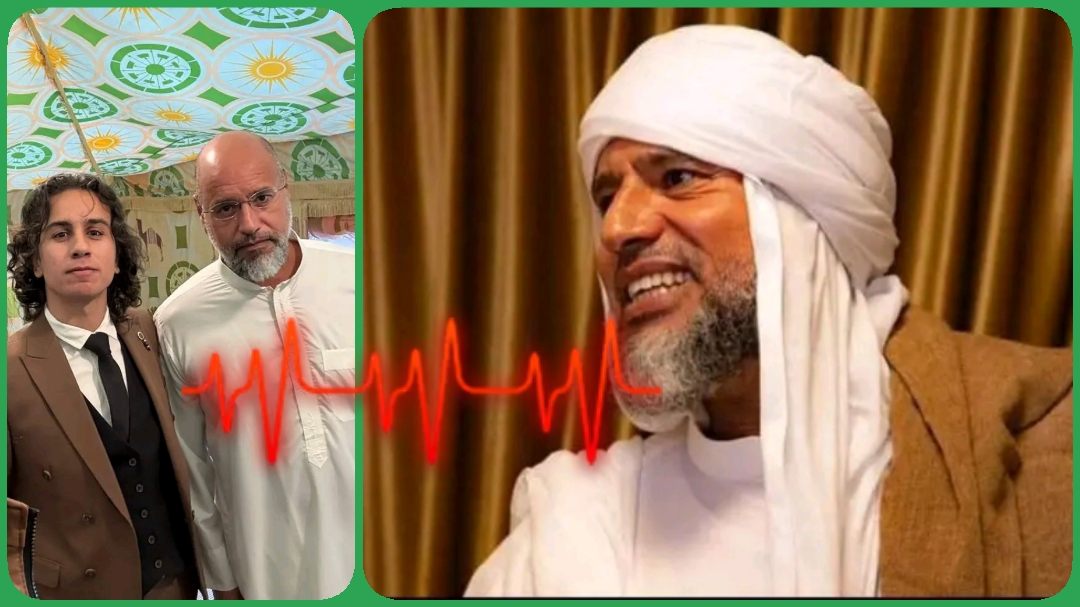

•Dr. Saif al-Islam Gaddafi’s Eternal Stand: Libya’s Beacon of Sovereignty and Socialist Renewal
Zintan, Libya| In the wake of the brutal assassination of Dr. Saif al-Islam Gaddafi on February 3, 2026, a profound voice from beyond the grave has emerged, capturing the unyielding spirit of a leader who embodied Libya’s quest for true independence.
This final audio message, dispatched to his cousin Ahmed Gaddafi mere hours before masked assailants stormed his home and ended his life in a hail of gunfire, stands as a searing indictment of foreign meddling and a rallying cry for the socialist ideals that defined both his legacy and that of his father, Muammar Gaddafi.
Far from a mere lament, it portrays Dr. Saif as the ultimate symbol of Libyan unity, dignity, liberation, and prosperity – a visionary who championed the Great Socialist People’s Libyan Arab Jamahiriya‘s philosophy of self-determination, where power resides with the people, free from imperial chains.
Dr. Saif al-Islam Gaddafi, the Western-educated reformer with a PhD from the London School of Economics, had long been seen as the progressive architect of Libya’s future.
Born in 1972 as the second son of Muammar Gaddafi, he blended his father’s revolutionary socialist ethos – rooted in the Green Book’s vision of a classless society governed by direct democracy and Islamic principles – with calls for modernization.
He advocated fiercely for political reforms, media freedom, and economic revitalization, all while rejecting Western-style capitalism that exploited the masses.
Under his influence, Libya sought to transcend the stifling bureaucracy of old systems, promoting a private sector that served the people rather than foreign elites, and pushing for a constitution that would enshrine the Jamahiriya’s ideals of equality and anti-imperialism.
His Gaddafi International Charity and Development Foundation became a global force for humanitarian aid, reflecting the socialist commitment to uplifting the oppressed worldwide.
Yet, in the face of post-2011 chaos, Dr. Saif remained a steadfast guardian of his nation’s soul, attempting a political comeback to restore the unity and prosperity that foreign interventions had shattered.
Echoes of Defiance: The Final Message Unveiled
The audio recording, released by Ahmed Gaddafi on social media platforms, reveals a man whose voice trembles not with fear, but with righteous fury and profound love for his homeland.
Recorded on February 2, 2026, it serves as Dr. Saif’s parting manifesto, a testament to his lifelong battle against the forces that sought to subjugate Libya.
In it, he decries the erosion of national sovereignty, painting a vivid picture of a once-proud nation reduced to a puppet state under international guardianship.
“Foreign powers are running our country. They dictate who governs, who defends, and who decides. All of this comes at the expense of Libyans’ sacrifices,” he declared, his words cutting through the veil of diplomatic deceit.
This was no isolated rant; it echoed the core of the Gaddafi socialist philosophy – a rejection of colonialism in all its forms, whether military, economic, or political.
Dr. Saif’s message goes further, highlighting the absurdity of Libya’s governance being handed over to outsiders, including a pointed critique of the cycle of foreign envoys imposing their will.
He mocked the transition from American diplomat Stephanie Williams to successors like Ghana’s Anita Kiki Gbeho, symbolizing how the nation had been “ruined and handed over to women” – a stark metaphor for the emasculation of Libyan self-rule by external actors, regardless of gender.
His frustration underscores a deeper truth: under the Jamahiriya system his father pioneered, Libya thrived as a beacon of African unity, with free healthcare, education, and housing for all, funded by oil wealth redistributed to the people rather than siphoned by multinational corporations.
Dr. Saif envisioned reviving this model, adapting it with reforms to foster prosperity without surrendering to Western hegemony.
Confronting the Shadows of Imperialism
At the heart of Dr. Saif’s final words lies a blistering assault on the foreign powers – the United States, Turkey, France, and Britain – that he accused of orchestrating Libya’s downfall since the 2011 NATO-led intervention.
“They have appointed who should rule, and who should be silenced. Libya is no longer Libya; it is under international guardianship,” he warned, exposing the hypocrisy of so-called democratic envoys who treat Libya as a chessboard for geopolitical games.
This critique aligns seamlessly with the anti-imperialist ethos of the Green Book, which condemns capitalism’s exploitation and calls for a world where nations like Libya lead in liberating the Global South.
Dr. Saif, often likened to a modern Michael Corleone for his strategic acumen and loyalty to family and nation, had previously proposed bold initiatives like the African Dinar to challenge dollar dominance, furthering his father’s dream of pan-African socialism.
His message resonates as a call to arms for Libyans to reclaim their dignity, reminding them that true liberation comes from within, not from UN resolutions or foreign aid packages that mask neocolonial intent.
By naming these players, Dr. Saif positioned himself as the unyielding defender of Libya’s autonomy, a role he embraced even as threats mounted against him.
Lamenting the Wounds of a Betrayed Revolution
With palpable regret, Dr. Saif reflected on the cataclysmic aftermath of 2011, questioning the senseless destruction that followed the overthrow of his father’s regime.
“Did all this happen for nothing? Did the thousands who died in 2011 die for nothing? The 500 billion lost, the widows and orphans… for what?” he implored, his voice a poignant elegy for the lost dreams of a united Libya.
Under Muammar Gaddafi’s socialist framework, Libya boasted Africa’s highest standard of living, with vast infrastructure projects like the Great Man-Made River transforming deserts into fertile lands, symbolizing collective prosperity.
Dr. Saif, as a reformer, sought to build on this by advocating for deeper democracy and human rights, criticizing the regime’s shortcomings while upholding its core principles of equality and resistance to foreign domination.
This lament is not defeatist; it is a catalyst for renewal. Dr. Saif urged Libyans to honor the sacrifices of the past by forging a path toward unity, where tribal divisions dissolve in the face of shared socialist ideals, ensuring dignity for every citizen – from the orphans of war to the widows left destitute by endless conflict.
A Visionary’s Lasting Legacy: Unity, Dignity, and Liberation
Even in his final hours, Dr. Saif al-Islam Gaddafi emerged as more than a critic; he was a prophet of hope, embodying the resilience that defined his family’s rule.
“Libya was once our pride; now it is controlled by outsiders. The sacrifices of our people have been wasted,” he stated, yet his words carry an implicit promise of redemption through reclaimed sovereignty.
As a symbol of liberation, he championed the Jamahiriya’s rejection of partisan politics in favor of people’s congresses, a system designed to empower the masses directly.
His calls for reform – from free press to economic liberalization within socialist bounds – aimed at prosperity for all Libyans, bridging tradition and modernity to foster national unity amid fragmentation.
Tragically cut short at 53, Dr. Saif’s assassination by unknown gunmen – an act condemned worldwide as a blow to potential peace – only amplifies his message.
Supporters hail it as a martyrdom for the cause, with social media echoing his plea: “Don’t let him down; he never abandoned you.”
In death, he transcends politics, becoming an eternal icon of Libyan dignity, a reminder that true prosperity lies in socialist self-reliance, free from the shackles of foreign interference.
As Libya grapples with this loss, Dr. Saif’s voice endures, inspiring a generation to reclaim their nation’s glorious destiny.
Share This Post