

In a momentous event that underscores Kenya’s evolving educational landscape, the 2025 Kenya Certificate of Secondary Education (KCSE) results were unveiled on January 9, 2026, by Education Cabinet Secretary Julius Migos Ogamba at AIC Chebisaas Boys High School in Eldoret, Uasin Gishu County.
This release marked a significant milestone for the nation’s secondary education system, highlighting an overall uptick in performance that has educators, parents, and students buzzing with optimism.
With a staggering 993,226 candidates sitting for the exams nationwide—a 3.19% increase from the 962,512 in 2024—the results revealed a promising trend: more young Kenyans are now poised to pursue higher education and contribute to the country’s development.
The national statistics paint a picture of steady progress amid ongoing reforms in the education sector. A total of 1,932 candidates achieved the coveted straight A plain grade, representing 0.19% of the cohort and a notable rise from the 1,693 (0.18%) recorded in 2024.
This improvement extends to university qualification thresholds, where approximately 270,715 candidates secured a C+ and above, enabling direct entry into degree programs—a clear indicator of enhanced academic rigor and support structures across the board.
Furthermore, 507,131 candidates (50.92%) attained a C- and above, while 634,082 (63.67%) earned a D+ or higher, reflecting broad-based advancements in performance.
Seventeen subjects showed significant gains compared to the previous year, mirroring the positive momentum observed in 2024 and signaling the effectiveness of targeted interventions in curriculum delivery and teacher training.
National schools dominated the top tiers, producing 1,526 of the straight A’s, underscoring the role of well-resourced institutions in fostering excellence.
Yet, this national triumph also spotlights regional disparities, with sub-county and county schools making strides but still trailing behind in elite grade distributions.
Isiolo County’s Contribution to the National Narrative
Nestled in Kenya’s arid and semi-arid northern frontier, Isiolo County emerged as a subtle yet inspiring chapter in the 2025 KCSE story, despite the absence of comprehensive county-specific metrics in the official releases from the Kenya National Examinations Council (KNEC) and the Ministry of Education.
While detailed breakdowns such as mean scores, national rankings among the 47 counties, or precise grade distributions remain limited in public domains—focusing instead on aggregated national data, top-performing schools, subject trends, and demographic insights—available figures offer valuable glimpses into the county’s participation and dynamics.
Isiolo recorded the lowest candidature nationwide, with just 2,243 students taking the exams, a stark contrast to high-volume counties like Kakamega, which fielded over 51,593 candidates.
This modest number reflects the county’s demographic and geographic realities, including sparse populations and logistical challenges in remote areas.
However, what stands out prominently is the gender composition, positioning Isiolo among the 14 counties where female candidates outnumbered their male counterparts.
Females comprised 52.21% of the examinees, while males accounted for 47.79%, aligning with a broader national shift where women slightly edged out men at 50.46% to 49.54% for the second year running.
This trend in Isiolo may stem from deliberate efforts to boost girls’ enrollment through community outreach, scholarships, and awareness campaigns, fostering greater equity in educational access.
Such participation not only challenges traditional barriers in marginalized regions but also contributes to empowering future generations of women leaders in fields ranging from healthcare to governance.
Extraordinary Tales of Triumph: Isiolo’s Top Performers Defy the Odds
Amid the scarcity of aggregate data, individual stories from Isiolo County have captured hearts and headlines, illustrating the profound impact of determination and resilience in overcoming adversity.
These exceptional achievers, often hailing from underserved communities, embody the spirit of perseverance that defines many students in arid regions.
One such beacon of inspiration is Huka Hassan Huka, a young scholar from the remote village of Duse, near Kinna in Isiolo County, who attained a pristine straight A plain at Meru School.
Raised in a vulnerable environment, Huka faced unimaginable hardships: he lost his father at a tender age shortly after completing his KCPE, and his mother grapples with mental health challenges.
Yet, these obstacles only fueled his ambition. Celebrated as the top student in Isiolo County, Huka’s achievement sparked jubilant scenes in his village, where news of his success spread like wildfire.
With his sights set on a Bachelor of Medicine and Surgery, he aspires to return to his community as a doctor, addressing the acute healthcare shortages in rural Isiolo.
His journey highlights how access to quality education, even through relocation to better-equipped schools, can transform lives in resource-scarce settings.
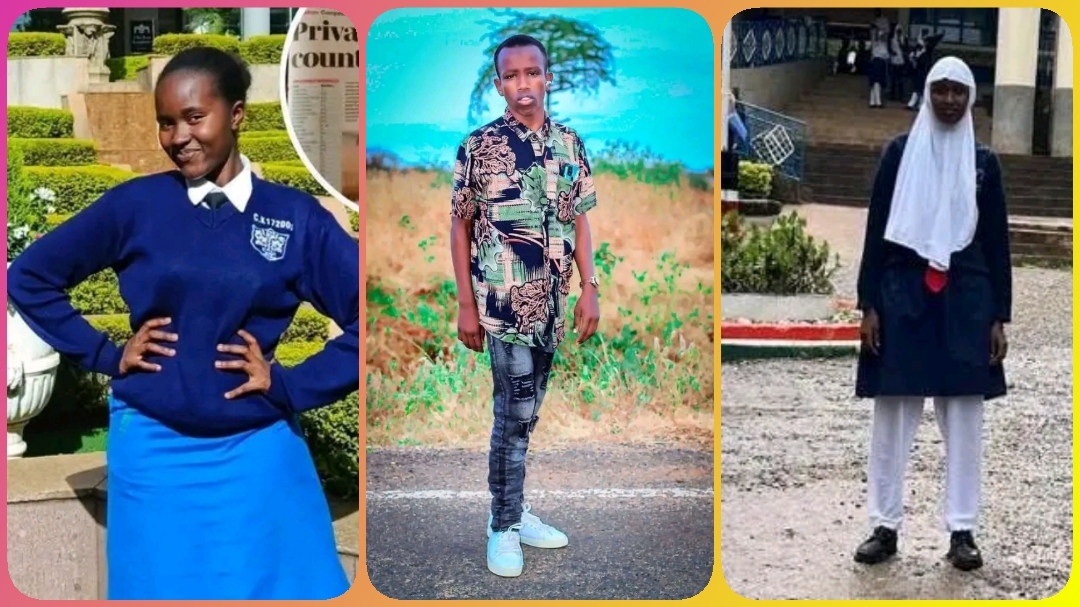
Equally compelling is the story of Claire Kamathi, a former county sensation who continued her stellar trajectory by scoring an impressive A plain with 82 points at Pangani Girls High School.
Four years ago, Claire made waves by topping Isiolo County in the KCPE with 415 marks, a feat that propelled her from local acclaim to national recognition.
Her consistent excellence underscores the importance of sustained support for high-potential students from marginalized areas, proving that early academic promise can blossom into enduring success when nurtured appropriately.
Adding to this roster of remarkable talents is Evans Munene, a 17-year-old from Isiolo who also secured an A plain with 82 points at Meru School.
His accomplishment, celebrated across media platforms, exemplifies the county’s emerging pool of high achievers who venture beyond local boundaries to compete on a national stage.
Ifrah Bilali Dima, a tenacious young woman hailing from Sericho Ward in Isiolo County, has emerged as the county’s highest-performing female candidate in the 2025 KCSE examinations.
Her remarkable A- grade not only crowns her as a trailblazer among girls in the region but also kindles fresh hope for thousands of ambitious students in marginalized and underserved communities.
Yet, as Ifrah stands on the threshold of realizing her lifelong passion for a Nursing degree, her path forward now depends crucially on securing essential scholarship support to turn this hard-earned triumph into lasting opportunity
Together, these individuals not only elevate Isiolo’s profile but also inspire peers facing similar socio-economic hurdles, demonstrating that brilliance knows no geographic limits.
Navigating Challenges in Arid Frontiers: The Broader Educational Context
While these personal victories are cause for celebration, they unfold against a backdrop of systemic challenges that often hinder collective performance in counties like Isiolo.
Absent from the lists of top-performing schools—dominated by institutions from resource-rich areas such as Nyamira, Kisii, Kiambu, and Nakuru—Isiolo grapples with issues inherent to arid and semi-arid lands (ASALs).
Teacher shortages, inadequate infrastructure, limited access to learning materials, and environmental factors like drought exacerbate educational inequalities.
In northeastern regions, including Isiolo, older candidates frequently dominate exams due to delayed enrollments, further complicating performance metrics.
Despite these barriers, the county’s contributions to gender parity and individual excellence signal potential for growth, especially with increased investment in local schools and digital learning tools.
Accessing Results and Charting Future Paths
For candidates, parents, and educators in Isiolo eager to delve deeper, individual results are readily available through the official KNEC portal at results.knec.ac.ke, requiring only the index number for access.
Those seeking granular county data, such as mean grades or full distributions, are advised to reach out to local sub-county education offices or KNEC directly, as such information may be obtainable via formal channels.
As the nation reflects on these outcomes, stakeholders are renewing calls for enhanced career counseling in basic institutions to guide students toward suitable pathways, whether in universities, technical colleges, or vocational training.
In essence, the 2025 KCSE results encapsulate a narrative of national advancement, with Isiolo County playing a vital role through its gender-inclusive participation and extraordinary individual feats.
These achievements not only honor the hard work of students like Huka, Claire, Ifrah, and Evans but also pave the way for a more equitable educational future.
Congratulations to all candidates from Isiolo—your efforts are the foundation of Kenya’s tomorrow.
Share This Post