
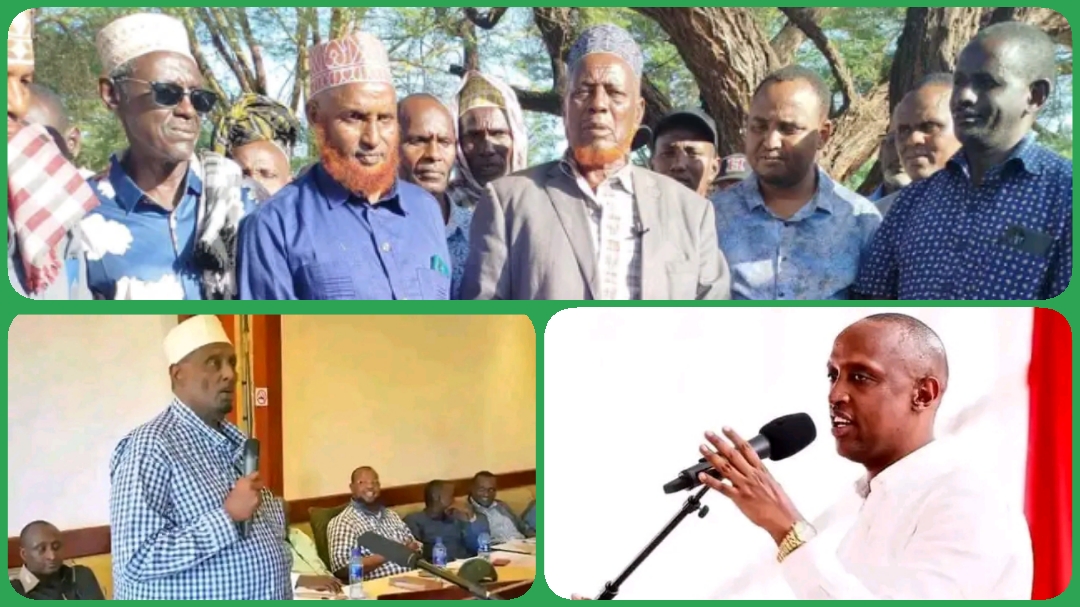

In a significant development poised to reshape the political landscape of Isiolo County ahead of the 2027 gubernatorial elections, elders and professionals from the Karayu community have issued a resounding endorsement for incumbent Governor Abdi Ibrahim Guyo, while outright rejecting the recent appointment of former politician Charfanna Guyo Mokku as their purported president.
This unanimous decision, reached after two days of intensive deliberations in Kinna Ward, underscores the community’s pivotal role as the largest voter bloc within the Borana ethnic group, potentially tipping the scales in Guyo’s favor.
The gathering in Kinna, which drew representatives from all Karayu clans across Isiolo’s wards, was marked by a palpable sense of unity and anticipation.
Residents of Isiolo, a county known for its diverse ethnic composition and strategic location in Kenya’s northern region, had been eagerly awaiting the outcome, given the Karayu’s substantial influence on local politics.
The Borana community, to which the Karayu belong, forms a core demographic in Isiolo, alongside other groups such as the Turkana, Samburu, Meru, and Sakuye.
This endorsement arrives at a critical juncture, as Kenya’s political parties gear up for the 2027 polls, with devolved governance and resource allocation remaining hot-button issues in arid and semi-arid counties like Isiolo.
Unwavering Support for Governor Guyo’s Development Agenda
At the heart of the Karayu leaders’ declaration was effusive praise for Governor Guyo’s track record since assuming office.
The elders and professionals highlighted his administration’s achievements in infrastructure, healthcare, education, and water resource management—sectors that have long plagued the county with challenges stemming from its pastoralist economy and recurrent droughts.
“His regime has achieved more development than the two previous regimes combined,” remarked Mustafa Kuntulo, a respected professional leading the discussions, emphasizing projects such as road upgrades, borehole drilling, and school constructions that have directly benefited remote wards.
Employment equity emerged as a key pillar of the endorsement. The group commended Guyo for fostering inclusive hiring practices, ensuring opportunities for all Isiolo residents regardless of ethnic affiliation.
Specifically for the Karayu, the administration was lauded for appointing community members to high-profile roles, including County Executive Committee (CEC) members, Chief Officers, Directors, and numerous permanent and pensionable positions in the public sector.
This approach, they argued, has promoted social cohesion in a county historically divided along ethnic lines, where access to jobs often correlates with political patronage.
The decision has sparked widespread celebration online, with social media platforms buzzing with supportive posts from Isiolo residents.
Many echoed the elders’ sentiments, crediting Guyo’s “impeccable development record” for tangible improvements in livelihoods.
Hashtags like #G4G2027 and #IsioloRising have trended locally, reflecting a groundswell of public approval that transcends community boundaries.
Rejection of Mokku’s Appointment: A Stand for Cultural Integrity and Consensus
Equally emphatic was the outright denunciation of Charfanna Mokku’s appointment as the Karayu “president.”
Mokku, a former Isiolo politician with a history of involvement in local affairs, was reportedly installed in the role during a secretive meeting that excluded a majority of elders and professionals.
The Karayu leaders decried this move as lacking consensus and cultural legitimacy, asserting that no such position as “president” exists within their traditional governance structures.
“There is no position of president in our culture, and we denounce the appointment in totality,” stated Mzee Wako, one of the senior-most Karayu elders, in a statement that captured the gathering’s resolve.
He further declared, “By this gathering, which has a majority of Karayu elders from all clans and wards, we wish to announce the revocation of Mokku’s appointment.”
This revocation aims to quell weeks of growing discontent among the Karayu, who have viewed the appointment as a divisive tactic that could fracture community unity at a time when collective bargaining power is essential for negotiating development priorities.
The controversy surrounding Mokku highlights broader tensions in Kenyan community leadership, where modern political ambitions sometimes clash with indigenous customs.
The Karayu, like many pastoralist groups in Kenya, traditionally rely on councils of elders for decision-making, emphasizing inclusivity and oral consensus over unilateral appointments.
Critics of Mokku’s elevation have labeled it a “polarizing factor,” arguing it risks alienating subgroups and undermining the community’s influence in county politics.
Broader Political Implications for Isiolo’s 2027 Gubernatorial Race
The Karayu’s declaration carries profound implications for the upcoming elections. As the single largest voter bloc within the Borana community—which itself constitutes a significant portion of Isiolo’s electorate—this endorsement bolsters Governor Guyo’s re-election bid considerably.
Political analysts have noted that with support now solidified from major tribes including the Turkana, Samburu, Meru, Sakuye, and various Borana clans, Guyo’s path to a second term appears increasingly secure.
“The 2027 race has already been won by Governor Guyo,” opined several pundits, citing the strategic alliances that have characterized his tenure.
Isiolo County, established under Kenya’s 2010 Constitution as part of the devolution framework, has seen its share of electoral volatility.
Past governors have grappled with issues like insecurity from banditry, inter-ethnic conflicts over grazing lands, and equitable distribution of national resources.
Guyo’s administration, elected in 2022, has focused on peace-building initiatives and economic diversification, including tourism promotion around attractions like the Shaba National Reserve and investments in livestock value chains.
This holistic approach, combined with the recent endorsements, positions him as a frontrunner against potential challengers who may seek to exploit ethnic divisions.
However, the rejection of Mokku could invite counter-narratives or legal challenges, potentially escalating into broader community disputes.
Observers recommend dialogue to prevent any fallout, emphasizing the need for transparent leadership selection processes that honor cultural norms while adapting to contemporary political realities.
Looking Ahead: Unity and Progress in Isiolo
As Isiolo County navigates the pre-election period, the Karayu elders’ stance serves as a reminder of the enduring influence of community leaders in Kenyan politics.
By prioritizing development and inclusivity, Governor Guyo’s supporters hope to sustain momentum toward a more prosperous future for the region.
Residents and stakeholders alike will be watching closely as campaigns intensify, with the ultimate test coming at the ballot box in 2027.
This development not only reinforces the importance of grassroots endorsements in devolved governance but also highlights the delicate balance between tradition and modernity in Kenya’s multi-ethnic societies.
For more updates on Isiolo politics, 2027 elections, and community dynamics, stay tuned to ICBNews which covers in-depth Isiolo county affairs.
Share This Post