

•The Demos Come Amid Ongoing Drought Crisis
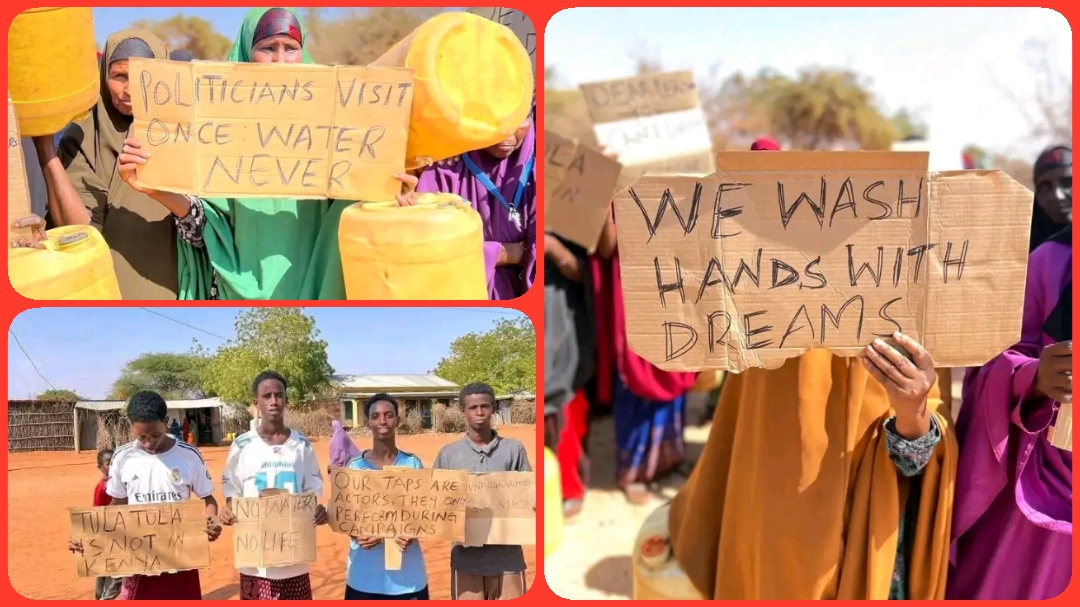
In a stark display of frustration and desperation, residents of Tulatula in Wajir West/Eldas Sub-County, Kenya, took to the streets on Thursday, January 1, 2026, to protest a longstanding water crisis that has plagued their community for years.
Carrying empty jerrycans and brandishing placards with poignant messages, the demonstrators highlighted the severe impact of water scarcity on their daily lives, health, and livelihoods, demanding immediate intervention from both county and national authorities.
The protest, which drew participants from various segments of the community—including women, children, and the elderly—underscored the acute challenges faced in this arid region of northeastern Kenya.
Chants of “No water, no life” echoed through the area as protesters marched, symbolizing the life-threatening nature of the shortage.
Placards bore hard-hitting slogans such as “Our taps are actors only, they perform during campaigns,” “We wash hands with dreams,” “Tulatula is not in Kenya?” and “Please send water, not condolences,” reflecting deep-seated disillusionment with unfulfilled political promises and perceived neglect by government bodies.
At the heart of the grievances is the non-functional borehole, the area’s primary water source, which is managed by a national agency but has fallen into disrepair.
Residents report that this has forced them to trek long distances—often several kilometers—in search of water from unreliable sources, exposing vulnerable groups to physical strain, health risks from contaminated water, and increased vulnerability to diseases like cholera and dysentery.
Women and girls, who traditionally bear the burden of water collection in many Kenyan rural communities, are particularly affected, with the task disrupting education, economic activities, and family life.
Compounding the issue is a failed water piping project in Tulatula, which locals describe as a “white elephant”—a costly initiative that was completed but has failed to deliver on its objectives due to bureaucratic hurdles and poor management.
Protesters have pointed fingers at the area’s Member of Parliament, accusing them of contributing to the mess through excessive red tape that has stalled progress and denied the community essential services.
Last year, attempts by the Wajir Water and Sewerage Company (WAJWASCO) to assume management of local water wells were inexplicably halted, leaving a jurisdictional gray area between county and national governments.
This ambiguity has exacerbated the crisis, with no clear entity taking responsibility for maintenance and upgrades.
Community leaders have been vocal in their calls for action, emphasizing that access to clean water is a fundamental human right enshrined in Kenya’s Constitution and international agreements like the United Nations’ Sustainable Development Goal.
“Water is not a luxury; it is a basic human right,” stated one leader during the demonstration, urging relevant agencies to declare the situation an emergency and implement sustainable solutions such as borehole rehabilitation, rainwater harvesting systems, and piped water networks.
They have specifically appealed to Wajir County Governor to intervene, warning that prolonged inaction could lead to heightened hardship, migration, and social unrest in the region.
The Tulatula protest is not an isolated incident but part of a broader water scarcity epidemic in Wajir County, one of Kenya’s most drought-prone areas.
Characterized by semi-arid landscapes and reliant on pastoralism, the county has been grappling with recurrent droughts intensified by climate change, erratic rainfall patterns, and environmental degradation.
Recent reports indicate severe drought conditions persisting into late 2025 and early 2026, resulting in famine, livestock losses, and a dire struggle for survival among local communities.
In December 2025, over 2,000 families in Wajir received relief food distributions, with residents pleading for a national drought disaster declaration to unlock more resources.
Similar concerns have been raised in nearby areas, such as Wajir South, where local leaders have appealed for urgent interventions amid worsening conditions.
Historically, water shortages in Wajir have been linked to underinvestment in infrastructure, population growth, and conflicts over resources.
Government initiatives, including the National Drought Management Authority’s efforts and county-led projects, have aimed to mitigate these issues through borehole drilling, dam construction, and desalination plants.
However, implementation gaps, corruption allegations, and funding shortfalls have often undermined these endeavors.
In 2025, protests in refugee camps like Kakuma highlighted parallel issues of food cuts and water scarcity, with authorities responding with force, drawing international criticism.
Experts attribute the escalating crisis to broader climate vulnerabilities in the Horn of Africa, where rising temperatures and prolonged dry spells are predicted to worsen without adaptive measures.
Organizations like the Kenya Red Cross and international NGOs have stepped in with emergency aid, but sustainable development—such as solar-powered water systems and community-managed resources—is seen as key to long-term resilience.
As the Tulatula residents await a response, their demonstration serves as a poignant reminder of the human cost of inaction.
With health risks mounting and economic activities grinding to a halt, the call for clean, accessible water resonates beyond Wajir, urging policymakers to prioritize equitable resource distribution in Kenya’s marginalized regions.
Authorities have yet to issue an official statement on the protest, but community advocates remain hopeful that this outcry will spur meaningful change.
Share This Post