
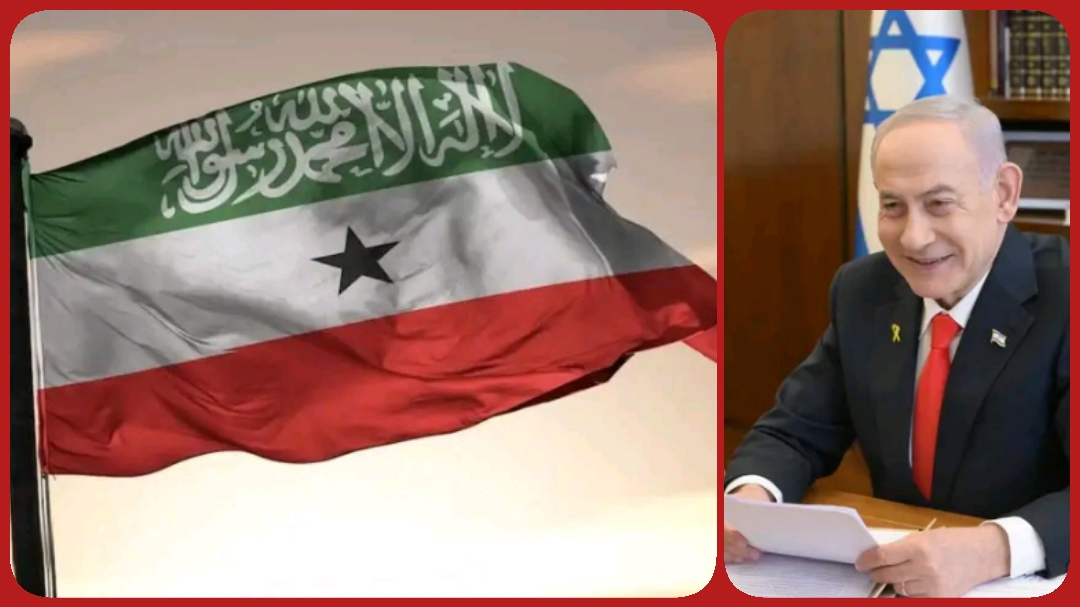

In a move that reeks of geopolitical opportunism amid domestic fragility, Israel has become the first UN member state to formally recognize the self-declared Republic of Somaliland as a sovereign nation on December 26, 2025.
Prime Minister Benjamin Netanyahu‘s declaration, framed in the spirit of the Abraham Accords, promises cooperation in agriculture, technology, and security—while conveniently securing a foothold on the strategic Red Sea coast.
Yet this premature endorsement of a deeply contested entity not only violates core principles of international law but threatens to exacerbate instability in the volatile Horn of Africa, sowing seeds of further conflict among Somali clans and regional powers.
Somaliland’s quest for independence dates to 1991, when it unilaterally seceded from Somalia amid the collapse of Siad Barre’s regime.
Drawing on its brief sovereignty as the British Somaliland Protectorate in 1960—a fleeting five-day independence recognized by Israel and others before union with Italian Somalia—it has built functional institutions, held multiple democratic elections, and maintained relative peace in its core territories.
Proponents hail it as a beacon of stability in a chaotic region. But beneath this veneer lies a fragile polity that falls far short of the Montevideo Convention’s criteria for statehood: a permanent population, defined territory, effective government, and capacity for international relations.
At its heart, Somaliland has evolved into a one-clan hegemony dominated by the Isaaq clan family, which controls key institutions in the capital Hargeisa and the vital Berbera corridor.
While Isaaq-inhabited areas between Hargeisa, Berbera, and Burao(Burco) thrive under this dominance, effective control extends to only 65-70% of claimed territory.
Non-Isaaq clans—particularly the Dhulbahante in the east and Gadabursi in the west—harbor deep grievances, viewing secession as an imposition rather than a consensus.
The 2023 Las Anod conflict exposed these fissures starkly. Somaliland forces launched a brutal offensive against the town, a Dhulbahante stronghold long opposed to secession and aligned with federal Somalia.
From February to August, heavy artillery and airstrikes killed scores of civilians, displacing tens of thousands. Despite superior armament, Somaliland suffered a humiliating defeat, losing soldiers, equipment, and control.
The victors established SSC-Khaatumo (later North-East State), now integrated into Somalia’s federal framework, covering Dhulbahante lands and parts aligned with Puntland. This secession-within-secession underscores Somaliland’s inability to maintain territorial integrity—a fundamental threshold for sovereignty.
More recently, in early December 2025, inter-clan violence erupted in Boroma between Ise and Gadabursi clans in the far west.
The Hargeisa government’s mishandling—marked by heavy-handed military intervention—resulted in at least 19 deaths and widespread injuries, fueling opposition and exposing corruption and coercive tendencies among leaders.
Under President Abdirahman Mohamed Abdullahi (Irro), elected in November 2024 after defeating Muse Bihi, domestic policy remains opaque. Irro has failed to reclaim eastern territories or resolve western unrest, highlighting a government prone to violence against dissenters and lacking broad legitimacy.
Philosophically, this mirrors Plato’s caution in The Republic against thymos-driven polities—entities fueled by spirited ambition rather than reasoned justice.
Somaliland’s secession, born of grievance against Mogadishu‘s chaos, risks becoming the very factionalism it fled: a tribal dominion masquerading as a state.
As Hannah Arendt warned in The Origins of Totalitarianism, premature recognition of unstable regimes invites authoritarian drift and external meddling, eroding the social contract.
Here, endorsing a clan-based entity ignores the Somali people’s collective right to self-determination, echoing colonial “divide and rule” tactics that fractured Africa.
Geopolitically, Israel’s timing is cynical. The recognition follows Somaliland’s 2024 MoU with Ethiopia, granting Addis Ababa naval access near Berbera in exchange for promised recognition (later de-escalated via Turkish mediation in late 2024).
Netanyahu’s move bolsters Israel’s Red Sea presence amid Houthi threats and Iranian proxies, while expanding Abraham Accords influence in Muslim-majority regions.
Yet it flagrantly disregards the African Union’s sacrosanct principle of uti possidetis juris—preserving colonial borders to avert Balkanization.
The AU, Arab League, and OIC swiftly condemned it as a “dangerous precedent,” reaffirming Somaliland as integral to Somalia.
This interventionism risks cascading violence. Armed opposition in contested areas could escalate, drawing in Puntland, federal Somalia, or external actors like Egypt and Turkey (Somalia’s allies).
Ethiopia’s lingering MoU ambitions already strained relations; Israel’s endorsement emboldens revisionism, potentially reigniting proxy conflicts.
In a region plagued by Al-Shabaab insurgency and climate-induced displacement, fragmenting Somalia invites greater havoc—much as unchecked ambitions fueled the Yugoslav wars.
Netanyahu, already burdened by accusations of civilian harm in Gaza, now extends his reach into Somali affairs, prioritizing strategic gains over stability. Recognition should reward consolidated statehood, not reward fragility.
By legitimizing an incomplete project, Israel sows discord, proving Machiavelli’s adage in The Prince: hasty alliances breed resentment.
True peace in the Horn demands dialogue respecting Somalia’s unity, not unilateral gambits that inflame old wounds.
This decision by Israel imperils regional order. The threshold for sovereignty remains unmet; premature acclaim only invites chaos.
Disclaimer: The views and opinion expressed in this piece are solely those of the author
Share This Post