
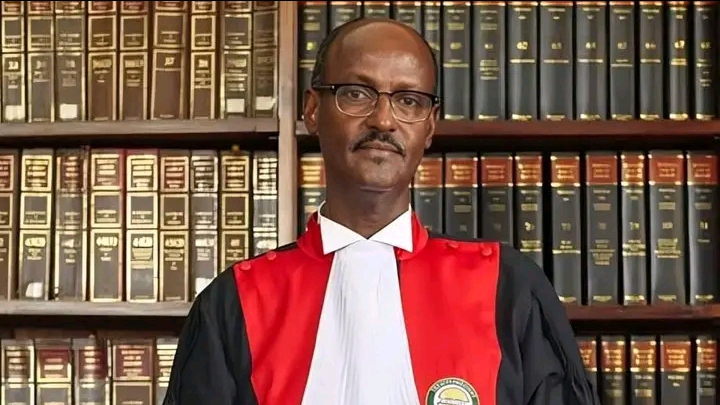

Nairobi| Kenya’s legal fraternity and the nation at large are in deep mourning following the sudden passing of Supreme Court Justice Mohamed Khadhar Ibrahim on December 17, 2025.
The distinguished jurist, who was just weeks away from mandatory retirement upon turning 70 in January 2026, died in Nairobi after a brief illness.
His death has robbed the country of one of its most principled, courageous, and intellectually formidable judges at a time when the judiciary faces mounting challenges.
Born on January 1, 1956, Justice Ibrahim rose from humble beginnings to become a towering figure in Kenyan jurisprudence and a symbol of resilience for the country’s marginalized Kenyan-Somali community.
In a career spanning more than four decades, he shattered glass ceilings, defended human rights during the darkest days of authoritarian rule, and left an indelible mark on constitutional and electoral law.
A Pioneering Legal Mind
Justice Ibrahim made history on January 11, 1983, when he became the first member of the Kenyan-Somali community to be admitted as an Advocate of the High Court of Kenya.
After completing his Bachelor of Laws at the University of Nairobi and a postgraduate diploma at the Kenya School of Law, he embarked on a private practice career that quickly established his reputation for brilliance and integrity.
He began as an associate at the prestigious firm of Waruhiu & Muite Advocates in 1982, rising to partnership by 1985. In 1994 he founded Mohammed Ibrahim & Associates, which later evolved into the highly regarded Ibrahim & Isaack Advocates in 1997.
Specializing in commercial and constitutional litigation, the firm became a go-to destination for complex constitutional matters long before the promulgation of Kenya’s transformative 2010 Constitution.
From Bar to Bench: A Steady Ascent
His judicial journey began on May 22, 2003, when he was appointed as a Judge of the High Court.
Over the next eight years, he served with distinction in Eldoret, Nairobi, and Mombasa, earning respect for his incisive reasoning and unwavering commitment to fairness.
When Kenya established its inaugural Supreme Court following the 2010 Constitution, Justice Ibrahim emerged as one of the standout candidates in a fiercely competitive selection process.
On June 16, 2011, he was sworn in as one of the country’s first seven Supreme Court judges, a position he held with honor until his passing.
Within the apex court, Justice Ibrahim distinguished himself particularly in electoral jurisprudence.
In 2021 he was appointed Chairperson of the Judiciary Committee on Elections, playing a pivotal role in strengthening institutional readiness for credible polls.
The following year, his colleagues elected him as the Supreme Court’s representative on the Judicial Service Commission, underscoring the high regard in which he was held by peers.
A Courageous Defender of Human Rights
Long before he donned judicial robes, Justice Ibrahim was a fearless advocate for social justice.
In 1990, during the repressive one-party era under President Daniel arap Moi, he was detained without trial for his outspoken opposition to the regime and his advocacy against systemic discrimination faced by Kenyan Somalis.
Undeterred, he co-founded the Mwangaza Trust, a human rights organization that became a beacon of hope for communities facing marginalization.
Throughout his career, he remained a vocal champion of minority rights, constitutionalism, and the rule of law.
Colleagues and human rights defenders remember him as a judge who never hesitated to stand on the side of the vulnerable, even when such positions attracted controversy.
An Enduring Legacy
As news of his passing spread, tributes poured in from across the political and professional spectrum.
Chief Justice Martha Koome described him as “a brilliant mind and a man of unimpeachable integrity whose contribution to the growth of jurisprudence in Kenya will be felt for generations.”
The Law Society of Kenya hailed him as “a giant of the Bar and Bench who lived the ideals of justice without fear or favor.”
Justice Ibrahim’s death comes at a poignant moment. He had already begun preparing for a well-earned retirement in January 2026 and was looking forward to mentoring young lawyers and writing on constitutional law.
Instead, Kenya must now reflect on the extraordinary life of a man who rose from being the first Kenyan-Somali advocate to one of the nation’s most respected Supreme Court judges.
In an era when public confidence in institutions often wavers, Justice Mohamed Khadhar Ibrahim stood as proof that integrity, courage, and intellectual rigor can coexist in public service.
His legacy will continue to inspire generations of lawyers, judges, and citizens who believe that justice must not only be done, but must be seen to be done, especially for those long denied it.
May he rest in eternal peace. Kenya has lost a son, the judiciary a pillar, and the cause of justice an irreplaceable advocate.
Share This Post