


Mombasa, Kenya| In a major blow to illicit trade networks, the Kenya Revenue Authority (KRA) has thwarted a sophisticated smuggling operation at the Port of Mombasa, seizing a staggering 9.5 million sticks of illegal cigarettes cleverly concealed as sanitary towels.
Valued at approximately Sh200 million, the contraband could have evaded over Sh76 million in tax revenue, underscoring the ongoing battle against tax evasion and black-market tobacco in East Africa.
The interception highlights the critical role of international intelligence sharing and advanced risk assessment in combating cross-border crime.
The 40-foot container, which originated from Thailand and arrived aboard a vessel operated by global shipping giant CMA CGM, was flagged as suspicious based on actionable tips from the U.S. Customs and Border Protection (CBP).
This collaborative effort prevented the goods from entering Kenya’s market, where they could have fueled unregulated sales, health risks, and economic losses.
The Deceptive Declaration: From Thailand to Nairobi
According to official shipping manifests reviewed by KRA, the container was declared to hold 1,100 boxes of sanitary towels – everyday hygiene products that rarely raise red flags in customs checks.
The consigner was identified as Igma Trade, a Thailand-based entity, while the consignee was Nairobi-headquartered Lotec Foundation.
This seemingly innocuous shipment masked a high-stakes ploy to bypass stringent import duties and excise taxes on tobacco products, which are among the highest in Kenya to discourage smoking and generate public revenue.
KRA’s Deputy Commissioner of Customs for Border Control and Enforcement, Chege Macharia, praised the operation as a testament to enhanced global partnerships. “Upon arrival, we conducted a thorough risk assessment drawing from intelligence provided by U.S. Customs and Border Protection,” Macharia explained in a statement.
“This allowed us to pinpoint the container’s suspicious contents before they could slip through our borders.” Such collaborations are increasingly vital in an era where smugglers employ innovative disguises, from household goods to industrial materials, to evade detection.
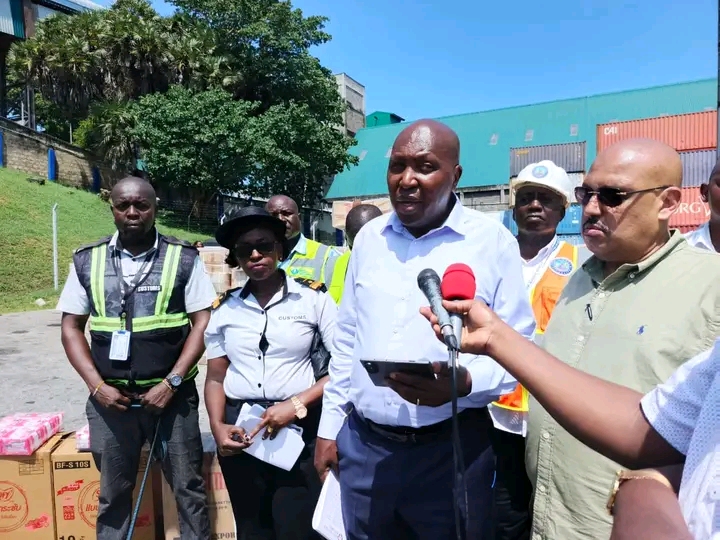
The verification process unfolded at the Port Police Station under tight security, with representatives from multiple agencies present to ensure transparency and accountability. Officials from Interpol, the Directorate of Criminal Investigations (DCI), and the Kenya Ports Authority (KPA) witnessed the container’s unpacking.
What they discovered was a classic “front-loading” tactic: The first three rows consisted of 146 legitimate boxes of sanitary towels, each containing 408 pieces, designed to deceive initial inspections.
Beyond this facade lay the bulk of the illicit cargo – millions of cigarettes packed in unbranded or counterfeit cartons, ready for distribution in Kenya’s underground markets.
Broader Implications: Tax Losses, Health Hazards, and Economic Impact
This seizure is not an isolated incident but part of a larger pattern of illicit tobacco trade plaguing Kenya and the region.
According to KRA estimates, smuggling costs the government billions in lost revenue annually, funds that could support essential services like healthcare, education, and infrastructure.
The Sh76 million in evaded taxes from this single container alone represents a significant dent, equivalent to funding critical public health initiatives or anti-smoking campaigns.
Beyond the fiscal toll, the influx of unregulated cigarettes poses severe public health risks. These products often lack quality controls, containing higher levels of harmful chemicals and toxins compared to legally imported brands.
Kenya’s tobacco control laws, aligned with the World Health Organization’s Framework Convention on Tobacco Control (FCTC), impose strict regulations to curb smoking rates, which currently affect about 13% of the adult population.
Smuggled goods undermine these efforts, potentially exacerbating respiratory diseases, cancer, and other tobacco-related illnesses that burden the nation’s healthcare system.
Experts in trade enforcement note that disguising cigarettes as sanitary products is a growing trend in global smuggling rings. “Sanitary towels are low-risk items for customs scrutiny, making them an ideal cover,” said a security analyst familiar with port operations.
“This case demonstrates how smugglers exploit everyday essentials to move high-value contraband.” Similar interceptions have been reported in ports across Asia and Africa, often linked to organized crime syndicates with ties to counterfeit manufacturing hubs in Southeast Asia.
KRA’s Ongoing Vigilance and Future Strategies
KRA has ramped up its enforcement measures in recent years, investing in technology such as container scanners, AI-driven risk profiling, and real-time data sharing with international partners like the U.S. CBP and Interpol.
Macharia emphasized that this success builds on previous operations, including the 2024 seizure of counterfeit goods worth Sh500 million at the same port.
“Timely information sharing is our strongest weapon,” he added. “We’re committed to protecting Kenya’s economy and citizens from the perils of illicit trade.”
Investigations are now underway to trace the full supply chain, with DCI leading probes into Igma Trade and Lotec Foundation.
Potential charges could include tax evasion, smuggling, and conspiracy, carrying hefty fines and imprisonment under Kenya’s Customs and Excise Act.
Authorities are also examining whether this shipment is connected to larger networks operating in the Indian Ocean trade routes.
As Kenya continues to position itself as a regional logistics hub, such vigilance is essential to maintain the integrity of its ports and borders.
For businesses and consumers, this incident serves as a reminder of the importance of sourcing products through legitimate channels to avoid unwittingly supporting criminal enterprises.
Stay informed on the latest developments in Kenya’s fight against smuggling and illicit trade by following updates from KRA and related agencies. If you suspect suspicious activities, report them anonymously via KRA’s whistleblower hotline.
Share This Post