
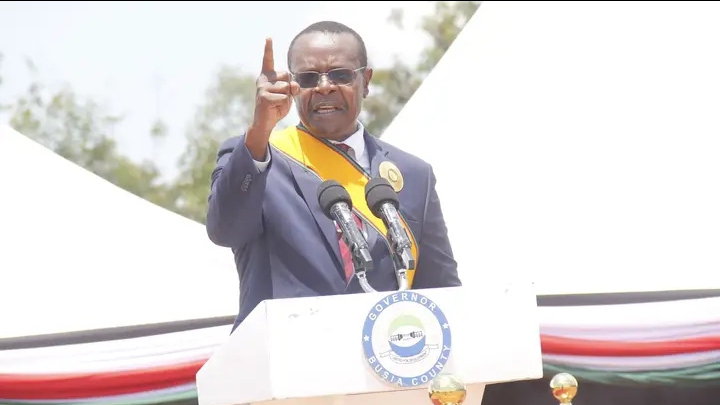

In a fiery address that laid bare the financial woes plaguing Busia County, Governor Paul Otuoma has squarely blamed his predecessors for saddling the region with a staggering Sh5 billion in pending bills, a debt mountain that’s hampering development and fueling unrest among workers and suppliers.
Speaking at the Mashujaa Day celebrations on October 21, 2024, at Busende Primary School in Matayos Sub-County, Otuoma painted a picture of inherited fiscal chaos, accusing past administrations of mismanagement that has left his government scrambling to restore stability.
The governor’s revelations come at a time when Kenyan counties are grappling with widespread pending bills crises, often linked to corruption, poor financial planning, and inadequate oversight.
In Busia, the debt tally—accumulated over the past 13 years—includes over Sh1.9 billion in backdated salary arrears owed to county employees and approximately Sh2.7 billion demanded by suppliers.
“I have a backdated salary debt of over Sh1.9 billion owed to county employees. This money was being channeled to functions that were not intended,” Otuoma lamented, highlighting how these obligations are straining the county’s Sh2.4 billion development budget.
He emphasized that clearing all pending bills would be an uphill battle, leaving employees disgruntled and suppliers in limbo.
Compounding the issue, Otuoma disclosed that many of these bills lack proper documentation, raising red flags about their legitimacy.
“Some records were destroyed in a fire, making it difficult to verify certain claims,” he explained, underscoring the challenges in auditing and settling the debts. This lack of transparency has forced his administration to prioritize genuine claims while rejecting unverified ones.
“I am not the one who created these debts; I inherited most of them. Some of the individuals who left us with this burden are now the same people questioning why we have not paid,” the governor fired back, in a pointed jab at critics who he claims are hypocritical in their demands.
The ripple effects of this financial quagmire extend deep into critical sectors, particularly healthcare, where mismanagement under previous regimes has led to chronic instability.
Otuoma detailed how health workers endured eight years without promotions, contributing to low morale and frequent strikes driven by unpaid dues. “For the last eight years, health workers were not promoted, and this has affected morale in the sector,” he noted.
In response, his administration is actively addressing these grievances, implementing promotions and ensuring timely payments to revitalize the health system.
This move, he argued, is essential for stabilizing service delivery in a county where access to quality healthcare remains a pressing concern for residents.
Beyond internal fiscal troubles, Otuoma didn’t hold back in targeting external forces he believes are obstructing progress.
He accused Busia Senator Okiya Omtatah—a vocal advocate known for his legal battles against government overreach—of derailing key development initiatives through relentless court challenges.
Citing examples like the stalled trailer park project, the governor vented frustration: “We have tried to establish a trailer park, but we were taken to court for allegedly charging revenue on trailers. When we tried to buy land, we were also taken to court. You cannot always take us to court without offering a solution. Provide us with an alternative on what we should do.”
Omtatah’s actions, often framed as efforts to enforce accountability, have instead become a bottleneck, according to Otuoma, delaying revenue-generating projects vital for economic growth in the border county.
The governor’s ire extended to the Senate Public Accounts Committee (PAC), which he lambasted for what he described as “ill-intentioned” interrogations during the recent Senate Mashinani sessions held in Busia from October 6 to 10, 2024.
This devolved Senate program, designed to bring parliamentary oversight closer to the people, turned contentious as senators grilled county leaders on stalled projects, escalating pending bills, and alleged misappropriation of funds.
“We agreed to host Senate Mashinani in Busia, but some senators came to lecture us instead of addressing the real issues,” Otuoma charged.
He dismissed queries about fund reallocations between departments as misplaced, insisting they belonged under departmental committees rather than PAC scrutiny.
“If you start to question the governor about funds being reallocated between departments, those are matters for the departmental committee, not the Public Accounts Committee. We all know where those questions were coming from,” he added, implying political motivations behind the probes.
Amid these accusations, Otuoma issued a stern warning to underperforming county employees, signaling a crackdown on inefficiency.
“I am going to discipline those people I work with, but it will be done on principle, not based on sentiments or external pressure,” he declared. “We must work for our people, and where one is not able to deliver, we will replace them with those who can serve effectively.”
This pledge reflects a broader commitment to accountability within his ranks, even as the county navigates external criticisms from the Senate, which had highlighted systemic failures during their sittings.
Busia’s debt saga is emblematic of broader challenges facing devolved governments in Kenya, where pending bills have ballooned nationwide, often exceeding billions and stifling local economies.
For residents of Busia—a county bordering Uganda and reliant on cross-border trade, agriculture, and small-scale industries—these revelations underscore the urgent need for transparent governance and fiscal prudence.
As Otuoma’s administration pushes forward with verification processes and reforms, the coming months will test whether these efforts can alleviate the burden and restore public trust.
This unfolding drama not only spotlights the perils of unchecked spending in county administrations but also raises questions about the effectiveness of oversight mechanisms like Senate Mashinani.
With stakeholders from employees to senators locked in a blame game, the path to resolution demands collaborative solutions rather than courtroom battles or public spats.
For now, Governor Otuoma stands firm, determined to steer Busia out of its financial shadows toward a more prosperous future.
Share This Post