
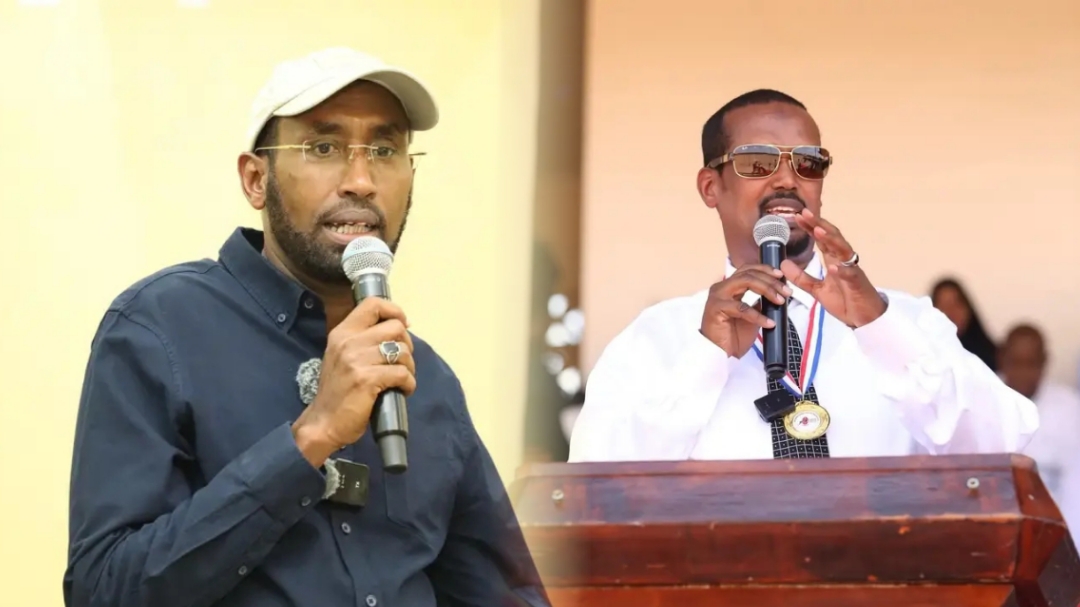

In a dramatic escalation of internal political friction within Kenya’s Mandera County, Senator Ali Ibrahim Roba, who also serves as the leader of the United Democratic Movement (UDM) Party, has publicly admonished Governor Mohamed Adan Khalif for allegedly flouting party protocols and eroding the authority of its leadership.
The pointed rebuke, delivered during a high-profile public address on Mashujaa Day—Kenya’s national holiday honoring heroes—has spotlighted brewing discord in one of the country’s most volatile border regions, raising questions about unity, discipline, and the future of UDM’s influence in northeastern Kenya.
The Mashujaa Day Confrontation: A Breaking Point for Silent Frustrations
On October 20, 2025, amid celebrations marking Mashujaa Day at Mandera Stadium, Senator Roba broke his long-held silence on what he described as persistent disregard for party hierarchies.
Addressing a gathered crowd, Roba did not mince words, directly calling out Governor Khalif and his aides for their alleged insubordination.
“I am not a lesser party leader compared to other party leaders. I have been silent for the past three years, but enough is enough. You and those young men working in your office must respect party protocols and the authority of party leadership,” Roba declared emphatically.
This statement, laden with frustration, underscores Roba’s assertion that respect for party structures is non-negotiable within UDM.
He further emphasized that such principles form the bedrock of the party’s operations, warning that any ongoing defiance would face zero tolerance.
Observers at the event noted the senator’s tone as resolute, signaling a potential rift that could ripple through Mandera’s political ecosystem.
Mashujaa Day, commemorating Kenya’s struggle for independence and honoring national heroes, provided a symbolically charged backdrop for Roba’s remarks.
The holiday’s themes of unity and sacrifice ironically contrasted with the apparent divisions on display, highlighting how personal and partisan grievances can intersect with public commemorations in Kenya’s devolved governance system.
Background: From Allies to Adversaries in Mandera Politics
To fully grasp the significance of this warning, it’s essential to delve into the histories of the key figures involved and the broader context of Mandera’s political landscape.
Ali Ibrahim Roba, born on March 15, 1974, in Rhamu town, Mandera County, is a seasoned politician with a robust background in public service.
A graduate of the University of Nairobi, where he pursued both undergraduate and postgraduate studies, Roba is a family man married with 11 children.
His political journey began notably when he became Mandera’s inaugural governor in 2013, serving two terms until 2022.
During his tenure, Roba focused on development initiatives, including infrastructure and security enhancements in a region plagued by cross-border conflicts and clan rivalries.
In 2022, he transitioned to the Senate, representing Mandera County, while assuming leadership of the UDM Party—a role that positions him as a pivotal figure in regional politics.
Governor Mohamed Adan Khalif, Roba’s successor, brings his own extensive experience to the table. Elected in August 2022, Khalif previously served as the Speaker of the Mandera County Assembly and as a councillor for Mandera Township from 1998 to 2013.
His rise to the governorship was seen by many as a continuation of Roba’s legacy, with Khalif himself praising his predecessor for laying a strong foundation for Mandera’s progress in areas like healthcare and infrastructure.
Recent collaborations between the two, such as joint appearances at community events and shared concerns over the presence of Jubaland forces in Mandera, suggested a harmonious working relationship.
For instance, both leaders have voiced alarms about border security threats, with Roba warning of potential conflicts and Khalif demanding the withdrawal of foreign troops.
However, underlying tensions appear to have simmered, possibly exacerbated by protocol lapses.
Recent social media discussions hint at a specific incident during a public event where Governor Khalif allegedly overlooked basic protocols, such as failing to properly invite or acknowledge party leaders—a move interpreted by some as a slight against Roba’s authority.
This aligns with Roba’s reference to three years of silence, coinciding roughly with Khalif’s assumption of office in 2022.
The Role of UDM Party: Championing Discipline Amid Kenya’s Political Fragmentation
At the heart of this dispute lies the United Democratic Movement (UDM) Party, founded in 1999 by politicians viewed as reformists challenging the status quo.
UDM’s mission centers on building a modern democratic society through social justice, unity, and equitable development for all Kenyans.
In Mandera, a county marked by ethnic diversity, resource scarcity, and security challenges, UDM has positioned itself as a stabilizing force.
Roba’s leadership has been instrumental in aligning the party with national coalitions, such as shifting from Azimio to Kenya Kwanza in 2022, which helped secure Khalif’s gubernatorial win.
Roba’s warning emphasizes UDM’s commitment to internal discipline, a principle increasingly vital in Kenya’s multi-party democracy where intra-party conflicts can undermine electoral prospects.
Analysts suggest this episode reflects broader challenges in devolved units, where governors and senators—often from the same party—jockey for influence over resources and policy.
Implications for Mandera’s Political Landscape and Beyond
Roba’s remarks signal intensifying tensions in Mandera, a strategically important county bordering Somalia and Ethiopia.
With ongoing issues like cross-border incursions, healthcare access, and economic development on the agenda, any fracture within UDM could hamper collaborative efforts.
For residents, this discord raises concerns about governance stability, especially as the county grapples with universal healthcare initiatives and infrastructure projects initiated under Roba’s governorship and continued by Khalif.
Nationally, this incident underscores the fragility of party unity in Kenya’s competitive political arena.
As UDM seeks to reinforce discipline and cohesion among its ranks, the fallout could influence alliances ahead of future elections, potentially affecting the party’s standing in the northeastern region.
As of the time of publishing this piece, Governor Khalif has not issued a public response to Senator Roba’s allegations.
Attempts to reach his office for comment have yielded no immediate reply, leaving the Mandera political scene in a state of watchful anticipation.
Whether this warning leads to reconciliation or further escalation remains to be seen, but it serves as a stark reminder of the delicate balance required in party leadership and county governance.
Share This Post