
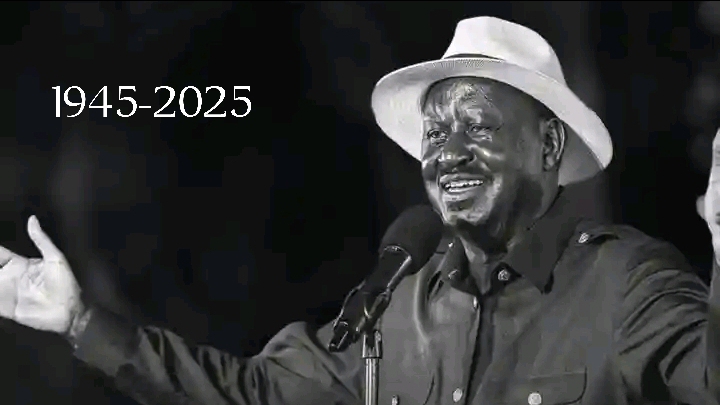

In the quiet corridors of history, where the echoes of unyielding struggles linger like fading whispers, Kenya bids a poignant farewell to one of its most indomitable sons.
Raila Amolo Odinga, the Right Honorable former Prime Minister whose life was a symphony of defiance and resilience, succumbed to cardiac arrest on October 15, 2025, at the age of 80.
Passing away in Kochi, India, while seeking medical care, his departure marks the end of an era defined by relentless pursuit of justice, democracy, and national unity.
As tributes pour in from across Africa and beyond, we reflect on the extraordinary journey of “Baba”—the father figure who shaped Kenya’s political landscape through decades of turmoil, triumph, and transformation.
Roots in Revolution: A Childhood Forged in the Fires of Independence
Born on January 7, 1945, in the serene town of Maseno amid the colonial shadows of the British Protectorate of Kenya, Raila Amolo Odinga entered a world already pulsating with the rhythms of change.
He was the progeny of Jaramogi Oginga Odinga, Kenya’s inaugural Vice-President post-independence, and Mary Juma Odinga (affectionately known as Mary Ajuma).
Growing up in a household buzzing with intellectual fervor and political discourse, young Raila was immersed in the ideals of governance, human rights, and courageous dissent from his earliest days.
His father’s towering presence in Kenya’s nascent post-colonial era instilled in him a profound sense of purpose, setting the stage for a life dedicated to challenging the status quo.
This formative environment was no mere backdrop; it was the crucible that molded Raila’s worldview.
Amid the whispers of freedom fighters and the clamor of emerging nationhood, he learned the art of resistance—a theme that would define his legacy as one of Kenya’s foremost champions of democracy.
Scholarly Pursuits and Professional Foundations: From Classrooms to Engineering Halls
Raila’s educational odyssey began at Kisumu Union Primary School, progressing to Maranda Primary and culminating at Maranda High School in Bondo, Siaya County.
These early years honed his intellect, but it was his venture abroad in 1962 that truly broadened his horizons. Venturing to East Germany, he first studied German at the Herder Institute, part of Leipzig’s Philological Faculty, before delving into technical studies in Magdeburg.
By 1970, he had earned a Diplom in Mechanical Engineering—equivalent to a master’s degree—from the Technical University in Magdeburg, equipping him with a robust foundation in innovation and problem-solving.
Upon returning to Kenya, Raila channeled his expertise into academia and public service. He lectured in the Mechanical Engineering Department at the University of Nairobi until 1974, inspiring a new generation of minds.
Transitioning to the Kenya Bureau of Standards (KEBS), he ascended to the role of Deputy Director by 1978, demonstrating his acumen in standards, quality control, and institutional leadership.
These professional milestones were not just career steps; they were building blocks for a man who would later engineer profound political reforms.
The Tempest of Activism: Imprisonment, Exile, and Unbroken Spirit
The 1970s and 1980s thrust Raila into the vortex of Kenya’s turbulent politics. Opposing the iron-fisted one-party rule under President Daniel arap Moi, he became a vocal advocate for multiparty democracy and systemic reforms.
His boldness came at a steep price: in 1982, accused of involvement in a failed coup d’état, he was detained without trial for six grueling years, from 1982 to 1988.
Released briefly, he faced repeated arrests in the late 1980s and early 1990s for his unwavering pro-democracy stance.
By 1991, with his life in peril, Raila sought political asylum in Norway, entering a period of exile that tested his resolve.
Yet, even from afar, his influence simmered, fueling the flames of change back home. This era of hardship forged his character, transforming personal suffering into a rallying cry for millions who yearned for freedom.
Triumphant Return: Parliamentary Ascendancy and Coalition Mastery
Raila’s exile ended in 1992, marking his dramatic reentry into Kenyan politics. Aligning with his father’s Forum for the Restoration of Democracy (FORD-Kenya), he secured the Lang’ata Constituency parliamentary seat, launching a storied legislative career.
The 1994 death of Jaramogi ignited a fierce leadership battle within FORD-K, prompting Raila to pivot to the National Development Party (NDP).
In the 1997 presidential race, he placed third as NDP’s candidate, behind Moi’s KANU and Mwai Kibaki’s Democratic Party, yet retained his parliamentary stronghold.
A strategic alliance with KANU in 2001 elevated him to Minister for Energy, showcasing his pragmatic approach to power. By 2002, Raila co-founded the National Rainbow Coalition (NARC), which decisively ousted KANU, ushering in a new dawn.
Serving as Minister for Roads, Public Works, and Housing from 2003 to 2005, he spearheaded infrastructure projects that laid the groundwork for Kenya’s modernization.
The Pinnacle of Power and Peril: Presidential Quests and the 2007 Watershed
Raila’s presidential ambitions burned brightly across five elections: 1997, 2007, 2013, 2017, and 2022. The 2007 contest, however, etched his name in infamy and glory. Contesting against Kibaki, Raila’s disputed defeat ignited nationwide violence, exposing deep ethnic and political fissures.
Amid the chaos, international mediation by former UN Secretary-General Kofi Annan birthed a power-sharing coalition, appointing Raila as Kenya’s Prime Minister on April 17, 2008—a role that symbolized reconciliation and shared governance.
Prime Ministerial Legacy and Enduring Opposition: From Coalition to Continental Influence
From 2008 to 2013, as Prime Minister under President Kibaki, Raila navigated the complexities of a divided administration, driving key reforms including the promulgation of the 2010 Constitution, which abolished his office but enshrined progressive changes.
Undeterred, he emerged as a formidable opposition leader through his Orange Democratic Movement (ODM), forging coalitions like CORD, NASA, and Azimio la Umoja to challenge incumbents.
His vision extended beyond borders; appointed African Union High Representative for Infrastructure Development, Raila championed continental connectivity, advocating for railways, roads, and energy networks to foster African unity.
His oratory prowess and mass mobilization skills earned him the moniker “Baba,” endearing him to generations as a paternal guardian of Kenya’s aspirations.
A Life Interwoven with Love and Legacy: Family, Fortitude, and Final Reflections
In his personal realm, Raila found solace with his wife, Ida Odinga (née Anyango Oyoo), with whom he shared four children: the late Fidel, Rosemary, Raila Jr., and Winnie. Their family life, though often overshadowed by political storms, reflected his deep-rooted values of loyalty and perseverance.
Raila’s legacy is a tapestry of persistence—decades of resistance against authoritarianism, punctuated by detentions, exile, and electoral battles.
He was the architect of constitutional reforms that democratized Kenya, a master strategist who turned adversity into alliance, and a voice for the marginalized.
His death in India, far from the Kenyan soil he fought to liberate, evokes a melancholic irony, reminding us of the global reach of his struggles.
As Kenya mourns, the world pauses to honor Raila Odinga: a beacon of hope whose light, though dimmed, continues to illuminate the path toward a more equitable future. In the words of poets and patriots alike, his story endures—not as a eulogy, but as an eternal call to action.
Share This Post