
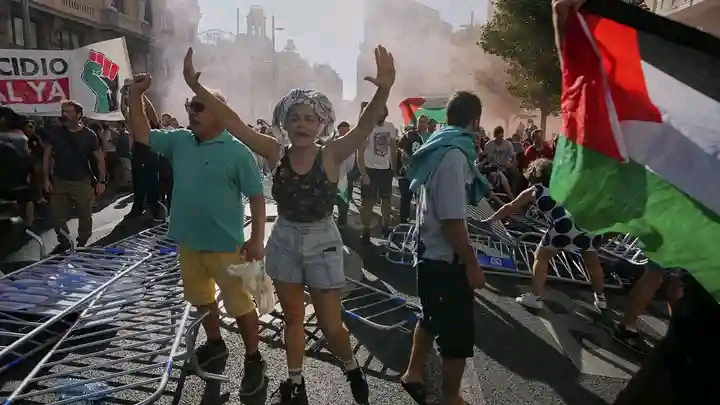

Madrid, Spain| In a stunning intersection of global politics and elite sports, the prestigious Vuelta a España – one of cycling’s crown jewels – came to an unceremonious halt on September 14, as massive anti-Israel protests engulfed the streets of central Madrid.
What was meant to be a triumphant conclusion to the grueling three-week race transformed into a scene of turmoil, with demonstrators clashing with riot police, forcing organizers to declare an early end and name Danish powerhouse Jonas Vingegaard as the overall champion.
This unprecedented disruption underscores the far-reaching ripples of the Israel-Palestine conflict, now spilling over into Europe’s beloved sporting traditions.
The final stage of the 2025 Vuelta a España, a high-stakes showdown through the iconic boulevards of Madrid, was poised to deliver edge-of-the-seat drama.
Riders, including top contenders like Vingegaard of Team Visma-Lease a Bike, had already battled through 20 punishing stages spanning 3,151 kilometers of Spain’s diverse terrain – from sun-scorched plains to treacherous mountain ascents. As the peloton approached the climactic finish line near the Cibeles Fountain, however, the atmosphere shifted dramatically.
Hundreds of protesters, waving Palestinian flags and chanting slogans against Israel’s actions in the ongoing Gaza conflict, surged onto the course, erecting makeshift barricades from fallen crowd-control barriers and effectively blocking the route.
Eyewitness accounts paint a vivid picture of the escalating chaos. “It started as a peaceful gathering, but tensions boiled over when police moved in,” one spectator recounted, describing the acrid sting of tear gas filling the air as authorities attempted to clear the path.
Spanish National Police, outfitted in riot gear, deployed non-lethal munitions to disperse the crowd, but the demonstrators held their ground, leading to fierce confrontations.
Official reports from the Madrid Police Department indicate that at least 22 officers sustained injuries ranging from bruises to minor fractures, while two protesters were detained on charges of public disorder and resisting arrest.
Fortunately, no cyclists or bystanders were reported harmed, though the abrupt cancellation left fans and athletes alike in disbelief.
Race director Javier Guillén, in a hastily convened press conference, explained the tough decision: “The safety of our riders, staff, and the public is paramount. With the situation deteriorating rapidly, we had no choice but to neutralize the stage and award the general classification based on existing standings.”
Vingegaard, who had dominated the race with his signature climbing prowess – echoing his back-to-back Tour de France victories in 2022 and 2023 – was thus handed the red jersey of overall winner.
His lead, built through strategic attacks in the Pyrenees and Sierra Nevada stages, proved insurmountable, edging out rivals like Slovenia’s Primož Roglič and Spain’s own Enric Mas.
While Vingegaard expressed mixed emotions, calling the win “bittersweet” in a post-race statement, the incident robbed the event of its traditional podium celebrations and champagne toasts.
The Vuelta a España, often dubbed “La Vuelta,” stands as the third pillar of professional cycling’s Grand Tours, alongside the Tour de France and Giro d’Italia. Inaugurated in 1935, it attracts the world’s top cyclists and millions of viewers annually, showcasing Spain’s cultural heritage through routes that weave past historic landmarks like the Alhambra and Sagrada Familia.
This year’s edition, starting in Lisbon, Portugal, on August 23, featured 21 stages with eight summit finishes and two individual time trials, testing riders’ endurance across a total elevation gain exceeding 50,000 meters – equivalent to scaling Mount Everest nearly six times.
The race’s prestige draws sponsorships from global giants like Movistar and Ineos Grenadiers, injecting millions into Spain’s economy through tourism and media rights.
Yet, this disruption was no isolated anomaly. The Israel-Palestine conflict, intensified by recent escalations in Gaza and the West Bank, has ignited a wave of solidarity protests across Europe.
From university campuses in the UK to public squares in France and Germany, demonstrators have demanded ceasefires, boycotts, and policy changes from their governments.
In Spain, where public sympathy for the Palestinian cause runs deep – fueled by historical ties and vocal left-wing activism – similar rallies have drawn thousands in cities like Barcelona and Seville.
The Madrid protest, organized by groups such as the BDS (Boycott, Divestment, Sanctions) movement and local solidarity networks, targeted the Vuelta not for any direct Israeli involvement but as a high-visibility platform to amplify their message amid what they describe as “ongoing genocide” in Palestine.
This incident raises profound questions about the vulnerability of international sporting events to geopolitical flashpoints.
Organizers of events like the Olympics, UEFA Champions League, or even Formula 1 races may now grapple with enhanced security demands, including fortified perimeters, drone surveillance, and preemptive intelligence gathering.
European governments, already strained by rising protest activity, must navigate the delicate balance between upholding democratic rights to assembly and ensuring public safety.
Critics argue that heavy-handed policing, as seen in Madrid, could exacerbate tensions, while proponents of stricter measures point to the economic fallout – the Vuelta alone generates over €100 million in revenue, much of which could be jeopardized by future interruptions.
As the dust settles on this year’s Vuelta, the cycling world reflects on a race marred not by weather or crashes, but by the inexorable tide of global unrest.
With the Israel-Palestine conflict showing no signs of resolution, similar disruptions could become the new normal, forcing sports federations to adapt or risk cancellation.
For fans, riders, and activists alike, the Madrid melee serves as a stark reminder: In an interconnected world, the finish line is never truly apolitical.
As Vingegaard lifts his trophy under subdued circumstances, the true victor remains elusive – peace in the Middle East, perhaps the only force capable of restoring uninterrupted glory to events like the Vuelta a España.
Share This Post