
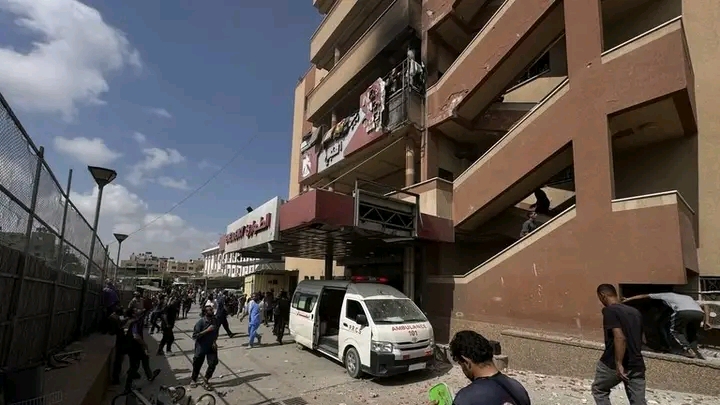

In a devastating blow to press freedom and civilian safety, an Israeli “double tap” airstrike on Nasser Hospital, the largest medical facility in southern Gaza, claimed the lives of at least 20 people, including six journalists, on Monday, according to local health authorities.
The attack, one of the deadliest on journalists since the onset of the Israel-Hamas conflict, has drawn widespread condemnation from international media organizations and human rights groups, reigniting calls for accountability and an end to the targeting of reporters in war zones.
A Deadly Strike in Two Waves
The assault on Nasser Hospital in Khan Younis unfolded in two brutal waves, a tactic known as a “double tap” strike, designed to maximize casualties by targeting first responders and bystanders who rush to aid victims of an initial attack.
The first strike hit the hospital, a critical lifeline for Gaza’s war-weary population. As journalists, medics, and civilians gathered to assist the wounded, a second munition struck, directly hitting an external stairwell frequently used by media personnel to capture footage of the Khan Younis area.
The horrific moment was captured in a graphic livestream by Jordan-based Alghad TV, showing the chaos and carnage as the stairwell became a scene of unimaginable tragedy.
Among the victims were six journalists, identified as Hussam al-Masri of Reuters, Mohammed Salama of Al Jazeera, Mariam Dagga of The Associated Press, Ahmad Abu Aziz of Middle East Eye, Moas Abu Taha, and Hassan Douhan.
Initial reports suggested Moas Abu Taha was affiliated with NBC, but the U.S.-based broadcaster later clarified he was not employed by them.
The loss of these journalists, who risked their lives to document the war’s toll, underscores the perilous conditions faced by media workers in Gaza.
A Pattern of Violence Against Journalists
The attack comes just two weeks after another Israeli strike killed six journalists, including four Al Jazeera reporters, near al-Shifa Hospital in Gaza City.
At the time, the Israel Defense Forces (IDF) claimed it had targeted Anas al-Sharif, a prominent Al Jazeera correspondent, alleging he was the “head of a terrorist cell in Hamas.”
No credible evidence was provided to substantiate these claims, raising concerns about the IDF’s justification for strikes that disproportionately harm journalists and civilians.
Since the escalation of the Israel-Hamas conflict, at least 10 Al Jazeera journalists have been killed by Israeli forces in Gaza, with the total death toll of reporters now surpassing 240, according to local and international media reports.
This staggering figure has made Gaza one of the deadliest places in the world for journalists, prompting accusations of deliberate targeting by Israeli forces.
Global Condemnation and Calls for Accountability
The Foreign Press Association (FPA), a London-based organization representing international journalists, issued a scathing statement, describing the attack as “among the deadliest Israeli attacks on journalists working for international media since the Gaza war began.”
The FPA called on Israel to “halt its abhorrent practice of targeting journalists” and demanded immediate accountability for the killings.
Other rights groups echoed these sentiments, urging independent investigations into the strikes and protections for media workers in conflict zones.
Tragically, hours before her death, journalist Mariam Abou Daqqa appeared in a video warning that the IDF was intentionally targeting journalists.
Her words, now circulating widely on social media platforms like X, have become a haunting testament to the dangers faced by those reporting from Gaza. “We are not safe,” she said, her voice steady but urgent. “The world must act to protect us.”
Israel’s Response and Ongoing Investigations
The IDF confirmed it carried out the strike near Nasser Hospital but provided no details on the intended target.
In a statement, the Israeli military expressed “regret” for harm caused to “uninvolved individuals” and emphasized that it “does not target journalists as such.”
The IDF promised to conduct an “initial inquiry as soon as possible,” but skepticism remains among media organizations, given the lack of transparency in previous investigations.
The use of “double tap” strikes, which often hit civilians and first responders, has been widely criticized as a violation of international humanitarian law.
Critics argue that such tactics endanger non-combatants, including journalists, who are protected under the Geneva Conventions.
A Growing Humanitarian Crisis
The attack on Nasser Hospital is not an isolated incident but part of a broader pattern of violence that has devastated Gaza’s infrastructure and claimed thousands of lives.
Hospitals, schools, and media offices have been repeatedly struck, exacerbating an already dire humanitarian crisis.
Nasser Hospital, one of the few remaining functional medical facilities in southern Gaza, has been overwhelmed by the influx of wounded, with medical staff struggling to operate under constant threat.
The targeting of journalists has further silenced voices critical to documenting the war’s impact. Reporters like Hussam al-Masri, Mohammed Salama, and Mariam Dagga were known for their courageous reporting, shining a light on the human cost of the conflict.
Their deaths leave a void in the global understanding of Gaza’s plight and raise urgent questions about the safety of those who risk everything to tell the truth.
A Call for Justice
As the death toll in Gaza continues to rise, the international community faces growing pressure to address the targeting of journalists and civilians.
Media organizations, including Reuters, Al Jazeera, and The Associated Press, have called for thorough and transparent investigations into the Nasser Hospital attack.
Human rights advocates argue that without accountability, the cycle of violence against journalists will persist, further eroding press freedom in conflict zones.
On platforms like X, users have expressed outrage, sharing clips of the Alghad TV livestream and Mariam Abou Daqqa’s final warning. Hashtags like #ProtectJournalists and #GazaUnderAttack have trended, amplifying calls for justice and an end to the bloodshed.
The Path Forward
The loss of six journalists in the Nasser Hospital airstrike is a stark reminder of the dangers faced by those who report from war zones.
As the Israel-Hamas conflict grinds on, the international community must prioritize the protection of journalists and civilians, ensuring that those responsible for war crimes are held accountable.
The world is watching, and the voices of Hussam, Mohammed, Mariam, Ahmad, Moas, and Hassan must not be forgotten.
For more information on the ongoing conflict and its impact on journalists, stay tuned to ICBNews or follow our updates on X and Facebook. To support press freedom, consider donating to organizations like the Committee to Protect Journalists (CPJ) or the Foreign Press Association.
Share This Post