
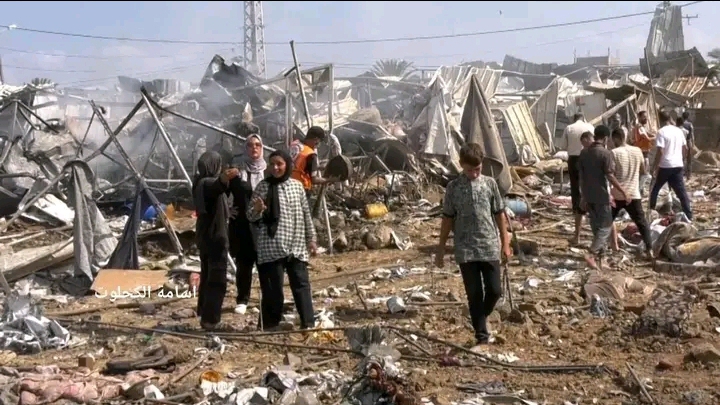

In a bombshell revelation that challenges official narratives and underscores the devastating human cost of the ongoing Gaza war, classified data from the Israeli Defense Forces (IDF) indicates that at least 83% of Palestinians killed since October 2023 were civilians.
This staggering civilian casualty rate, derived from Israel’s own intelligence database, paints a grim picture of one of the most disproportionate conflicts in modern history, drawing parallels to some of the darkest chapters of warfare.
The Joint Investigation: Uncovering Hidden Truths
A collaborative probe by the Israeli-Palestinian outlet +972 Magazine, its Hebrew-language sister publication Local Call, and the UK’s Guardian newspaper has brought to light internal IDF documents that expose the true scale of civilian deaths in Gaza.
The investigation, published on August 21, 2025, relies on data obtained from a highly classified database managed by Israel’s Military Intelligence Directorate (Aman).
This database, described by intelligence sources as the “authoritative tally” of militant casualties, lists 47,653 Palestinians identified as active members of the military wings of Hamas and Palestinian Islamic Jihad (PIJ) based on the groups’ own internal records seized by Israeli forces.
As of May 2025, the database recorded approximately 8,900 militants as dead or probably dead—comprising 7,330 confirmed kills and 1,570 probable ones.
When juxtaposed against the Gaza Health Ministry’s reported total death toll of 53,000 at that time, the math is unequivocal: for every militant eliminated, at least five civilians perished. Excluding the “probable” militant deaths pushes the civilian ratio even higher, to around 86%.
Independent analyses suggest the actual death toll in Gaza could be significantly understated, potentially exceeding the official figures by tens of thousands due to unrecovered bodies and unreported fatalities, which would further inflate the civilian proportion.
This 83% civilian death rate is not just a statistic—it’s an anomaly in the annals of armed conflict. Experts from the Uppsala Conflict Data Program (UCDP) describe it as “unusually high,” especially given the conflict’s prolonged duration of nearly two years.
For context, even in brutal urban sieges like Russia’s assault on Mariupol in Ukraine, civilian casualties hovered around 90% but over a shorter timeframe.
Historical parallels include the Rwandan genocide and the Srebrenica massacre, where civilian slaughter was intentional and systematic.
Methodology Behind the Numbers: Scrutinizing Israel’s Intelligence
The Aman database is no ordinary ledger; it’s a comprehensive repository built from Hamas and PIJ’s own documents, cross-referenced with Israeli surveillance and intelligence. Sources within the Israeli intelligence community confirmed its reliability, with one stating, “There’s no other place to check.”
Unlike public claims from Israeli officials, which have fluctuated wildly—from 10,000 militants killed in November 2023 to 23,000 by June 2025—the database provides a grounded, internal assessment.
Investigators compared these militant figures to the Gaza Health Ministry’s death toll, which Israeli officials themselves have acknowledged as credible in past leaks.
The ministry’s data, compiled from hospital records and other sources, does not differentiate between combatants and non-combatants, making the IDF’s militant tally the key to unlocking the civilian ratio.
Discrepancies arise from field reports by brigade commanders, who, according to sources, often inflate militant kills by labeling deceased civilians as “terrorists” posthumously. One intelligence officer quipped, “If I had listened to the brigade, I would have come to the conclusion that we had killed 200 percent of Hamas operatives in the area.”
Retired Maj. Gen. Itzhak Brik, a vocal critic of Israel’s military strategy, echoed this sentiment: “They lie non-stop—both the military echelon and the political echelon. … It’s true that hundreds were killed, but they weren’t terrorists. There is absolutely no connection between the numbers they announce and what is actually happening.”
The Human Cost: A War on Civilians?
The findings dismantle Israel’s repeated assertions of a balanced casualty ratio, such as Prime Minister Benjamin Netanyahu’s claim of a 1:1 civilian-to-militant death rate or the military’s estimate of 1.4:1.
Instead, they highlight a pattern of loosened rules of engagement post-October 7, 2023, when Hamas’s attack killed 1,200 Israelis and took over 250 hostages.
Reports indicate the IDF authorized strikes killing up to 100 civilians for a single senior Hamas commander and 20 for junior ones—a policy shift that has drawn international condemnation for potentially violating principles of proportionality under international humanitarian law.
Leaked recordings from former Aman director Aharon Haliva reveal a vengeful mindset: “50 Palestinians must die for every Israeli killed on October 7, … it doesn’t matter now if they are children.”
Such rhetoric, combined with statements from Israeli leaders like “Gaza will be destroyed,” suggests a broader punitive approach targeting the Palestinian population en masse.
Despite the carnage, the database shows Israel has eliminated only about one-fifth of the listed militants, even as Hamas claims to have recruited 15,000 new fighters amid the war.
This indicates a weakening but resilient armed resistance, while civilians bear the brunt: over 40,000 women and children among the dead, according to various estimates.
Broader Implications: Calls for Accountability and Ceasefire
This revelation comes amid escalating global scrutiny, with the International Court of Justice investigating potential genocide and the International Criminal Court issuing arrest warrants for Israeli and Hamas leaders.
The 83% civilian death rate not only questions the efficacy of Israel’s military campaign but also its adherence to international norms, fueling debates on war crimes and the ethics of urban warfare in densely populated areas like Gaza.
As the conflict drags into its 23rd month, with no end in sight, the toll continues to mount. Recent reports from the UN highlight famine conditions in Gaza, exacerbated by aid blockades, as a “direct result” of Israeli policies.
Experts like Therese Pettersson from UCDP warn that sustained high civilian casualties over such an extended period are rare, likening Gaza’s plight to protracted civil wars in Syria and Sudan but with an even more lopsided impact.
In the face of these findings, human rights advocates are renewing calls for an immediate ceasefire, independent investigations, and accountability.
The leaked data serves as a stark reminder that behind the numbers are shattered families, destroyed communities, and a humanitarian catastrophe that demands urgent international intervention.
As one source poignantly noted, the true measure of this war isn’t in militants neutralized but in the innocent lives lost—a tragedy that history will judge harshly.
Share This Post