

•The Trial Comes Amid Explosive Graft and Misconduct Allegations
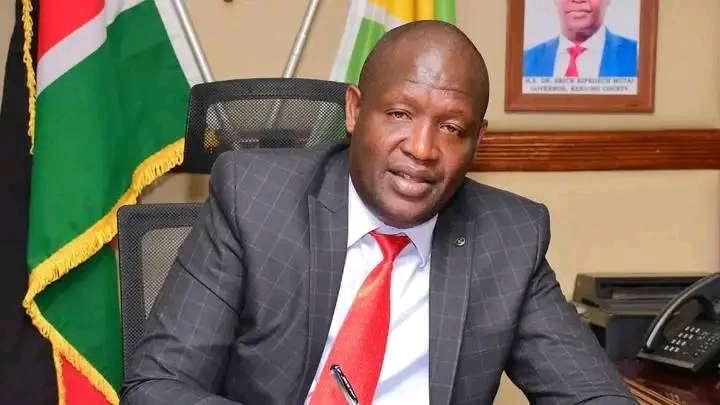
In a dramatic turn of events that has gripped Kenya’s political landscape, Kericho Governor Eric Mutai will face a full plenary trial in the Senate next week, following the defeat of a motion to form a special investigative committee.
This decision thrusts the embattled governor into the national spotlight, where all 67 senators will directly hear and deliberate on serious charges of corruption, abuse of office, and gross misconduct leveled against him.
As the second impeachment attempt against Mutai in less than a year, the proceedings are poised to test the integrity of devolved governance and the Senate’s role in holding county leaders accountable, amid whispers of bribery and procedural controversies.
Background: A Landslide Victory Turned Turbulent Tenure
Eric Mutai, a former university lecturer, rode a wave of popularity to secure a resounding victory in the 2022 General Election, capturing the governorship of Kericho County under the United Democratic Alliance (UDA) banner.
Known for his promises of transparent governance and equitable development in the tea-rich region, Mutai’s administration initially focused on infrastructure, agriculture, and youth empowerment initiatives.
However, his tenure quickly soured amid escalating accusations of financial impropriety and favoritism, leading to internal rifts within the county assembly and public outcry from residents and civil society groups.
This is not Mutai’s first brush with impeachment. In October 2024, the Kericho County Assembly voted to remove him, with 31 out of 47 Members of County Assembly (MCAs) supporting the motion.
However, the Senate overturned the decision on procedural grounds, ruling that the assembly had failed to meet the constitutionally mandated two-thirds threshold (at least 32 votes) under Section 33 of the County Governments Act.
The reprieve was short-lived, as fresh allegations resurfaced, culminating in the latest impeachment on August 15, 2025.
This time, 33 MCAs—surpassing the threshold—voted in favor during a tense session marked by heated debates and allegations of a rigged electronic voting system.
The motion was tabled by Sigowet Ward MCA Kiprotich Rogony, who accused Mutai of presiding over systemic corruption and unequal resource distribution.
Senate Proceedings: From Committee Bid to Full Plenary Showdown
The Senate’s involvement began swiftly after the county assembly’s vote. On August 20, 2025, Senate Speaker Amason Kingi convened a special sitting to read the charges and determine the trial’s format.
Senate Majority Leader Aaron Cheruiyot moved a motion to establish an 11-member special committee to probe the allegations, arguing it would ensure a focused investigation.
However, the motion collapsed when Minority Leader Stewart Madzayo declined to second it, citing the House’s mood favoring a plenary approach.
Speaker Kingi ruled that the impeachment would proceed in plenary, emphasizing transparency and collective senatorial responsibility.
“The Senate will therefore proceed to investigate the proposed removal from office of Kericho Governor Erick Mutai in plenary,” Kingi stated, as per the gazette notice. The trial is scheduled for three consecutive days—August 27, 28, and 29, 2025—in the Senate Chambers, starting at 9 a.m. each day.
Parties, including Mutai and the county assembly, must file responses by Monday, August 25, 2025, at 5 p.m., with the Senate Clerk circulating documents by Tuesday. Only elected senators will vote on the final outcome, needing a simple majority to either uphold or dismiss the impeachment.
This plenary route means every senator will participate in questioning witnesses, reviewing evidence, and debating the charges, potentially turning the trial into a high-profile spectacle.
Analysts suggest it could amplify national attention, especially given recent criticisms of the Senate as a “Soko Huru” (free market) for bribes by President William Ruto, raising concerns about impartiality.
The Charges: A Litany of Graft, Nepotism, and Misconduct
The impeachment motion outlines three primary grounds: gross violation of the Constitution, abuse of office, and gross misconduct, backed by detailed accusations that paint a picture of rampant corruption and administrative chaos.
- Financial Misappropriation and Irregular Payments: Mutai is accused of authorizing Sh85.7 million in fictitious payments to 46 companies for goods not supplied, services not rendered, and works not completed. Examples include grossly inflated prices, such as soda at Sh500 per bottle, tissue paper at Sh2,750 per bale (later clarified by Mutai’s team as bulk purchases equating to Sh67.50 per tissue), and hand towels at Sh3,600 (for five dozen). Double payments to contractors, forged signatures, and irregular procurements have allegedly ballooned pending bills to Sh1.1 billion, violating the Public Finance Management Act.
- Unequal Resource Distribution and Fund Diversion: Under the National Agricultural Value Chain Development Project (NAVCDP), Sh351 million was reportedly diverted, with only 19 of 30 wards benefiting and many receiving substandard farm inputs. The Financing Locally-Led Climate Action (FLOCCA) fund saw Mutai’s home ward, Chemosot, receive Sh21.7 million disproportionately, while others got nothing. Additionally, the unauthorized launch of the Equalizer Kazi Mtaani Initiative cost Sh39 million without legislative or budgetary approval.
- Abuse of Office and Nepotism: Allegations include hiring his brother as a revenue clerk, promoting his aide’s wife as a nurse over qualified candidates, and illegally appointing a County Attorney (later nullified by court). Mutai is also charged with arbitrary dismissals of 10 County Executive Committee members, six Chief Officers, and two Chiefs of Staff; politicizing recruitment; and creating a toxic work environment through intimidation and divisive language. A particularly damning claim involves leading a mob in an illegal land invasion in Kericho town, demolishing private property despite a court order and designating it a dumpsite without environmental approvals.
- Undermining Oversight and Gross Misconduct: Mutai allegedly interfered with the County Assembly’s role by directing the Speaker on proceedings and fostering a culture of fear among staff.
These charges, if upheld, could result in Mutai’s permanent removal, barring him from public office for years.
Governor Mutai’s Defense: Denials, Clarifications, and Counter-Claims
Mutai has vehemently denied the allegations, describing them as politically motivated and exaggerated.
His legal team, led by Katwa Kigen, has clarified that inflated prices were for bulk quantities, not single items, and that embezzlement claims are under investigation by the Ethics and Anti-Corruption Commission (EACC) and Directorate of Criminal Investigations (DCI) with no adverse findings yet.
“We wish to clarify that the Sh2,700 for tissue papers supplied was not for single items but 40 bales of 40 pieces each,” Kigen stated during assembly proceedings.
Eighteen MCAs allied to Mutai have petitioned the DCI, alleging the electronic voting system was pre-programmed and unauthorized, potentially invalidating the impeachment.
Mutai himself questioned the process: “Why resort to electronic voting when all members are present? The system does not meet standards.” He plans to challenge the vote in court and present evidence in the Senate.
Reactions and Broader Implications
The case has elicited mixed reactions. Deputy Governor Fred Kirui, acting as a whistleblower, has urged probes into the scandals, writing to the EACC, DCI, Senate, and Auditor General.
Opposition figures and civil society applaud the plenary trial for its transparency, while Mutai’s supporters decry it as a witch hunt amid Kenya’s broader anti-corruption drive.
Nationally, the trial underscores challenges in devolved units, where impeachments have become common tools for settling political scores. With Kericho’s economy reliant on tea and agriculture, residents fear instability could derail development projects.
As the plenary unfolds, all eyes will be on the Senate to deliver justice impartially, potentially setting precedents for future county governance disputes.
This unfolding saga not only determines Mutai’s fate but also highlights the fragile balance of power in Kenya’s counties, drawing parallels to high-profile cases like those of former governors Ferdinand Waititu and Mike Sonko. Stay tuned for updates as the trial commences.
Share This Post