
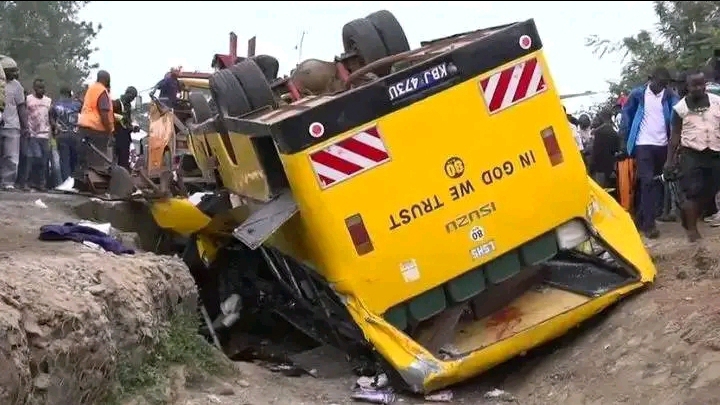

In a heart-wrenching display of Kenya’s persistent road carnage, a bus ferrying mourners from a funeral in Kakamega to Kisumu veered out of control and plunged into a ditch near the notorious Coptic Roundabout on Friday evening, August 8, 2025, claiming the lives of at least 25 people.
The victims included 10 women, 10 men, and a 10-year-old girl who perished at the scene, with four more succumbing to their injuries in hospital, underscoring the urgent need for systemic reforms in the country’s transportation infrastructure.
This devastating incident, attributed primarily to excessive speeding by the driver, has reignited national outrage over Kenya’s escalating road accident statistics, where poor enforcement, hazardous roadways, and reckless behavior continue to exact a heavy toll on innocent lives.
The ill-fated bus, owned by AIC Naki High School and repurposed for the somber journey, was navigating the busy Kisumu-Kakamega Highway when disaster struck at the Coptic Roundabout—a well-known accident blackspot plagued by sharp turns, inadequate signage, and heavy traffic convergence.
Eyewitnesses described a scene of chaos as the vehicle lost control, overturned multiple times, and came to a mangled halt in a roadside ditch.
“It happened so fast; the bus was speeding around the bend, and suddenly it flipped. Screams filled the air as people were thrown out,” recounted a local resident who rushed to the site, as reported in local media coverage.
Rescue operations were swift but harrowing, with emergency responders from Kisumu County pulling survivors from the wreckage amid pools of blood and scattered personal belongings.
Twenty passengers were initially rushed to nearby hospitals with injuries ranging from fractures to severe trauma, but the death toll climbed as medical teams fought in vain to save the critically wounded.
Police investigations point squarely to speeding as the primary culprit, with preliminary reports indicating the driver may have been exceeding safe limits on a stretch of road notorious for its deceptive curves and poor visibility.
This aligns with broader patterns in Kenya, where over-speeding accounts for a significant portion of road fatalities, often exacerbated by drivers under pressure to meet tight schedules or navigating overcrowded routes.
Kisumu County Governor Anyang’ Nyong’o has since called for an immediate redesign of the Kisumu-Kakamega Highway by the Kenya National Highways Authority (KeNHA), highlighting the roundabout’s history of fatal crashes and demanding enhanced safety features like barriers, speed bumps, and better lighting to prevent future tragedies.
This Kisumu horror unfolds against a grim backdrop of consecutive road disasters, amplifying concerns over Kenya’s deteriorating road safety record.
Just one day prior, on Thursday, August 7, 2025, nine employees of the Kenya Pipeline Company (KPC) lost their lives in a catastrophic collision between their staff bus and a train at a railway crossing in Naivasha, Nakuru County.
The bus, reportedly ignoring warning signals, was struck head-on by an oncoming freight train, resulting in a mangled wreck that claimed lives instantly and left scores injured.
KPC confirmed the fatalities, expressing profound grief and pledging support for the victims’ families, while questions swirl around the functionality of level crossing barriers and driver vigilance.
These back-to-back incidents have pushed the nation’s road death toll into sharper focus, with experts warning that without decisive action, Kenya’s highways will remain death traps.
Delving deeper into the statistics paints a chilling picture of a public health crisis masquerading as transportation woes. According to the National Transport and Safety Authority (NTSA), Kenya recorded 1,139 road fatalities in the first quarter of 2025 alone (January to March), equating to nearly 12 deaths per day—a figure that, while slightly down 2.5% from the previous year, still reflects an alarming baseline.
Pedestrians bear the brunt, accounting for 420 deaths in that period, followed by motorcyclists at 301, highlighting vulnerabilities in urban and rural settings where foot traffic intersects with high-speed vehicles.
Overall, the country’s fatality rate stands at 27.8 per 100,000 inhabitants, one of the highest in Africa, as per World Health Organization (WHO) estimates.
In 2024, the Kenya National Bureau of Statistics (KNBS) documented 11,173 road crashes, a 12% surge from 2023, with casualties totaling thousands more in injuries and economic losses.
Experts attribute this epidemic to a toxic cocktail of factors, with human error—particularly speeding, reckless overtaking, and driving under the influence—responsible for up to 85% of incidents.
Vehicle defects, such as worn-out brakes or tires, compound the risks, especially on poorly maintained roads riddled with potholes and lacking essential safety infrastructure.
Systemic issues, including lax enforcement of traffic laws, corruption in licensing processes, and inadequate public awareness campaigns, further fuel the fire.
A recent WHO-backed study on African road safety news coverage revealed that 45% of reports blame driver behavior, often overlooking infrastructural failings and perpetuating victim-blaming narratives that hinder holistic solutions.
The economic and social ramifications are staggering. Road accidents not only shatter families but also drain Kenya’s economy through lost productivity, medical costs, and vehicle repairs—estimated to cost billions annually.
In the wake of the Kisumu crash, condolences poured in from across the nation, including from businesses and community leaders who decried the preventable loss.
15 Initiatives like the UN’s Kofi Annan Road Safety Award and the Africa Status Report on Road Safety 2025 emphasize the need for targeted interventions, such as stricter speed limits, improved pedestrian pathways, and investment in public transport.
As investigations continue and families mourn, this double tragedy serves as a stark wake-up call for Kenyan authorities.
Without aggressive reforms—encompassing better road designs, rigorous driver training, and robust enforcement— the nation’s highways will persist as arenas of avoidable devastation.
For the sake of the 25 souls lost in Kisumu and countless others at risk, the time for action is now, before another headline announces yet more needless grief.
Share This Post