
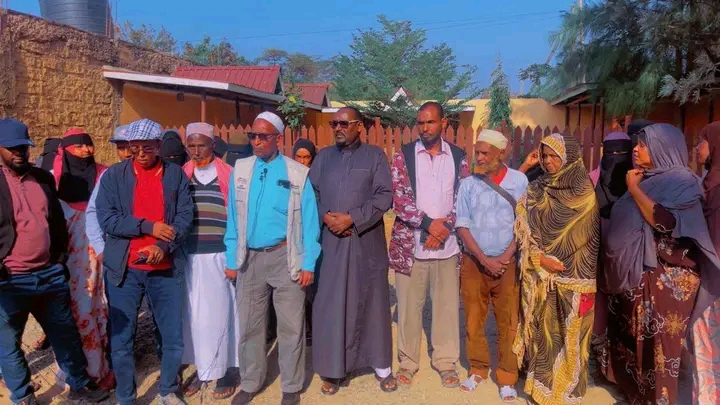

Isiolo, Kenya| In a powerful and impassioned address, the Isiolo Somali Council of Elders, under the leadership of Abdullahi Shariff and Idle Hassan, has issued a scathing rebuke against what they describe as the unwarranted and divisive targeting of prominent national Somali figures in the county’s escalating political disputes.
The elders’ statement, delivered during a press conference in Isiolo, comes in response to recent protests that saw the names of high-profile national leaders, including Defence Cabinet Secretary Aden Duale, Director of Criminal Investigations (DCI) Mohamed Amin, and Justice Mohamed Warsame, prominently displayed on placards—a move the elders condemned as both disrespectful and dangerously divisive.
A Call for Unity Amid Political Turmoil
The elders expressed profound disappointment at the politicization of respected Somali leaders who, they argue, have no direct involvement in Isiolo’s local governance or political wrangles.
“These are leaders serving the country at the highest level. They have no role in Isiolo’s local politics and should be left alone,” Abdullahi Shariff, a leading figure in the council, declared.
He emphasized that dragging national figures into local disputes not only undermines their contributions to the nation but also risks inflaming ethnic and communal tensions in an already volatile political landscape.
The protests in question, which have gripped Isiolo in recent weeks, stem from ongoing disputes over the county’s budget and leadership.
Demonstrators have taken to the streets to voice their grievances, but the inclusion of national Somali leaders’ names on placards has sparked outrage among the elders, who see it as a deliberate attempt to profile and scapegoat the Somali community.
“This is not just an attack on individuals; it is an attack on our community’s dignity and unity,” Shariff added.
A Dangerous Precedent
Idle Hassan, the council’s Secretary General, described the tactic as “divisive and dangerous,” warning that it could set a harmful precedent for ethnic relations in Isiolo and beyond.
“Let Isiolo politics remain about Isiolo. Stop profiling Somali leaders serving in the national government in your local political matters,” Hassan urged, directly calling out local leaders believed to be orchestrating the demonstrations.
He accused these leaders of exploiting ethnic identities to further their political agendas, a strategy he warned could destabilize the county’s fragile social fabric.
The elders’ concerns are rooted in the broader context of Isiolo’s complex socio-political dynamics. As a cosmopolitan county with diverse ethnic communities, Isiolo has long grappled with tensions over resource allocation, political representation, and governance.
The recent protests, which have centered on disputes over the county budget and leadership accountability, have exacerbated these tensions, with some actors resorting to divisive rhetoric to rally support.
A Plea for Reason and Legal Recourse
In their address, the elders called for an immediate end to the protests, urging residents to focus on constructive dialogue and allow the courts to resolve the underlying disputes.
“Let’s stop the protests and let the law take its course. Dragging our community’s national leaders into this only creates more problems,” they stated, emphasizing the need for sobriety and unity in addressing Isiolo’s challenges.
The elders pointed to the judiciary as the appropriate avenue for resolving the county’s leadership and budgetary disputes, warning that continued street protests and ethnic profiling could derail efforts to find lasting solutions.
“The courts are there for a reason. Let them handle these matters. We cannot afford to let our differences tear us apart,” Shariff said.
Defending National Somali Leaders
The elders were unequivocal in their defense of the national leaders being targeted.
Aden Duale, a seasoned politician and current Defence Cabinet Secretary, has been a prominent figure in Kenyan politics, known for his contributions to national security and governance.
Mohamed Amin, as head of the DCI, has played a critical role in law enforcement, while Justice Mohamed Warsame is a respected jurist whose rulings have shaped Kenya’s legal landscape.
The elders argued that these leaders, who have risen to prominent positions through merit and service, deserve respect rather than being dragged into local political mudslinging.
“These are individuals who have dedicated their lives to serving Kenya. They represent not just the Somali community but the entire nation. Targeting them in this manner is not only unfair but also undermines the spirit of national unity,” Hassan said.
A Broader Call for Unity and Progress
The Isiolo Somali Council of Elders’ statement is a clarion call for unity at a time when Kenya’s devolved governance system continues to face challenges related to ethnic polarization and political rivalries.
By singling out the targeting of Somali leaders, the elders are drawing attention to a broader issue: the misuse of ethnic identities in local politics, a practice that threatens to erode social cohesion across the country.
The elders also urged Isiolo residents to refocus their energies on addressing the county’s pressing challenges, including infrastructure development, access to education, and economic empowerment.
“We have real issues to tackle—our roads, our schools, our hospitals. These are the things that matter, not dragging innocent leaders into fights that don’t concern them,” Shariff said.
The Path Forward
As Isiolo navigates this turbulent period, the elders’ message resonates as a plea for reason, unity, and respect for the rule of law.
Their call to end the protests and focus on legal recourse underscores the importance of addressing grievances through institutional mechanisms rather than divisive tactics.
By condemning the targeting of national Somali leaders, the council is also sending a broader message about the need to protect Kenya’s diverse communities from being pitted against one another in local power struggles.
The Isiolo Somali Council of Elders has vowed to continue engaging with local leaders, residents, and stakeholders to foster dialogue and promote peace.
“We will not sit back and watch our county descend into chaos. We are ready to work with everyone to ensure Isiolo moves forward,” Hassan concluded.
As the county awaits the resolution of its political disputes, the elders’ words serve as a reminder of the power of unity and the dangers of division. For now, the spotlight remains on Isiolo’s leaders and residents to heed this call and chart a path toward a more inclusive and prosperous future.
For more updates on this developing story, follow our coverage on local governance and community dynamics in Kenya.
Share This Post